
Anime Hair Color Quiz
How the Scales are Structured
Who Usually Takes This Test?
See How You Compare
Below is a preview of how scores are typically distributed across each scale.
Example Questions From the Test
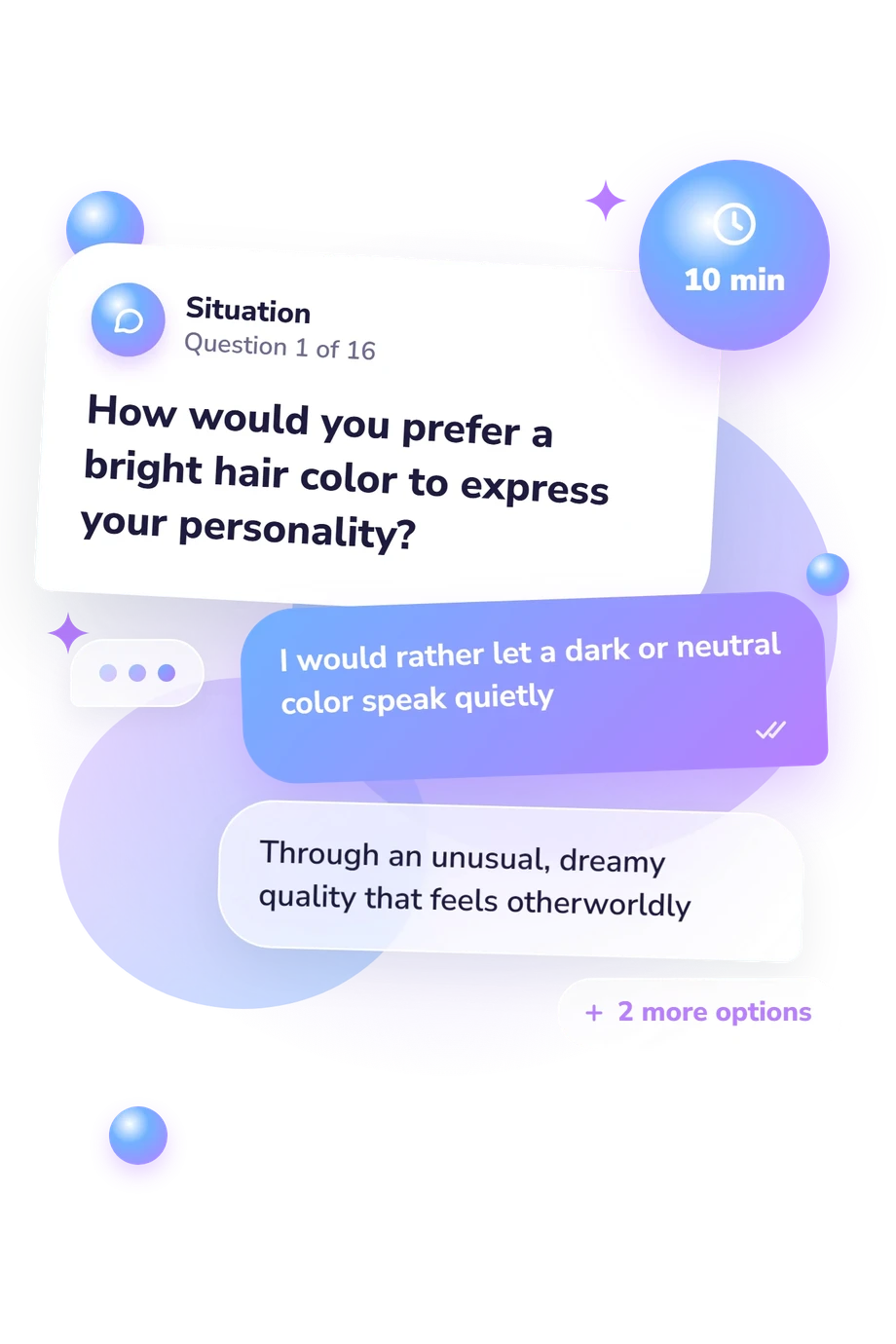
- I would rather let a dark or neutral color speak quietly
- Through an unusual, dreamy quality that feels otherworldly
- Through a friendly warmth that does not command the room
- Through open, optimistic energy that is easy to notice
- A smooth, even line with no visible separation
- Rounded ends that flow into soft waves
- Textured ends with mild, wearable definition
- Jagged layers or spikes that create a striking outline
- I would prefer a shade that changes less noticeably over time
- I would accept occasional upkeep for a muted reddish tint
- I could maintain it during periods when I want a bolder look
- The upkeep would feel worthwhile for a consistently vivid result
Anime Hair Color Quiz - Description and methodology of the test
Visitors imagining an expressive, character-inspired look can use this assessment to connect hair preferences with mood, silhouette, and intended impression. The anime hair color quiz suits anyone exploring an anime-influenced style, whether planning a makeover or clarifying personal taste. It compares visual directions rather than declaring one correct choice. British-spelling readers may recognize it as an anime hair colour quiz.
What This Assessment Explores
Color, shape, movement, upkeep, and finish express personality. The assessment suits people exploring anime-inspired style. A preference profile, not a beauty judgment, clarifies what a quiz about my anime hair colour reveals about drama, softness, polish, and fantasy.
Four displayed outcomes are:
- Crimson Flame Edge (0-12) measures vivid red and angular shapes; Different Direction (0-4), Selective Affinity (5-8), and Strong Affinity (9-12).
- Golden Blonde Adventure (0-12) measures sunny blonde and lively movement; Different Direction (0-4), Selective Affinity (5-8), and Strong Affinity (9-12).
- Midnight Black Precision (0-12) measures glossy dark color and controlled lines; Different Direction (0-4), Selective Affinity (5-8), and Strong Affinity (9-12).
- Pastel Dream Waves (0-12) measures pastel color and flowing decoration; Different Direction (0-4), Selective Affinity (5-8), and Strong Affinity (9-12).
Methodology and Evidence Base
Each item presents a styling situation with four choices covering color intensity, line quality, movement, upkeep, decoration, and the impression a look creates. Selecting the closest option makes this a forced-choice self-report exercise, useful for asking what a quiz about your anime hair colour might show when several aesthetics appeal.
Answers feed four profile totals. Each scale uses a 0-12 range, but no point-by-point weighting rule is published; higher totals indicate stronger alignment. The same profile can serve an anime-inspired hair-color quiz for guys because the choices are not gender-restricted.
The approach is conceptually consistent with Doi, Mori, and Sakai (2014) on animation-character hair-color associations. Saegusa and Watanabe (2013) link hair-color matching with self-concept, while Nakashima, Fujimoto, and Yamanishi (2023) examine personality cues in created-character appearance. These sources provide context, not proof of copied scoring or samples.
This is not a standardized version of those studies, so it has no established norms, diagnostic thresholds, or verified reliability for these exact items. Mood, self-image, and response bias can influence the result, which is best read as focused style reflection.
- Doi, Motonori, Misaki Mori, and Hideki Sakai. "D-19 Personality Given by Hair Colors of Animation Characters (Abstract for the 45th Annual Meeting, Special Issue)." Journal of the Color Science Association of Japan, 38(3), 252-253, 2014.
- Saegusa, Chihiro, and Katsumi Watanabe. "Hair-Color Matching and Self-Concept: An Exploratory Study on Japanese Women." In Proceedings - 2013 International Conference on Biometrics and Kansei Engineering, ICBAKE 2013, 289-292. IEEE, 2013. 10.1109/ICBAKE.2013.30
- Nakashima, Fuka, Naoki Fujimoto, and Ryosuke Yamanishi. "Do Appearances Represent Personality of Created Characters." Procedia Computer Science, 225, 1776-1785, 2023. 10.1016/j.procs.2023.10.167
Updated: