
Animal Behavior Quiz
How the Scales are Structured
Who Usually Takes This Test?
See How You Compare
Below is a preview of how scores are typically distributed across each scale.
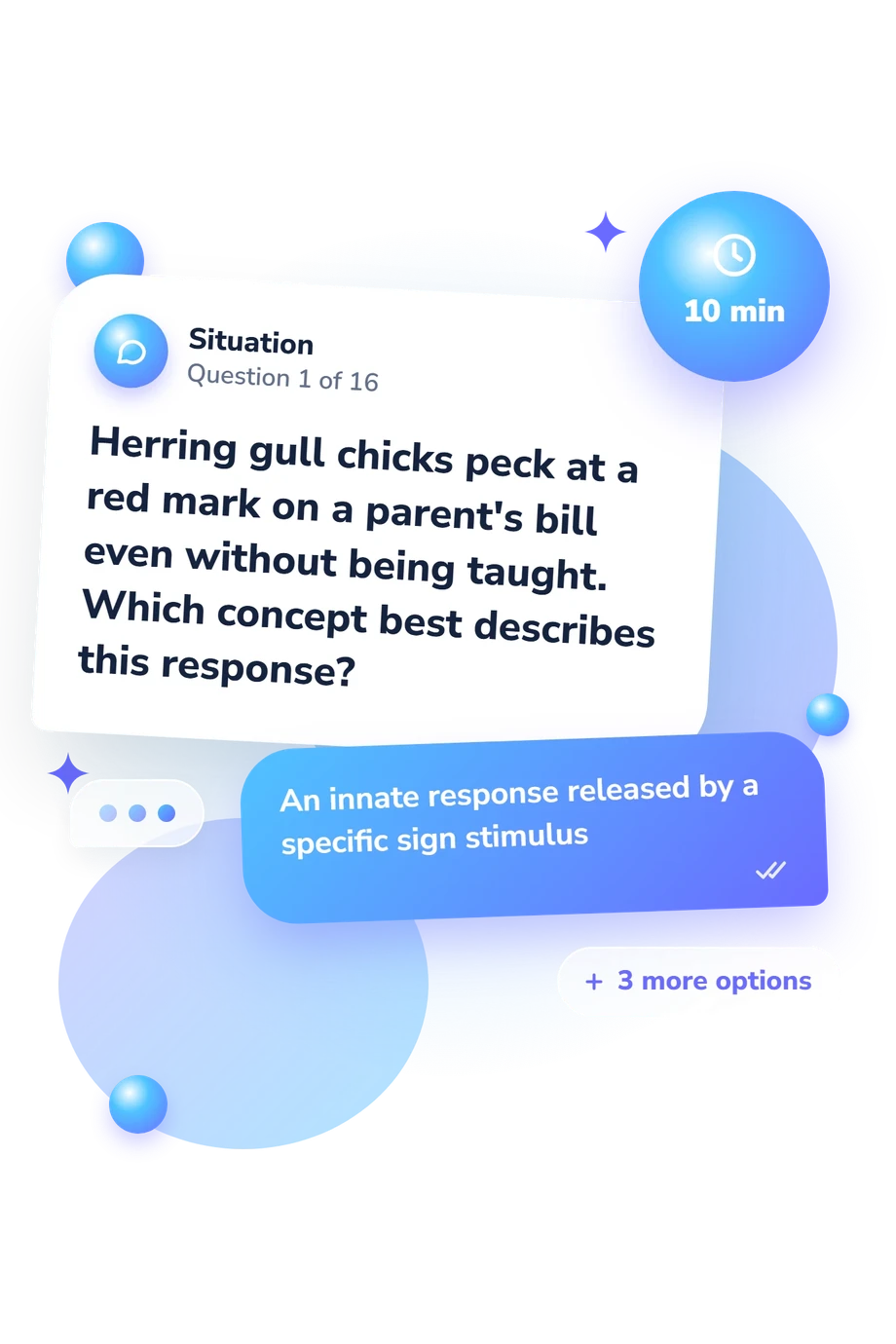
Example Questions From the Test
- An innate response released by a specific sign stimulus
- Operant conditioning maintained by food rewards
- Habituation to a frequently encountered visual cue
- Imprinting on the individual that provides care
- Sensitization
- Habituation
- Classical conditioning
- Observational learning
- A territory must contain every resource an animal uses
- A territory is actively defended against certain intruders
- A territory is always smaller than the animal's nesting site
- A territory is occupied only during migration
Animal Behavior Quiz - Description and methodology of the test
People who want a structured way to check their grasp of core ethology concepts can use this animal behavior quiz as a focused learning snapshot. It suits students, curious readers, and anyone revising how animals learn, communicate, choose habitats, cooperate, compete, and respond to environmental cues. As an animal behaviour quiz, it can also identify topics worth revisiting before deeper study.
What This Assessment Explores
The questionnaire checks recognition of major animal-behavior ideas rather than personal temperament. As an animal behavior test, it suits readers connecting terminology with situations involving movement, learning, communication, mating, cooperation, foraging, territory, timing, and social observation.
The result draws on these connected areas:
- Learning processes distinguish habituation, conditioning, imprinting, and social learning.
- Signals and communication cover sign stimuli, honest displays, and receiver responses.
- Social and reproductive behavior covers mate choice, kin selection, reciprocal exchange, and conflict.
- Ecology and timing cover patch use, defended space, circadian cues, and environmental effects.
- Animal Behavior Knowledge: 0-16 reports overall performance: Building Foundations (0-6) means core distinctions need review; Developing Knowledge (7-12) reflects many major principles with finer gaps; Strong Knowledge (13-16) indicates a consistent grasp across varied scenarios.
Methodology and Evidence Base
Each of the animal behavior questions presents a short scenario followed by four answer choices. The task is to select the concept that best explains the behavior, mechanism, ecological trade-off, or evolutionary pattern described. This format tests recognition and application, not just recall of isolated definitions.
Responses are aggregated into a single displayed knowledge result covering the tested concepts. The result is presented as one educational knowledge score, without separate scores for the thematic areas above.
Its conceptual framework is consistent with Bolhuis, Giraldeau, and Hogan (2021), while Tinbergen (1963) supports distinguishing immediate mechanisms from developmental and evolutionary explanations. Charnov (1976) supplies the marginal-value perspective used in the foraging scenario, and Maynard Smith and Harper (2003) give the conceptual background for signaling and honesty. The questionnaire is conceptually consistent with these works, not an adaptation or validation of them.
Interpretation should account for prior coursework, wording familiarity, attention, and guessing. A strong result suggests command of the tested concepts, while a lower band points to useful review targets rather than measuring every aspect of practical competence.
- Bolhuis, Johan J., Luc-Alain Giraldeau, and Jerry A. Hogan (eds.). (2021). The Behavior of Animals: Mechanisms, Function and Evolution (2nd ed.). Wiley. 10.1002/9781119109556
- Tinbergen, N. (1963). On aims and methods of Ethology. Zeitschrift für Tierpsychologie, 20(4), 410-433. 10.1111/j.1439-0310.1963.tb01161.x
- Charnov, Eric L. (1976). Optimal foraging, the marginal value theorem. Theoretical Population Biology, 9(2), 129-136. 10.1016/0040-5809(76)90040-X
- Maynard Smith, John, and David Harper. (2003). Animal Signals. Oxford University Press. 10.1093/oso/9780198526841.001.0001
Updated: