
Am I Nonbinary Quiz
How the Scales are Structured
Who Usually Takes This Test?
See How You Compare
Below is a preview of how scores are typically distributed across each scale.
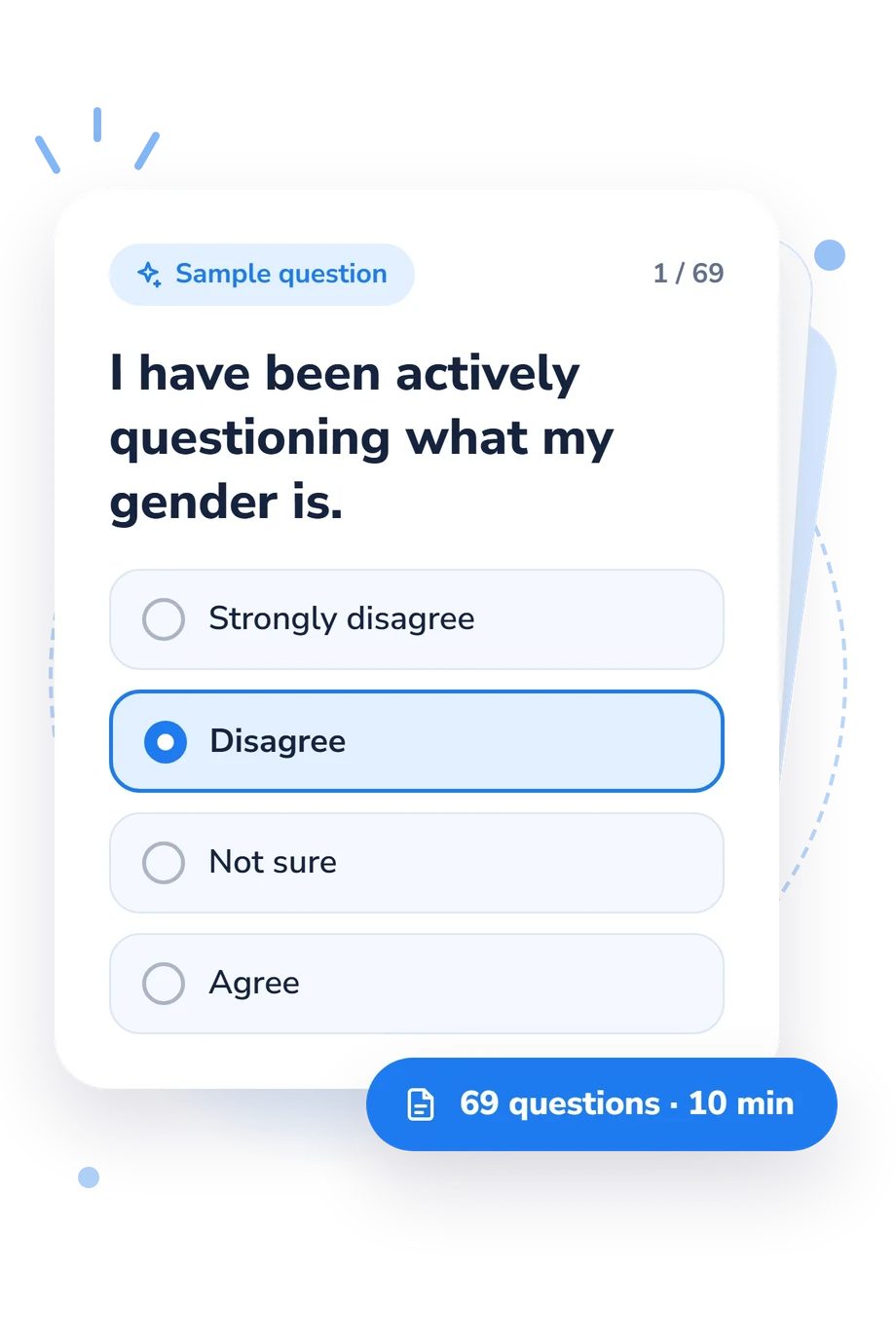
Example Questions From the Test
- Strongly disagree
- Disagree
- Not sure
- Agree
- Strongly disagree
- Disagree
- Not sure
- Agree
- Strongly disagree
- Disagree
- Not sure
- Agree
Am I Nonbinary Quiz - Description and methodology of the test
For people reflecting on whether binary gender categories describe them fully, the Am I Nonbinary Quiz organizes experiences that can be difficult to name. It is intended for anyone exploring gender labels, pronouns, expression, or recognition, and it presents a profile of recurring themes rather than a forced identity verdict. As a non binary quiz, it can give language to patterns that may otherwise feel scattered.
What This Assessment Explores
The statements cover labels, pronouns, address, presentation, gender questions, and recognition beyond the binary. They suit people seeking vocabulary while exploring gender; no particular identity is required.
For someone considering this non binary test, the profile organizes those themes without prescribing a label.
The following items explain each dimension:
- Expression & Pronoun Comfort (0-20) measures comfort with varied presentation, pronouns, and address; higher scores indicate more openness, with Prefers Consistency (0-6), Some Flexibility (7-13), and Highly Open & Comfortable (14-20).
- Gender Questioning (0-30) measures active uncertainty and exploration; higher scores indicate more ongoing questioning, with Low questioning (0-10), Moderate questioning (11-20), and High questioning (21-30).
- Nonbinary Affinity (0-30) measures resonance with identities beyond the binary; higher scores suggest stronger alignment, with Low affinity (0-10), Moderate affinity (11-20), and High affinity (21-30).
Methodology and Evidence Base
Each statement uses four response options-Strongly disagree, Disagree, Not sure, and Agree-so endorsement is recorded by degree rather than by a yes-or-no choice. Items address questioning, label and pronoun experimentation, expression, and recognition beyond binary categories. For someone taking the am i non binary quiz, responses become descriptive totals and displayed bands; no single answer determines the profile.
The closest conceptual reference is the Genderqueer Identity Scale (GQI; McGuire et al., 2019), whose multidimensional approach aligns with separate profiles of gender-related experience. This nonbinary quiz is also conceptually comparable with the Gender Self-Report (Strang et al., 2023) and Deogracias et al. (2007). Those sources support the framework's relevance, but this questionnaire is not an adaptation, standardized edition, or validated reproduction of them.
Because this online self-report tool has no established population norms, its bands are descriptive rather than diagnostic. Current context, response style, self-awareness, and changing comfort with gender language can influence answers. Read the profile as a snapshot of themes to reflect on, not a fixed conclusion about identity.
- McGuire, Jenifer K., Titia F. Beek, Jory M. Catalpa, and Thomas D. Steensma. (2019). The Genderqueer Identity (GQI) Scale: Measurement and validation of four distinct subscales with trans and LGBQ clinical and community samples in two countries. International Journal of Transgender Health, 20(2-3), 289-304. 10.1080/15532739.2018.1460735
- Strang, John F., Gregory L. Wallace, Jacob J. Michaelson, Abigail L. Fischbach, Taylor R. Thomas, Allison Jack, et al. (2023). The Gender Self-Report: A Multidimensional Gender Characterization Tool for Gender-Diverse and Cisgender Youth and Adults. American Psychologist, 78(7), 886-900. 10.1037/amp0001117
- Deogracias, Joseph J., Laurel L. Johnson, Heino F. L. Meyer-Bahlburg, Suzanne J. Kessler, Justine M. Schober, and Kenneth J. Zucker. (2007). The Gender Identity/Gender Dysphoria Questionnaire for Adolescents and Adults. Journal of Sex Research, 44(4), 370-379. 10.1080/00224490701586730
Updated: