
Am I Intimidating Quiz
How the Scales are Structured
Who Usually Takes This Test?
See How You Compare
Below is a preview of how scores are typically distributed across each scale.
Example Questions From the Test
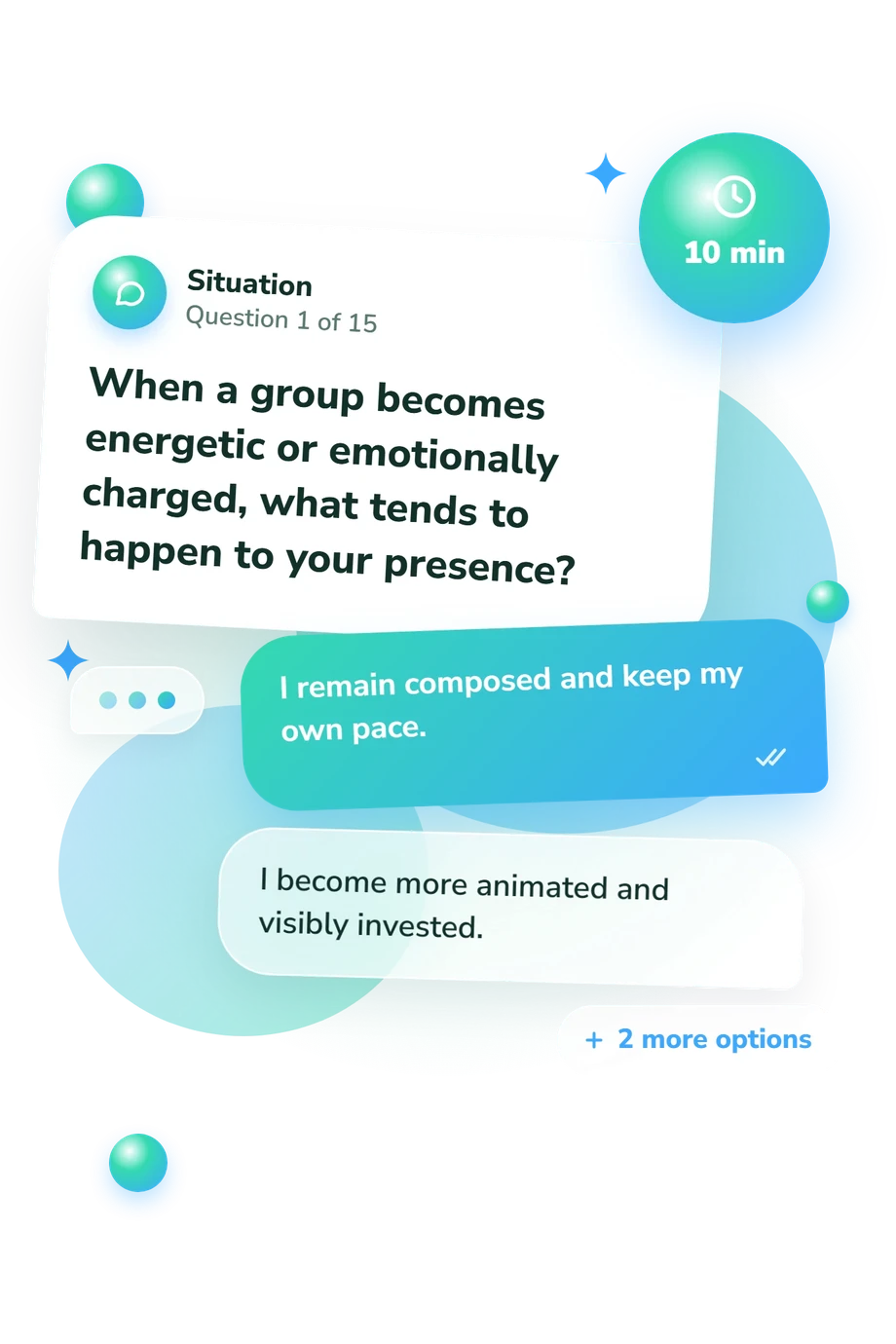
- I remain composed and keep my own pace.
- I become more animated and visibly invested.
- I adapt to the group’s energy without standing out much.
- I take the lead and begin setting the group’s tempo.
- I become upright and still, with controlled movements.
- I stay fairly compact and avoid drawing much physical attention.
- I use broad gestures or comfortably claim a prominent position.
- I look relaxed and use a moderate amount of space.
- I name the impact and explain what correction I need.
- If the issue is minor, I quietly adjust and continue.
- I address it immediately in direct, concise terms.
- I ask what happened before discussing the impact.
Am I Intimidating Quiz - Description and methodology of the test
People who wonder how their confidence, reserve, or directness lands in social situations can use this questionnaire for a structured self-check. The Am I Intimidating Quiz is especially useful when you want to understand why others may hesitate, engage cautiously, or respond strongly to you. The do-I-look-intimidating quiz question is reframed around interpersonal signals rather than appearance alone.
What This Assessment Explores
Rather than offering a simple are-you-intimidating quiz label, the questionnaire examines how behaviors may be experienced by others. It suits anyone reflecting on approachability, conversational force, and visible presence. Results describe tendencies, not a fixed character judgment.
The displayed profile separates three dimensions:
- Approachability Signals (0-15) shows how much invitation and conversational access you offer: Open-door cues (0-5) are welcoming; Selective openness (6-10) is receptive but reserved; Reserved access (11-15) may give hesitant people fewer openings. Reserve is not rejection.
- Communication Force (0-15) reflects pressure, certainty, and directness: Diplomatic (0-5) softens disagreement; Clear & firm (6-10) stays definite yet flexible; Forceful (11-15) may feel compelling or intimidating. It describes style, not correctness or intent.
- Presence Intensity (0-15) reflects eye contact, expression, posture, and social energy: Gentle presence (0-5) softens impact; Noticeable presence (6-10) mixes openness and reserve; High-intensity presence (11-15) may feel commanding.
Methodology and Scientific Basis
Four-option responses present brief social situations and ask which reaction best matches usual behavior. The items address feedback, interruption, disagreement, eye contact, posture, attention, entering a room, and maintaining contact, so the profile draws on both communication and nonverbal conduct.
Answers combine into the three displayed scores, but no published item-weighting rule, norm group, reliability estimate, or clinical cutoff is stated. The bands organize self-reflection rather than population percentiles or diagnoses.
Evidence is conceptual. The Nonverbal Immediacy Scale (Richmond et al., 2003) supports attention to eye contact, posture, expressiveness, and interpersonal accessibility. Willis, Palermo, and Burke (2011) show why facial and bodily expressions matter for perceived approachability, while Wiggins, Trapnell, and Phillips (1988) provide an interpersonal-circumplex framework for assertive and affiliative styles. This questionnaire is conceptually consistent with those works, not an adaptation or validation of them. The am-I-intimidating-to-guys quiz concern should be interpreted in context because culture, familiarity, current emotion, and response bias affect perception.
- Richmond, V. P., McCroskey, J. C., & Johnson, A. D. (2003). Development of the nonverbal immediacy scale (NIS): Measures of self- and other-perceived nonverbal immediacy. Communication Quarterly, 51(4), 504-517. 10.1080/01463370309370170
- Willis, M. L., Palermo, R., & Burke, D. (2011). Judging Approachability on the Face of It: The Influence of Face and Body Expressions on the Perception of Approachability. Emotion, 11, 514-523. 10.1037/a0022571
- Wiggins, J. S., Trapnell, P., & Phillips, N. (1988). Psychometric and Geometric Characteristics of the Revised Interpersonal Adjective Scales (IAS-R). Multivariate Behavioral Research, 23(4), 517-530. 10.1207/s15327906mbr2304_8
Updated: