
Am I Cute Quiz for Guys
How the Scales are Structured
Who Usually Takes This Test?
See How You Compare
Below is a preview of how scores are typically distributed across each scale.
Example Questions From the Test
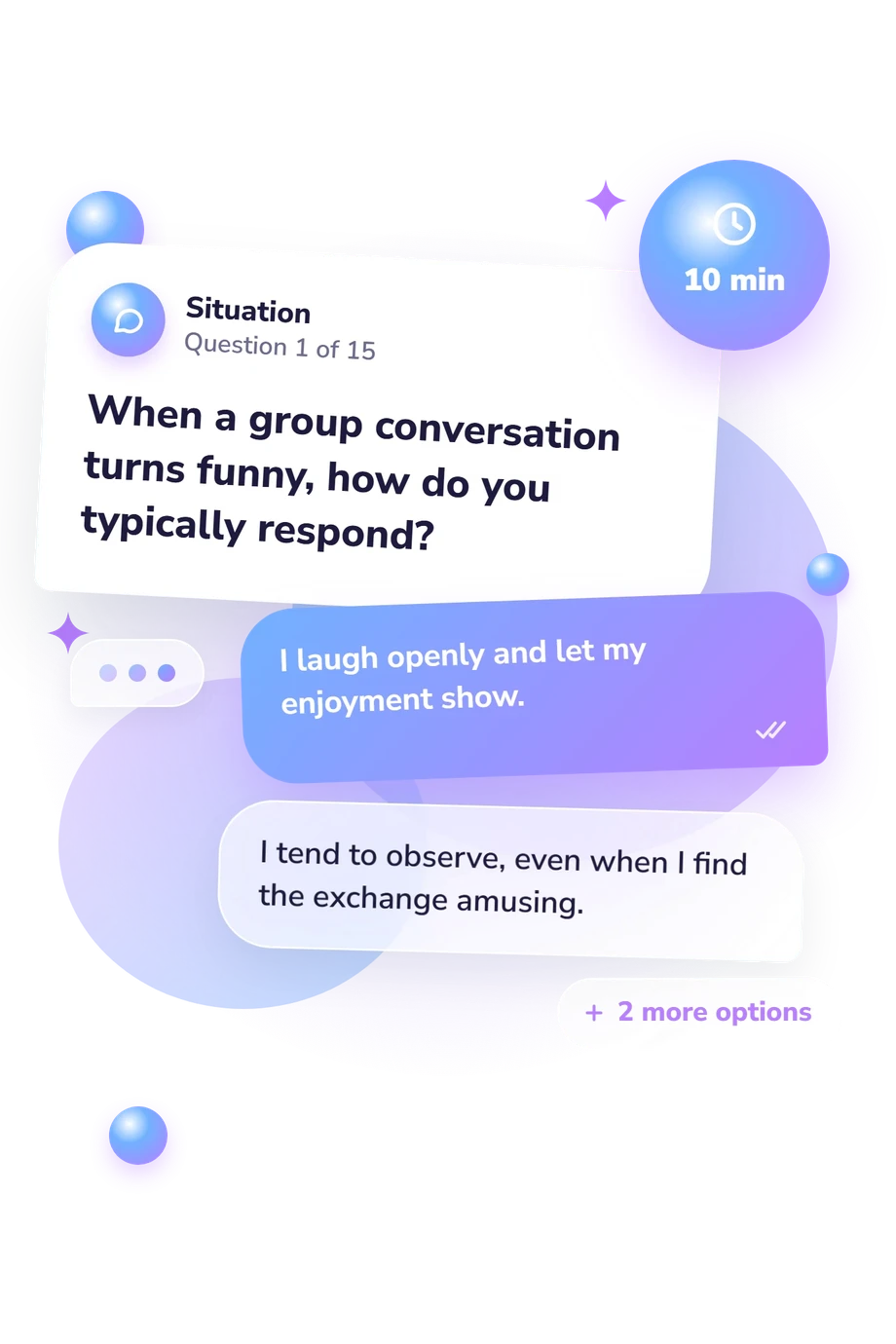
- I laugh openly and let my enjoyment show.
- I tend to observe, even when I find the exchange amusing.
- I smile or chuckle, but keep my reaction fairly restrained.
- I join the playful energy with an expressive reaction or joke of my own.
- On most social occasions, with several details intentionally coordinated.
- Occasionally, usually by changing one easy detail.
- Rarely; those details are not a significant part of how I dress.
- Fairly often, through one or two deliberate touches.
- Friendly and easy to talk to once conversation begins.
- Reserved or difficult to read at first.
- Bubbly, playful, or immediately engaging.
- Calm and polite, though not especially expressive.
Am I Cute Quiz for Guys - Description and methodology of the test
People who want a cute quiz for men can use this questionnaire to reflect on warmth, noticed social feedback, and style choices. The Am I Cute Quiz for Guys treats cuteness as an impression rather than a fixed verdict about appearance. Its questions connect warmth, approachability, presentation choices, and the feedback respondents notice. The result reflects self-reported patterns, not how other people actually experience the respondent.
What This Assessment Explores
Rather than treating cuteness as a single visual property, this cuteness self-assessment examines warmth, noticed interest, and presentation choices. The questions ask men to consider how approachability and appearance-related signals work together, including reserved and expressive styles.
The result separates three dimensions:
- Approachable Charm (0-15) describes how warmth appears, from Quiet Presence (0-5), through Gentle Openness (6-10), to Expressive Warmth (11-15).
- Observed Interest (0-15) reflects attraction-related feedback you notice, from Limited Visible Feedback (0-5), through Some Encouraging Signals (6-10), to Frequent Interest Signals (11-15).
- Presentation Signals (0-15) captures styling intention, from Understated Presentation (0-5), through Selective Polish (6-10), to Deliberate Charm (11-15).
Together, the profile shows whether your impression is conveyed mainly through warmth, feedback from others, presentation choices, or a combination. None of these styles is inherently better, and presentation reflects choices rather than objective beauty.
Methodology and Evidence Base
Each item in this self-reflection quiz presents a social or appearance situation and offers four response options. Choices distinguish expressive reactions, grooming intention, noticed feedback, and follow-up behavior; respondents select the description closest to recent experience. The questionnaire reports three profile scores and their displayed bands, while individual response weights are not specified.
Conceptually, it is consistent with Reis et al. (1982) on appearance and social experience, Nezlek (1999) on body image in daily interaction, and Leary and Kowalski (1990) on interpersonal impression. Langlois et al. (2000) reviewed agreement and social consequences in attractiveness judgments. The questionnaire is conceptually consistent with these ideas, but it does not reproduce any of those instruments or methods.
The self-report profile is not standardised against population norms, and it has no stated reliability estimates or clinical cutoffs. Your result may vary with current context, opportunities to receive feedback, and self-awareness. Interest cues may suggest attraction but cannot prove another person's feelings, so read the profile as a reflection on patterns rather than a fixed label.
- Reis, Harry T., Ladd Wheeler, Nancy Spiegel, Michael H. Kernis, John B. Nezlek, and Michael Perri. (1982). Physical attractiveness in social interaction: II. Why does appearance affect social experience? Journal of Personality and Social Psychology, 43(5), 979-996. 10.1037/0022-3514.43.5.979
- Nezlek, John B. (1999). Body image and day-to-day social interaction. Journal of Personality, 67(5), 793-817. 10.1111/1467-6494.00073
- Leary, Mark R., and Robin M. Kowalski. (1990). Impression management: A literature review and two-component model. Psychological Bulletin, 107(1), 34-47. 10.1037/0033-2909.107.1.34
- Langlois, Judith H., Lisa Kalakanis, Adam J. Rubenstein, Andrea Larson, Monica Hallam, and Monica Smoot. (2000). Maxims or myths of beauty? A meta-analytic and theoretical review. Psychological Bulletin, 126(3), 390-423. 10.1037/0033-2909.126.3.390
Updated: