
Am I a Risk Taker Quiz
How the Scales are Structured
Who Usually Takes This Test?
See How You Compare
Below is a preview of how scores are typically distributed across each scale.
Example Questions From the Test
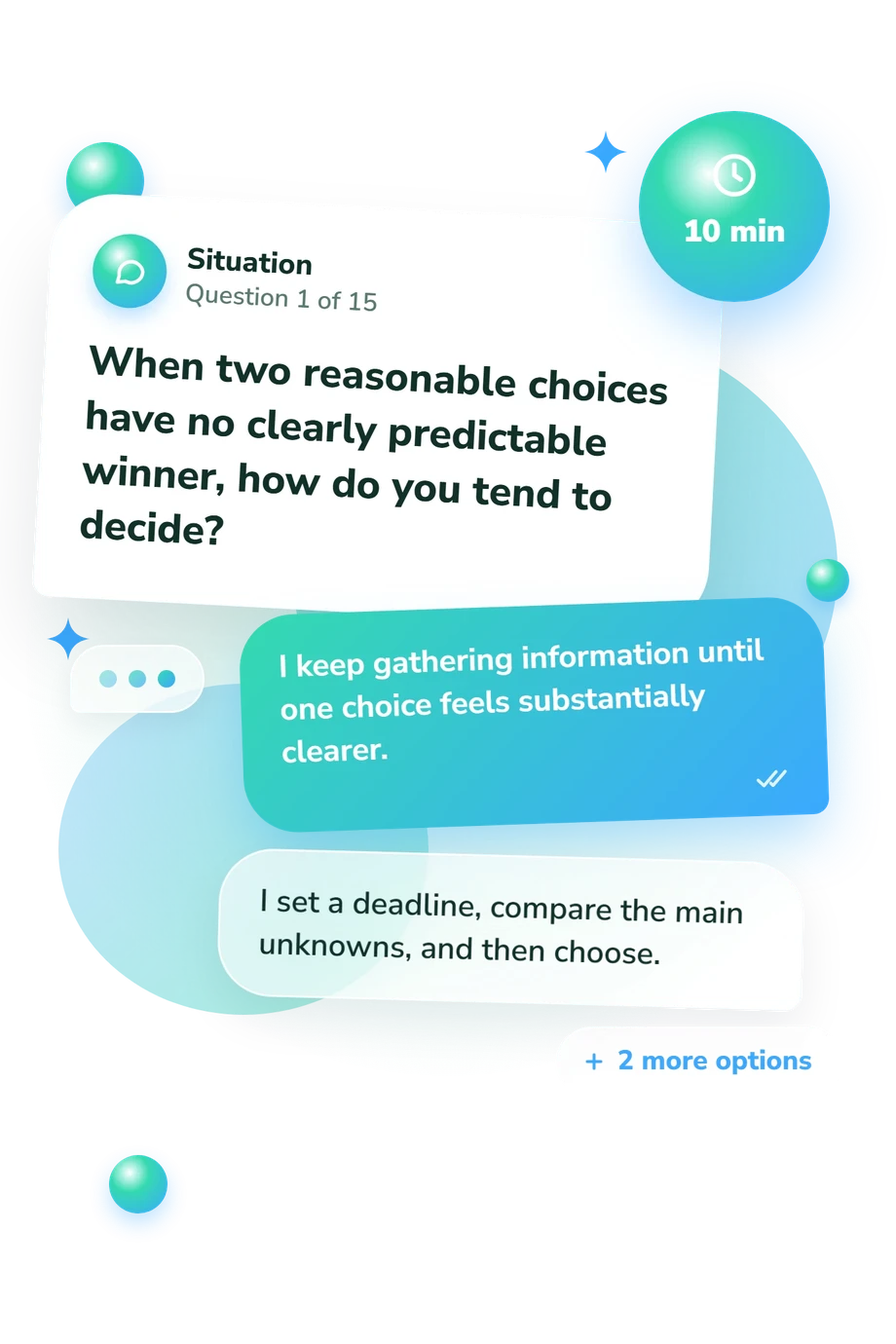
- I keep gathering information until one choice feels substantially clearer.
- I set a deadline, compare the main unknowns, and then choose.
- I lean toward the more predictable choice unless there is a strong reason not to.
- I choose with the information available and feel little need for certainty.
- Keep the work private or share it only in a supportive setting.
- Enter after receiving enough encouraging feedback from people I trust.
- Enter if the exposure or experience would matter to me despite possible rejection.
- Enter readily because the potential recognition is worth a strong chance of rejection.
- I make a firm alternative plan and choose that instead.
- I keep the event as one option but prepare a definite backup.
- I remain interested and decide when the forecast becomes clearer.
- I am happy to show up and adapt to whatever version occurs.
Am I a Risk Taker Quiz - Description and methodology of the test
People who want to understand why some choices feel energizing while others feel too exposed may find this profile useful. The Am I a Risk Taker Quiz examines everyday preferences around novelty, meaningful trade-offs, and incomplete information. Its scenarios examine choices about novelty, meaningful trade-offs, and incomplete information, making this a risk taking quiz that supports self-reflection without reducing a person to boldness or caution.
What This Assessment Explores
Rather than asking whether risk is good or bad, the questionnaire examines responses to novelty, possible loss, and uncertainty in ordinary decisions. Scenarios involve food, travel, creative work, negotiations, money, work roles, projects, and games. This risk-taking profile is a pattern of preferences, not a verdict about one choice.
The three displayed scales describe separate tendencies:
- Novelty Appetite (0-15) shows attraction to unfamiliar experiences when stakes are modest, not overall recklessness: Familiarity-Oriented (0-5), Selectively Exploratory (6-10), or Novelty-Drawn (11-15).
- Stakes Willingness (0-15) shows readiness to accept manageable loss for valued upside, not financial, career, or safety advice: Preservation-Focused (0-5), Trade-Off Selective (6-10), or High-Stakes Inclined (11-15).
- Uncertainty Comfort (0-15) shows comfort with unresolved information, plans, or outcomes, not whether choices are wise or safe: Clarity-Seeking (0-5), Flexible with Conditions (6-10), or Open-Ended (11-15).
Methodology and Evidence Base
Taken as a risk-taking assessment, the questionnaire uses everyday scenarios with four response options. Items cover unfamiliar experiences, resource trade-offs, and unresolved plans or outcomes; options span positions from greater preference for certainty or familiarity to greater openness to novelty, stakes, or ambiguity. Responses produce three profile scores. The displayed ranges do not provide a scoring formula, so readers should not infer how many points a response contributes or how items are weighted.
The content is conceptually consistent with DOSPERT (Weber et al., 2002), which treats risk attitude as domain-specific, and with GRiPS (Zhang et al., 2019), which examines broader risk propensity. The novelty items echo sensation-seeking work by Zuckerman et al. (1978), while comfort with unresolved information is consistent with Herman et al. (2010). These sources support the constructs, but this online questionnaire is not a direct administration or adaptation of any of them.
Results are descriptive self-report scores. Mood, goals, finances, and honesty about imagined choices affect responses. Displayed bands are descriptive categories; they do not by themselves establish population norms or clinical cutoffs.
- Weber, Elke U., Ann-Renée Blais, and Nancy E. Betz. (2002). A domain-specific risk-attitude scale: measuring risk perceptions and risk behaviors. Journal of Behavioral Decision Making, 15(4), 263-290. 10.1002/bdm.414
- Zhang, Don C., Scott Highhouse, and Christopher D. Nye. (2019). Development and validation of the General Risk Propensity Scale (GRiPS). Journal of Behavioral Decision Making, 32(2), 152-167. 10.1002/bdm.2102
- Zuckerman, Marvin, Sybil B. Eysenck, and Hans J. Eysenck. (1978). Sensation seeking in England and America: cross-cultural, age, and sex comparisons. Journal of Consulting and Clinical Psychology, 46(1), 139-149. 10.1037/0022-006X.46.1.139
- Herman, Jeffrey L., Michael J. Stevens, Allan Bird, Mark Mendenhall, and Gary Oddou. (2010). The Tolerance for Ambiguity Scale: Towards a more refined measure for international management research. International Journal of Intercultural Relations, 34(1), 58-65. 10.1016/j.ijintrel.2009.09.004
Updated: