
Am I a Hoe Quiz
How the Scales are Structured
Who Usually Takes This Test?
See How You Compare
Below is a preview of how scores are typically distributed across each scale.
Example Questions From the Test
- Chatting selectively and looking mainly for a serious match
- Meeting different people without aiming for exclusivity
- Leaving my intentions open because they depend on who I meet
- Looking for commitment but remaining open to something brief
- Reply warmly but steer the exchange toward a nonsexual topic
- Answer with an equally bold and suggestive message
- Acknowledge it privately without continuing that kind of exchange
- Respond playfully while keeping some details implied
- I make it unmistakable through direct flirting or sensual energy
- I give subtle hints and wait to see whether they are returned
- I am friendly but usually keep attraction concealed
- I flirt clearly once I sense mutual interest
Am I a Hoe Quiz - Description and methodology of the test
People reflecting on how they present themselves in dating and social situations may find the Am I a Hoe Quiz a useful prompt for self-understanding. The profile can clarify casual dating preferences without turning self-description into a verdict. It treats the result as a prompt for noticing personal context rather than evidence of character. The hoe quiz helps a reader see which choices feel natural, conditional, or unappealing.
What This Assessment Explores
The questions are for readers reflecting on how dating preferences, language, and attraction fit together. Rather than reducing the assessment to one question-is she a hoe quiz?-it turns that curiosity toward self-observation: what feels comfortable, what depends on trust, and what you would choose for yourself.
The displayed profile covers these three dimensions:
- Casual Connection Preference (0-15) shows whether exclusivity or open-ended connection currently appeals more: Commitment-Leaning (0-5), Context-Dependent (6-10), or Casual-Leaning (11-15).
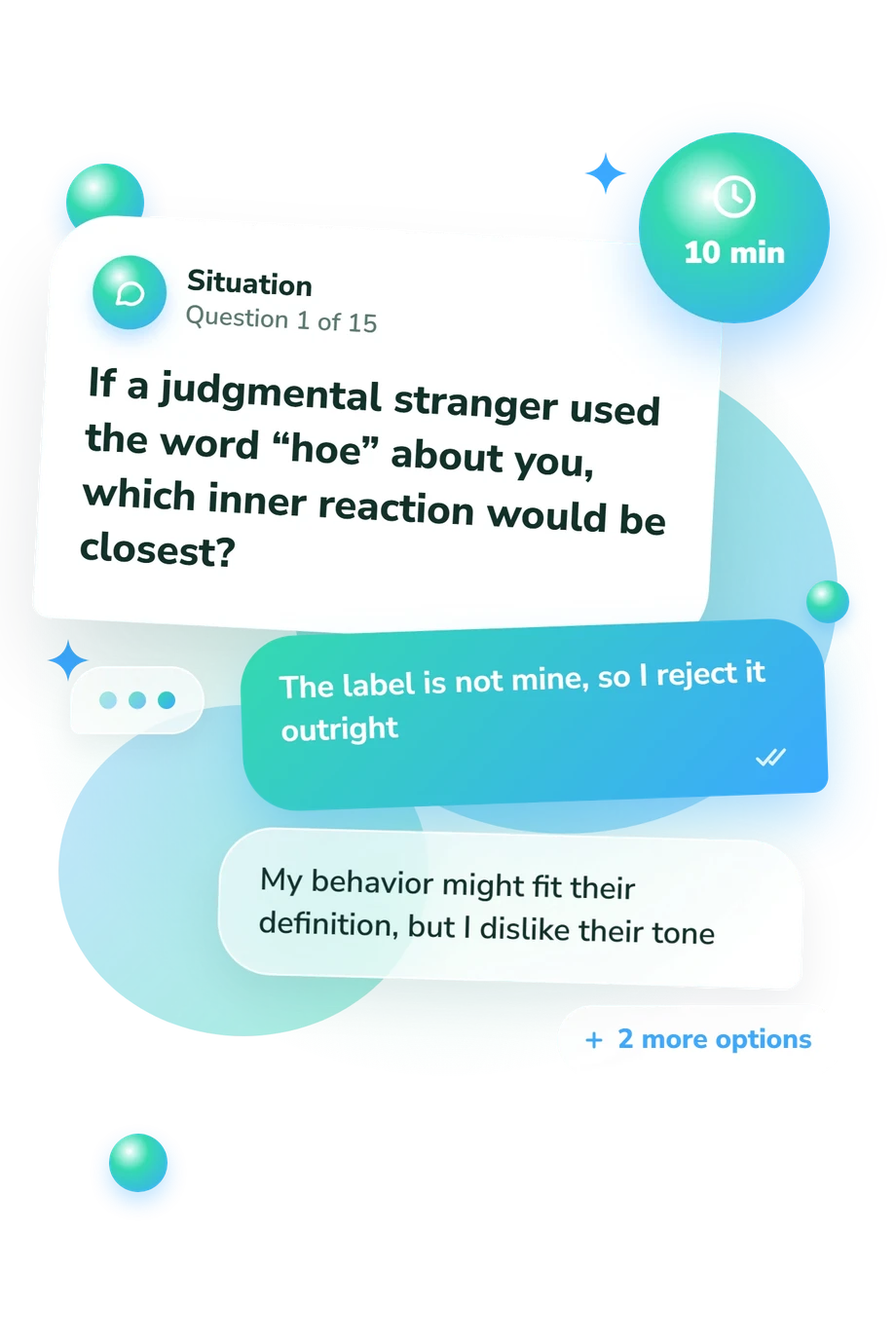
- Hoe Label Affinity (0-15) reflects how welcome the word “hoe” feels: Label-Rejecting (0-5), Contextual Use (6-10), or Label-Reclaiming (11-15), and a self-chosen label never permits disrespect.
- Sexual Self-Expression (0-15) reflects comfort showing attraction, sensuality, or curiosity: Private Expression (0-5), Selective Expression (6-10), or Open Expression (11-15), not sexual activity or personal worth.
Methodology and Scientific Basis
Each item presents a dating or social situation-meeting several people, receiving a suggestive message, choosing how to dress, or discussing sex-with four response options. The choices describe different comfort levels and styles; there is no correct answer.
Separate scores report casual-connection preference, relationship with the label, and sexual self-expression, while the displayed catalogue bands describe the profile. This separation keeps a preference for open-ended dating distinct from comfort with a word or with visible attraction; it does not turn any score into a verdict about conduct or worth.
The casual-connection dimension is conceptually consistent with the Sociosexual Orientation Inventory-Revised, and the expression dimension fits the sexual self-schema perspective associated with Andersen and Cyranowski. Reger’s work adds cultural context for labels that may be negotiated, reclaimed, or contested. The questionnaire is conceptually consistent with these named works, but it is not an adaptation of any one of them.
Because answers are self-reported, scores can shift with current relationship context, self-presentation, and willingness to answer candidly; read this hoe self-reflection test's profile as a snapshot rather than a fixed description of character.
- Lars Penke and Jens B. Asendorpf (2008). Beyond global sociosexual orientations: A more differentiated look at sociosexuality and its effects on courtship and romantic relationships. Journal of Personality and Social Psychology, 95(5), 1113-1135. 10.1037/0022-3514.95.5.1113
- Barbara L. Andersen and Jill M. Cyranowski (1994). Women's Sexual Self-Schema. Journal of Personality and Social Psychology, 67(6), 1079-1100. 10.1037/0022-3514.67.6.1079
- Jo Reger (2015). The Story of a Slut Walk: Sexuality, Race, and Generational Divisions in Contemporary Feminist Activism. Journal of Contemporary Ethnography, 44(1), 84-112. 10.1177/0891241614526434
Updated: