
Airport Signs and Markings Quiz
How the Scales are Structured
Who Usually Takes This Test?
See How You Compare
Below is a preview of how scores are typically distributed across each scale.
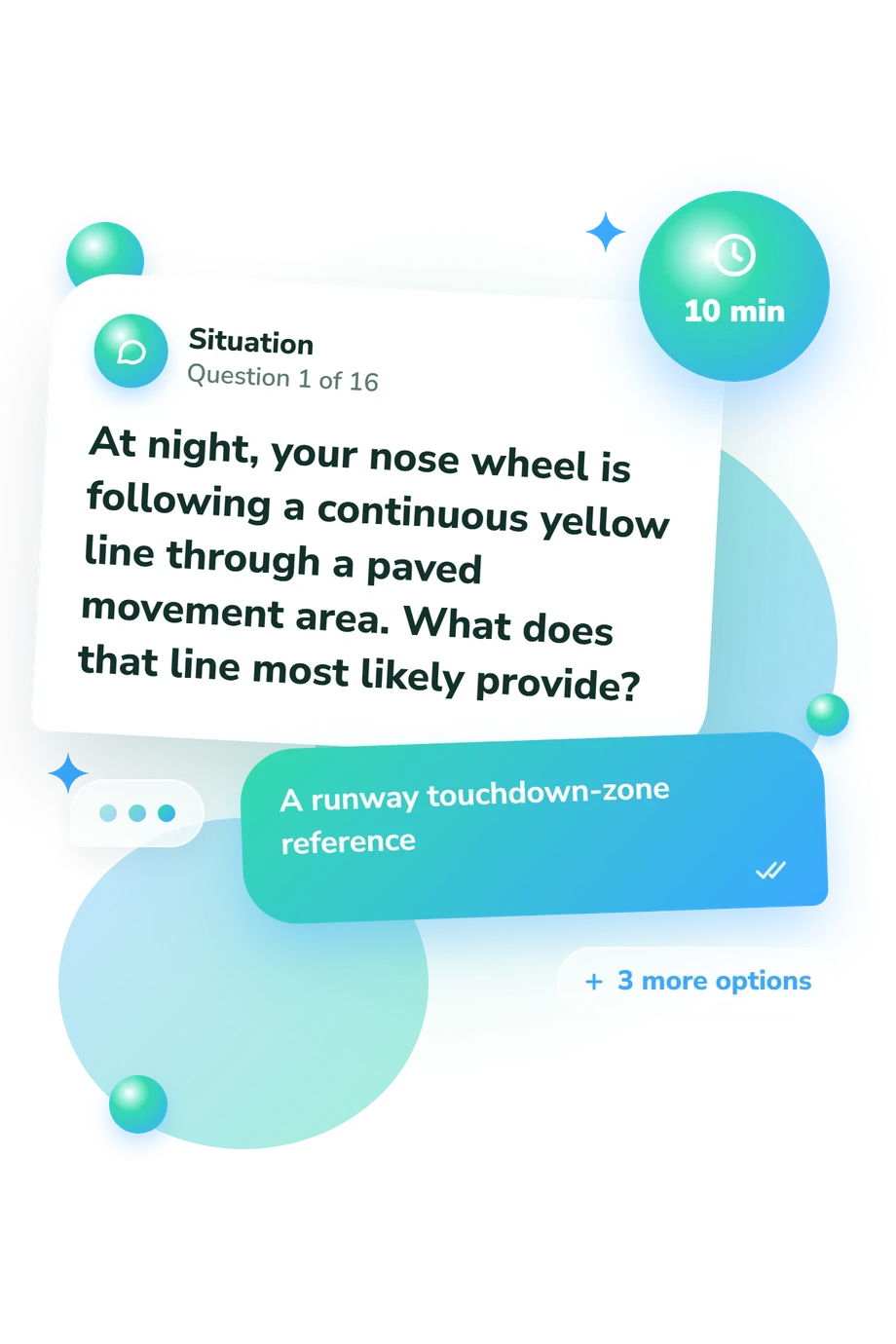
Example Questions From the Test
- A large white circle
- A large yellow X
- A pair of parallel white bars
- Alternating red and yellow stripes
- Yellow background, black inscription, and an arrow
- Red background with a white taxiway letter
- Black background, yellow inscription, and a yellow border
- Black background with a white numeral
- Runway 26
- Runway 28
- Runway 27
- Runway 274
Airport Signs and Markings Quiz - Description and methodology of the test
People who want to recognise runway and taxiway cues more confidently can use this airport signs and markings quiz as a focused knowledge check. It suits learners reviewing surface navigation, pilots refreshing familiar conventions, and readers who want to understand what common colors, letters, numbers, and lines communicate. An airport markings quiz result can point to topics that deserve another pass before formal study or operational practice.
What This Assessment Explores
Rather than measuring personality or symptoms, the questionnaire checks recognition of runway and taxiway cues and the decisions they support during ground movement. It suits learners, pilots, and readers refreshing practical airport knowledge.
The result, Airport Signs and Markings Knowledge, runs from 0 to 16 correct answers. Its bands are Foundation 0-6, Developing 7-12, and Strong 13-16, showing increasing command of FAA-style conventions.
This airport signage quiz brings four tested themes together:
- Sign colors and inscriptions identify mandatory, location, direction, and no-entry information.
- Pavement patterns distinguish runway and taxiway centerlines, edges, closures, thresholds, and aiming points.
- Holding-position situations test when authorization is required before entering a runway.
- Numbering and distance cues connect magnetic alignment, exits, displaced thresholds, and landing limits.
Methodology and Evidence Base
Each item describes a short airport-surface situation and offers four answer choices. The scenarios ask you to interpret colors, letters, numbers, lines, chevrons, bars, and holding-position patterns rather than recall an isolated definition. The displayed result reports how many answers were correct, so the score reflects performance on this fixed knowledge check.
Questions in this runway markings quiz also require context: a marking may signal a boundary, a restriction, a runway relationship, or an area unavailable for landing. The answer choices are deliberately close enough to test interpretation rather than simple visual matching.
The content is conceptually consistent with FAA airport-sign guidance, the FAA's AIM guidance, and AC 150/5340-18H. Estes et al. (2005) adds human-factors context on surface-marking clarity. The format keeps this airport signs quiz focused on interpreting a convention in context, not memorizing a list of labels.
Because it is a fixed educational check rather than a published adaptation, validation study, or norm-referenced psychological measure, its result is best read as a snapshot affected by familiarity and attention, while current regulations, charts, training, and ATC instructions govern real operations.
- Federal Aviation Administration. Pilot's Guide to Airport Signs & Markings. U.S. Department of Transportation, March 2026.
- Federal Aviation Administration. Aeronautical Information Manual, Chapter 2, Section 3: Airport Marking Aids and Signs. Basic with Changes 1, 2, and 3, effective July 9, 2026.
- Estes, Steven, Oscar Olmos, Cheryl Andrews, Anthony D. Andre, Susan Chrysler, and Dan Hannon. "Better Taxiway Surface Markings: Safer Airports." Ergonomics in Design: The Quarterly of Human Factors Applications 13, no. 2 (2005): 13-17. 10.1177/106480460501300204
- Federal Aviation Administration. AC 150/5340-18H: Standards for Airport Sign Systems. U.S. Department of Transportation, September 30, 2024.
Updated: