
6.5 Comprehension Quiz
How the Scales are Structured
Who Usually Takes This Test?
See How You Compare
Below is a preview of how scores are typically distributed across each scale.
Example Questions From the Test
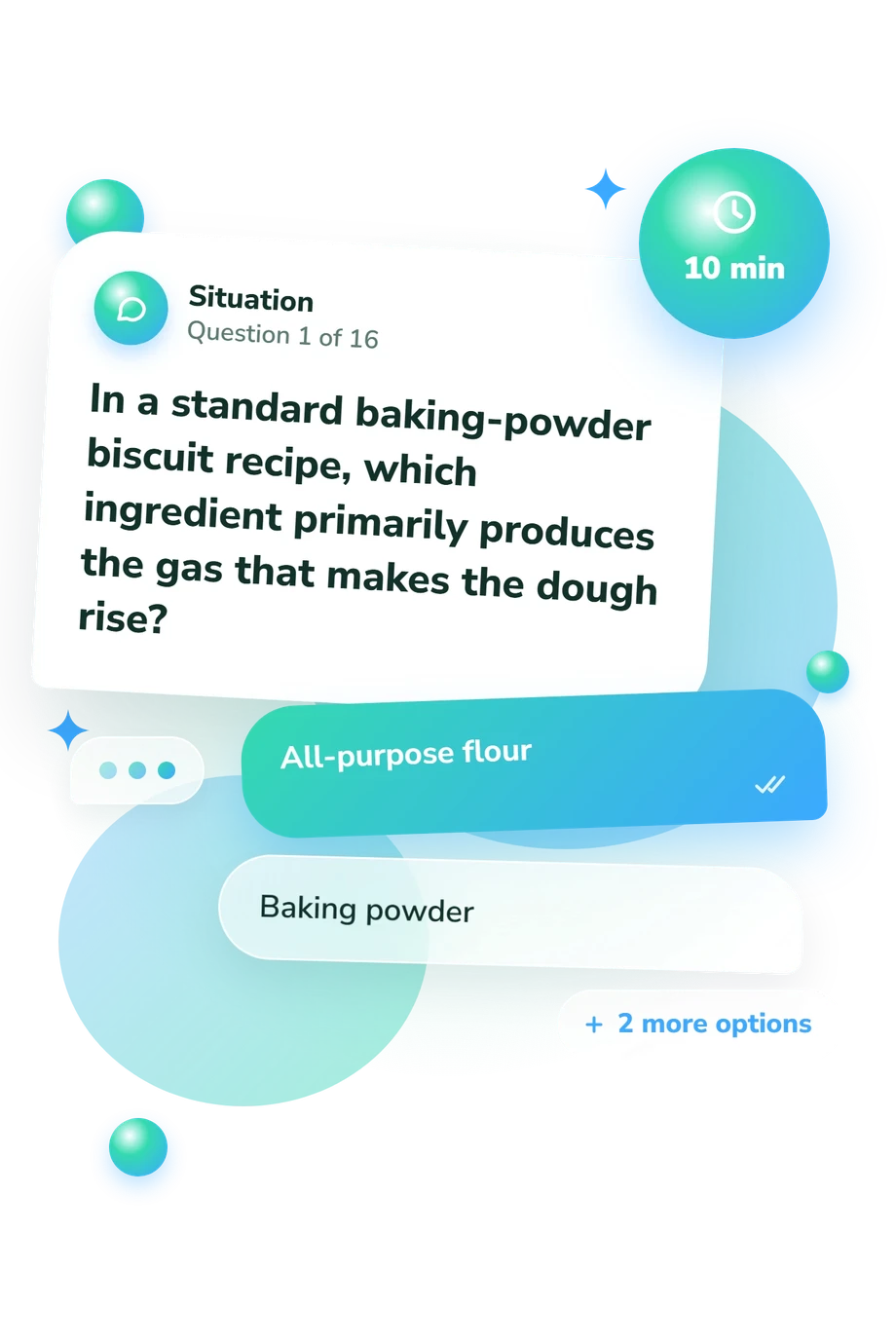
- All-purpose flour
- Baking powder
- Milk
- Cold butter
- Serving food immediately after it leaves the heat
- Cooking every ingredient in a separate pan
- Replacing fresh ingredients with shelf-stable ones
- Measuring, cutting, and organizing ingredients before cooking
- Firm, moist flesh with a mild, clean smell
- Soft flesh, brown patches, and excess liquid
- A strong ammonia smell and flesh that holds a fingerprint
- Dry edges, dull flesh, and a sharp odor
6.5 Comprehension Quiz - Description and methodology of the test
People who want to check their practical food knowledge can use the 6.5 comprehension quiz to see how well they handle everyday ingredient decisions. It suits learners, home cooks, and anyone reviewing basic kitchen principles before applying them in recipes. A food skills assessment such as this offers a focused snapshot of what respondents know and which areas may benefit from more study.
What This Assessment Measures
Questions focus on ingredient functions, label reading, freshness, measurement, substitutions, and dietary safety. Rather than judging overall cooking performance, this ingredient selection quiz checks whether practical knowledge transfers to common recipe and kitchen decisions. It suits learners and home cooks who want to identify foundations and topics for further practice.
The quiz reports one scale, Selecting Ingredients Knowledge (0-16), reflecting quiz performance. The bands are Foundation (0-6), Developing (7-12), and Strong (13-16), describing increasing consistency across recipes, labels, dietary needs, and kitchen scenarios.
The question groups are:
- Ingredient functions show what leaveners, fats, acids, and emulsifiers contribute.
- Labels and comparisons show how you use composition, sodium, and suitability information.
- Measurement and scaling show whether quantities are handled accurately.
- Freshness and quality show how you judge ingredients for immediate use.
- Safety and substitutions show whether choices address allergies, cross-contact, and dietary limits.
Methodology and Evidence Base
Each item presents a practical kitchen situation or factual prompt with four answer choices. Respondents select the best option rather than rate agreement or frequency, yielding one questionnaire score rather than separate scores for each topic. Selected-response results can be influenced by guessing, prior instruction, wording, and familiarity with food terminology.
The questionnaire is conceptually consistent with the Food Skills Questionnaire and Vidgen and Gallegos’ food-literacy framework, but it is not an adaptation of either instrument. The Food Skills Questionnaire addresses practical food knowledge and skills; the framework describes abilities such as accessing information, making informed choices, and applying knowledge in context. Their reliability, validity, and standardization findings do not automatically apply to this quiz’s score.
As a kitchen ingredient quiz, it works best as a learning checkpoint. The result can identify subjects for review, but multiple-choice performance cannot show hands-on technique, real-time sensory judgment, or complete kitchen management. Actual practice adds context that the score alone cannot capture.
- Kennedy, Lauren G., Emily J. Kichler, Jamie A. Seabrook, June I. Matthews, and Paula D. N. Dworatzek. “Validity and Reliability of a Food Skills Questionnaire.” Journal of Nutrition Education and Behavior 51, no. 7 (2019): 857-864. 10.1016/j.jneb.2019.02.003
- Vidgen, Helen Anna, and Danielle Gallegos. “Defining food literacy and its components.” Appetite 76 (2014): 50-59. 10.1016/j.appet.2014.01.010
Updated: