
2023 Year in Review Quiz
How the Scales are Structured
Who Usually Takes This Test?
See How You Compare
Below is a preview of how scores are typically distributed across each scale.
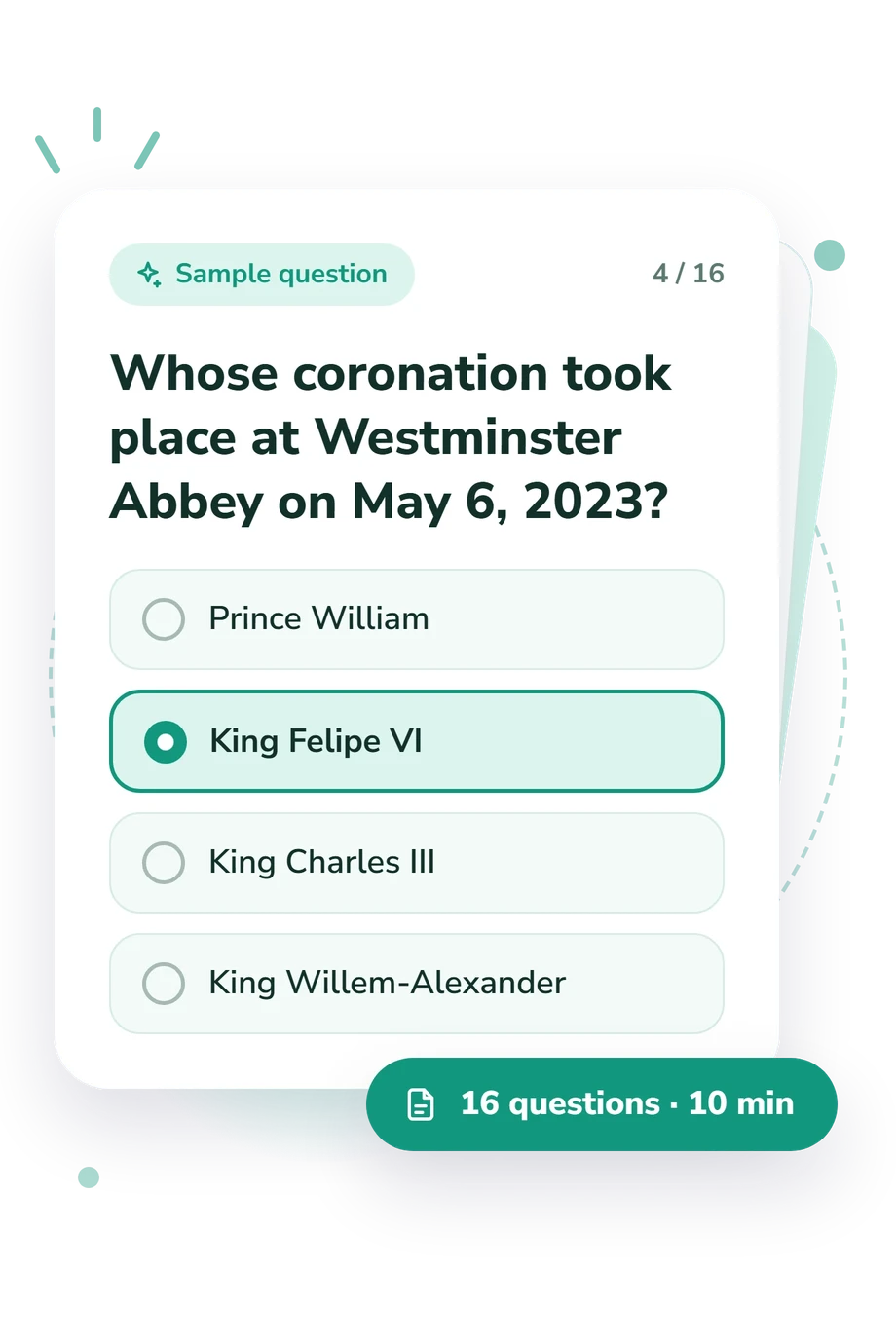
Example Questions From the Test
- Maria Ressa
- Narges Mohammadi
- Greta Thunberg
- Shirin Ebadi
- Saudi Arabia
- Qatar
- Egypt
- The United Arab Emirates
- Barbie and Napoleon
- Barbie and Oppenheimer
- The Little Mermaid and Oppenheimer
- Barbie and Mission: Impossible – Dead Reckoning Part One
2023 Year in Review Quiz - Description and methodology of the test
Readers who want to revisit the defining stories of 2023 can use this 2023 quiz as a structured check of performance on factual questions rather than a personality assessment. It suits anyone interested in public events, culture, science, sport, or international affairs. The result helps organize remembered topics and identify subjects to revisit after taking the quiz covering the year 2023.
What This Assessment Explores
This assessment measures performance on factual multiple-choice questions about 2023 events, people, discoveries, culture, and sport. It suits readers checking recognition of correct options across public-interest domains, not personality, opinion, or emotional traits. A higher result means more correct answers.
Across the questions, you identify names, places, dates, organizations, outcomes, and event contexts, using questions and answers about 2023 to test recognition rather than broad memory.
The result appears on the 2023 Year in Review Knowledge scale, which runs from 0 to 16. Its bands describe the total:
- Refresh the Year (0-6) marks fewer correct answers and suggests topics to revisit.
- Solid Recall (7-12) reflects recognition of many defining events, with some areas to refresh.
- Standout Recall (13-16) reflects high performance across the questions and connected contexts.
Methodology and Scientific Basis
Each item uses four answer options tied to a public event or cultural reference from 2023. The displayed score is the number of correct answers, so it reflects performance on these questions rather than confidence or speed. Choose the option that best matches your knowledge, then read the band as a snapshot of this question set.
The format is an online multiple-choice knowledge check covering public events and cultural references from 2023, making this 2023 trivia quiz broad enough to include science, sport, entertainment, and international affairs. It is conceptually consistent with research on online public-affairs quizzes, but it is not an adaptation of the study by Scacco, Muddiman, and Stroud (2016). That study is analogous evidence about quiz-based knowledge acquisition, not validation of this questionnaire.
The questionnaire presents a displayed score with descriptive bands, so interpret the result as the number of correct answers within those bands. Performance can vary with prior news exposure, regional interests, memory, and uncertainty between plausible options, so the score is a snapshot of performance on this question set.
- Scacco, Joshua M., Ashley Muddiman, and Natalie Jomini Stroud. “The Influence of Online Quizzes on the Acquisition of Public Affairs Knowledge.” Journal of Information Technology & Politics, vol. 13, no. 4, 2016, pp. 311-325. 10.1080/19331681.2016.1230920
- Altay, Sacha, Emma Hoes, and Magdalena Wojcieszak. “Following News on Social Media Boosts Knowledge, Belief Accuracy and Trust.” Nature Human Behaviour, vol. 9, 2025, pp. 1833-1842. 10.1038/s41562-025-02205-6
- Lelkes, Adam D., Vinh Q. Tran, and Cong Yu. “Quiz-Style Question Generation for News Stories.” Proceedings of the Web Conference 2021, 2021, pp. 2501-2511. 10.1145/3442381.3449892
- Delli Carpini, Michael X., and Scott Keeter. What Americans Know about Politics and Why It Matters. Yale University Press, 1996.
Updated: