
Freudly+971 508685814hello@freudly.ai
Freudly
identity

Who Is My Patron Saint Quiz
Who Is My Patron Saint Quiz - FreudlyTake a free who is my patron saint quiz to discover your patron saint. Quick, no sign-up needed. Start now!en
After 20 questions in about 10 minutes, the Who Is My Patron Saint Quiz offers a reflective profile of the saint whose qualities may resonate with your values, choices, and way of serving others. Use the result to explore spiritual themes and choose a direction for personal reflection.
Questions: 2010 minutes
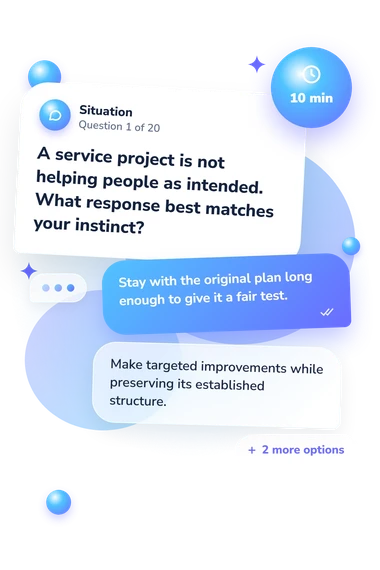
Who Is My Patron: situation and reply bubbles
July 22, 2026July 22, 2026Material has been updatedJuly 22, 2026Material has been published
6,615 views
585 completions
514 likes
Daniel HallPsychologist · Test reviewer
514 likes
Scale Explorer

How the Scales are Structured

St. Francis of AssisiSFoA
This scale reflects your affinity with Franciscan simplicity, care for creation, solidarity with others, and peacemaking.
example score8/12
8/12Franciscan resonanceexample score
0 – 4Different emphasis
5 – 8Franciscan resonance
9 – 12Strong Francis affinity
A score of 8 suggests a meaningful Franciscan resonance, with several themes of simplicity, kinship with creation, and reconciliation fitting your outlook or growth goals.
St. Ignatius of LoyolaSIoL
Measures affinity with St. Ignatius of Loyola’s style of reflective discernment, purposeful service, and flexible strategy.
example score4/12
4/12Different emphasisexample score
0 – 4Different emphasis
5 – 8Discernment resonance
9 – 12Strong Ignatius affinity
A score of 4 suggests a different emphasis, with a tendency to favor spontaneity, stable routines, or immediate action over structured reflection and mission-focused planning.
St. Joan of ArcSJoA
This scale measures your affinity for St. Joan of Arc’s direct, conviction-led courage and visible leadership under pressure.
example score2/12
2/12Different emphasisexample score
0 – 4Different emphasis
5 – 8Courageous resonance
9 – 12Strong Joan affinity
A score of 2 suggests a different emphasis, with a tendency to prefer deliberation, quieter influence, or adaptable paths over Joan’s direct, conviction-led style.
St. Thérèse of LisieuxSToL
Measures your affinity for St. Thérèse’s “Little Way” of expressing love through consistent, gentle, ordinary acts of care.
example score5/12
5/12Little Way resonanceexample score
0 – 4Different emphasis
5 – 8Little Way resonance
9 – 12Strong Thérèse affinity
A score of 5 suggests a modest “Little Way” resonance, with some preference for trust, gentleness, and steady care in everyday actions.
St. Thomas AquinasSTA
This scale reflects your affinity for disciplined study, careful reasoning, and integrating belief with understanding in how you approach life and service.
example score6/12
6/12Scholarly resonanceexample score
0 – 4Different emphasis
5 – 8Scholarly resonance
9 – 12Strong Thomas affinity
A score of 6 suggests a scholarly resonance, meaning structured learning and the search for coherence are meaningful themes for you without dominating your approach.
just completed the test
DATA-BASED USER COHORTS

Who Usually Takes This Test?

Curious Faith Explorers
41%OF USERS
People who enjoy learning about saints and want a light, reflective way to see which spiritual themes resonate with their personality.
Catholic Students and Young Adults
34%OF USERS
Students, campus groups, and young adults using it for conversation starters about vocation, virtues, and everyday discipleship.
Ministry and Group Leaders
25%OF USERS
Catechists, small-group facilitators, and retreat planners who use it to spark discussion about service styles and prayer habits.
BASED ON AGGREGATED, ANONYMIZED DATA FROM TENS OF THOUSANDS OF FREUDLY USERS.
Benchmarking

See How You Compare

Once you complete the test, your results are compared with real-world data from people in your country.
Below is a preview of how scores are typically distributed across each scale.
Shaded area — where most people score
Dot — the average
You — your score lands on each curve after the test— your score, after the test
St. Francis of AssisiSFoA
You?
Average5.1
Typical rangeTypical3.6 – 6.6
Possible0 – 12
St. Ignatius of LoyolaSIoL
You?
Average5.1
Typical rangeTypical3.1 – 7.2
Possible0 – 12
St. Joan of ArcSJoA
You?
Average6.3
Typical rangeTypical4.7 – 7.8
Possible0 – 12
St. Thérèse of LisieuxSToL
You?
Average6.1
Typical rangeTypical4 – 8.1
Possible0 – 12
St. Thomas AquinasSTA
You?
Average4.9
Typical rangeTypical3.2 – 6.6
Possible0 – 12
Featured On
SAMPLE QUESTIONS

Example Questions From the Test

    • Ask a pointed question that makes the group reconsider it.
    • State clearly why it matters, even if you are the only supporter.
    • Discuss it privately afterward with someone influential.
    • Let this version go and look for a better opening later.
    • Plan a substantial contribution for a less crowded month.
    • Complete one small helpful task with full attention.
    • Share information so more people notice the cause.
    • Set up a simple routine that lets me contribute regularly.
    • Review what went well and what needs to be completed tomorrow.
    • Notice when I felt most alive, resistant, grateful, or unsettled.
    • Write down the main events so I can remember them clearly.
    • Shift attention away from the day and begin fresh in the morning.
WHAT THE TEST MEASURES

Who Is My Patron Saint Quiz - Description and methodology of the test

identity

Readers exploring how values can shape spiritual practice can use the Who Is My Patron Saint Quiz to connect everyday choices with five saint profiles. It suits anyone who wants a patron saint quiz that turns preferences about service, courage, learning, simplicity, and discernment into focused prompts for reflection. The result suggests qualities to examine, not a single identity or prescribed path.

What This Assessment Explores

These scenarios cover service, decisions, learning, relationships, care, and difficulty. Readers deciding how to choose a saint name for confirmation quiz can compare profiles. The result highlights qualities and growth areas. A confirmation saint quiz displays these scales:

  • St. Francis of Assisi (0-12) measures simplicity, creation care, and peacemaking: Different emphasis (0-4); Franciscan resonance (5-8); Strong Francis affinity (9-12).
  • St. Ignatius of Loyola (0-12) measures discernment and purposeful service: Different emphasis (0-4); Discernment resonance (5-8); Strong Ignatius affinity (9-12).
  • St. Joan of Arc (0-12) measures courageous leadership: Different emphasis (0-4); Courageous resonance (5-8); Strong Joan affinity (9-12).
  • St. Thérèse of Lisieux (0-12) measures quiet, faithful care: Different emphasis (0-4); Little Way resonance (5-8); Strong Thérèse affinity (9-12).
  • St. Thomas Aquinas (0-12) measures study and reasoned dialogue: Different emphasis (0-4); Scholarly resonance (5-8); Strong Thomas affinity (9-12).

Methodology and Evidence Base

Each item presents a situation and four responses covering service, leadership, conflict, reflection, learning, care, courage, and decisions. The options are not right or wrong; the closest instinctive answer matters more than performance.

For someone considering how to choose a saint name for confirmation, the profiles offer a comparison point before a personal choice. Scoring compares five profile scores; scores within one point of the highest indicate a blended result.

The questionnaire uses a forced-choice format that matches response patterns with five saint profiles. Michael and Norrisey (1984) connect prayer forms with personality preferences; this questionnaire is an original reflective format that resembles that framework, not a reproduction or validated adaptation. Studies of temperament and Augustinian prayer by Francis, Cook, and McKenna (2025) and Cook, Francis, and Village (2026) offer tangential context, rather than evidence for these five profiles.

Its value as a saint quiz is reflective, not normative. The questionnaire has no stated population norms or clinical standardization. Self-report, current circumstances, and self-awareness can influence answers, so read the result as a current reflection rather than a diagnosis or fixed identity.

Literature:
  • Michael, Chester P., and Marie C. Norrisey. Prayer and Temperament: Different Prayer Forms for Different Personality Types. Charlottesville, VA: The Open Door, 1984.
  • Francis, Leslie J., Christopher C. H. Cook, and Ursula McKenna. “Psychological Temperament, Spirituality, and Augustinian Prayer: An Empirical Enquiry.” Journal of Spiritual Formation and Soul Care 18, no. 1 (2025): 99-109. 10.1177/19397909241309304
  • Cook, Christopher C. H., Leslie J. Francis, and Andrew Village. “Psychological Temperament and Augustinian Prayer and Spirituality: A Replication Study.” Journal of Spiritual Formation and Soul Care 19, no. 1 (2026): 134-145. 10.1177/19397909251328900
Popular tests
Comments
Leave a Comment