
Personality Complex Test
How the Scales are Structured
Who Usually Takes This Test?
See How You Compare
Below is a preview of how scores are typically distributed across each scale.
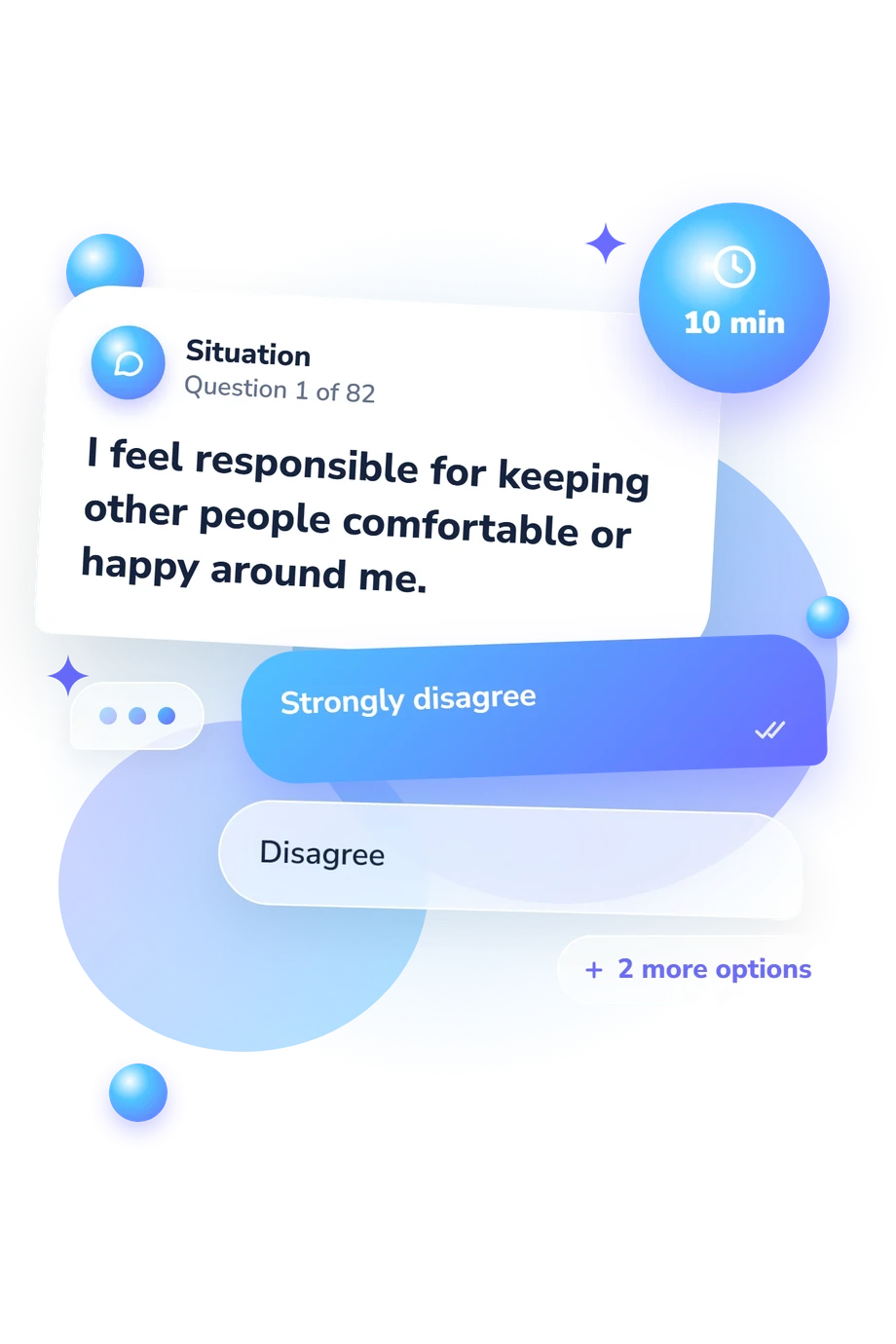
Example Questions From the Test
- Strongly disagree
- Disagree
- Not sure
- Agree
- Strongly disagree
- Disagree
- Not sure
- Agree
- Strongly disagree
- Disagree
- Not sure
- Agree
Personality Complex Test - Description and methodology of the test
People who want to understand why certain reactions recur in relationships, decisions, or achievement may find the personality complex test useful for structured self-reflection. This online questionnaire offers a snapshot of current self-reported tendencies across three patterns, helping respondents notice how they respond under interpersonal or performance pressure. It can also give a starting point for discussing personality pattern assessment results and habits that feel difficult to change.
What This Assessment Explores
The questionnaire examines how approval shapes relationships, how people manage uncertainty and shared control, and how high standards may connect with fear of failure. This personality complex questionnaire touches on people-pleasing, delegation, worst-case anticipation, rechecking, indecision, and self-criticism. Each pattern has a distinct meaning: approval-seeking concerns acceptance and reassurance; control-trust concerns control-driven reactions versus trust and flexibility; perfectionism-fear of failure concerns perfectionistic pressure and fear of failure.
Its three displayed patterns are:
- Approval-Seeking Pattern (0-30) shows how strongly validation shapes choices: Low 0-10, Moderate 11-20, High 21-30 indicate increasing reassurance needs and criticism sensitivity.
- Control-Trust Pattern (0-30) shows control-driven reactions versus trust: Trust-leaning 0-10, Balanced 11-20, Control-leaning 21-30 indicate increasing certainty-seeking.
- Perfectionism-Fear of Failure Pattern (0-30) shows perfectionistic pressure and fear of failure: Adaptive standards 0-10, Elevated pressure 11-20, Intense perfectionism 21-30 indicate increasing self-criticism.
Methodology and Scientific Basis
Statements use four response choices in varying agreement formats. Across items, choices include Strongly disagree, Disagree, Agree, Strongly agree, and sometimes Not sure; respondents give self-report judgments about usual reactions. Responses feed three pattern scores, but the questionnaire does not state item weights, reverse scoring, or normative conversion, so those mechanics should not be inferred from displayed ranges.
This questionnaire has conceptual contact with published work on related constructs. Yosopov and colleagues examine perfectionism, fear of failure, overgeneralization of failure, and procrastination; Larsen’s work addresses approval seeking; Rotter’s model concerns interpersonal trust; and Frost’s instrument describes perfectionism dimensions. These sources provide conceptual comparison only; they do not establish that this questionnaire reproduces or adapts any one instrument.
Results from a personality complex assessment show the displayed level for each pattern, and each score should be read within its own definition and band rather than ranked across the three scales. No norms, reliability estimates, or clinical cutoffs are reported, and scores may shift with current stress, recent experiences, self-awareness, or impression management. A result therefore does not establish a personality disorder.
- Yosopov, Lital, Donald H. Saklofske, Martin M. Smith, Gordon L. Flett, and Paul L. Hewitt. "Failure Sensitivity in Perfectionism and Procrastination: Fear of Failure and Overgeneralization of Failure as Mediators of Traits and Cognitions." Journal of Psychoeducational Assessment 42, no. 6 (2024): 705-724. 10.1177/07342829241249784
- Larsen, Knud S., Harry J. Martin, Richard H. Ettinger, and Joan Nelson. "Approval Seeking, Social Cost, and Aggression: A Scale and Some Dynamics." The Journal of Psychology 94, no. 1 (1976): 3-11. 10.1080/00223980.1976.9921389
- Frost, Randy O., Patricia Marten, Cathleen Lahart, and Robin Rosenblate. "The Dimensions of Perfectionism." Cognitive Therapy and Research 14 (1990): 449-468. 10.1007/BF01172967
- Rotter, Julian B. "A New Scale for the Measurement of Interpersonal Trust." Journal of Personality 35, no. 4 (1967): 651-665. 10.1111/j.1467-6494.1967.tb01454.x
Updated: