
Preppy Quiz
How the Scales are Structured
Who Usually Takes This Test?
See How You Compare
Below is a preview of how scores are typically distributed across each scale.
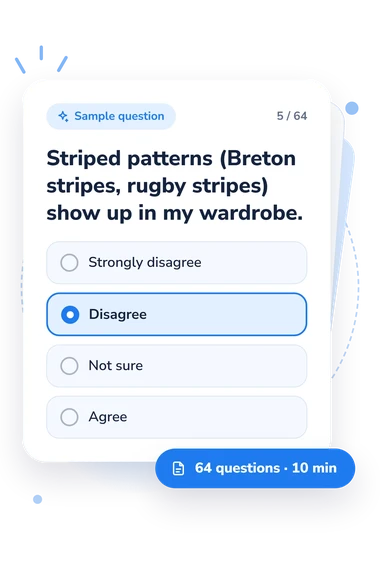
Example Questions From the Test
- Strongly disagree
- Disagree
- Agree
- Strongly agree
- Strongly disagree
- Disagree
- Agree
- Strongly agree
- Strongly disagree
- Disagree
- Not sure
- Agree
Preppy Quiz - Description and methodology of the test
People who want to understand whether their wardrobe and preferences communicate a polished, collegiate, or coastal sensibility can use this preppy quiz as a structured style reflection. It suits anyone comparing classic and trend-led prep, or naming an aesthetic that appears across clothing, routines, social plans, and leisure. As a preppy test, it turns recurring choices into a profile of visual direction, lifestyle alignment, and overall consistency.
What This Assessment Explores
Across clothing, grooming, routines, social plans, and leisure, the items look for recurring prep cues such as stripes, loafers, classic colors, etiquette, coastal activities, campus settings, and sporty or trend-led combinations. For readers wondering whether they are preppy, the useful question is how consistently these signals appear together. The three dimensions are:
- Classic vs Modern Prep (0-20) shows whether choices lean traditional or updated; Classic Prep 0-7, Balanced Blend 8-13, Modern Prep 14-20.
- Lifestyle Prep Vibe (0-20) reflects grooming, routines, hobbies, and social preferences; Low prep vibe 0-6, Moderate prep vibe 7-13, High prep vibe 14-20.
- Preppiness Index (0-40) summarizes how consistently classic staples and understated patterns shape the wardrobe; Light Prep Influence 0-13, Modern Prep Mix 14-26, Strongly Preppy 27-40.
Methodology and Evidence Base
Responses combine agreement choices with frequency options such as never, sometimes, often, and almost always; some items also allow “not sure.” Respondents judge personal habits, preferences, and imagined situations.
The questionnaire displays ranges and bands, but not answer points or unequal weighting. These describe reporting, not a scoring formula reconstructed by inspection.
Conceptually, the assessment is consistent with prep as an aesthetic language and social identity, not an adaptation of a published instrument. Banks and de La Chapelle (2011) provide the closest reference for heritage garments, Ivy associations, and contemporary reinterpretations. Lingala (2013) places prep within a cultural style with socioeconomic meaning, while Feinberg, Mataro, and Burroughs (1992) support reading clothing as social identity.
In this format, the result is a descriptive profile rather than a standardized scale or clinical diagnosis, even when it is used to ask whether you are preppy. The online format has no stated norms, and responses can shift with wardrobe access, local culture, mood, or changing taste. Tourangeau, Rips, and Rasinski (2000) explain how self-report is affected by memory, context, and self-presentation. Read as a how-preppy-are-you quiz, it offers a reflection prompt for comparing the result with your own choices.
- Banks, Jeffrey, and Doria de La Chapelle. Preppy: Cultivating Ivy Style. New York: Rizzoli, 2011.
- Lingala, Anu. The Origin and Evolution of "Prep" and its Socioeconomic Relevance. Honors thesis, Cornell University, 2013.
- Feinberg, Richard A., Lisa Mataro, and W. Jeffrey Burroughs. "Clothing and Social Identity." Clothing and Textiles Research Journal, 11(1), 1992, pp. 18-23. 10.1177/0887302X9201100103
- Tourangeau, Roger, Lance J. Rips, and Kenneth Rasinski. The Psychology of Survey Response. Cambridge University Press, 2000. 10.1017/CBO9780511819322