
Who Is My Guardian Angel Quiz
How the Scales are Structured
Who Usually Takes This Test?
See How You Compare
Below is a preview of how scores are typically distributed across each scale.
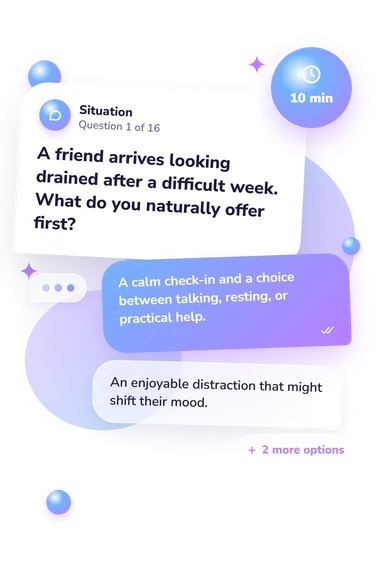
Example Questions From the Test
- A calm check-in and a choice between talking, resting, or practical help.
- An enjoyable distraction that might shift their mood.
- Space to recover without having to discuss what happened.
- A plan for addressing the main problem when they feel ready.
- Build a framework that shows how the main ideas connect.
- Begin with a hands-on example and pick up concepts as needed.
- Discuss it with people who bring different perspectives.
- Learn only the parts that serve my immediate purpose.
- Completing one useful task so I regain a sense of momentum.
- Spending unstructured time resting and tending to basic needs.
- Changing scenery and seeking something lively or stimulating.
- Talking with someone who helps me process the experience.
Who Is My Guardian Angel Quiz - Description and methodology of the test
People drawn to symbolic self-reflection can use this guardian angel quiz to explore guidance, courage, care, and insight. This symbolic guardian-angel questionnaire suits readers seeking language for personal values and ways of responding. The Who Is My Guardian Angel Quiz turns that interest into a comparative profile of symbolic affinities, not a claim about identity or ability.
What This Assessment Explores
Four symbolic responses organize the profile: meaning, protection, recovery, and understanding. The central question behind who is your guardian angel quiz is treated as a comparison of affinities, not an identification of one angel or an ability rating. Readers can notice recurring themes in their choices across four dimensions. The four dimensions are:
- Archangel Gabriel - Expressive Guidance (0-12) reflects communication, creative expression, and truth-telling: Reserved Messenger (0-4), Thoughtful Communicator (5-8), Inspired Messenger (9-12).
- Archangel Michael - Courageous Protection (0-12) reflects courage, boundaries, loyalty, and protection: Quiet Strength (0-4), Steady Defender (5-8), Courageous Protector (9-12).
- Archangel Raphael - Restorative Care (0-12) reflects compassion, renewal, support, and restoration: Independent Restorer (0-4), Supportive Presence (5-8), Restorative Companion (9-12).
- Archangel Uriel - Reflective Wisdom (0-12) reflects insight, discernment, learning, and perspective: Experiential Seeker (0-4), Practical Thinker (5-8), Insightful Illuminator (9-12).
Methodology and Scientific Basis
Each item presents an imagined situation involving relationships, learning, recovery, communication, or difficult decisions, followed by four possible responses. Choosing the option that feels most natural creates a pattern across the four dimensions. Score bands show lower, middle, or higher symbolic affinity, and scores within one point appear as blended affinity; the questionnaire does not state a fixed point value for each answer.
The catalogue defines these four symbolic scales. 1 Enoch, Jung’s archetypal writing, and Keck’s work on medieval angelic imagery offer contextual parallels for angelic roles and symbolic figures; they do not establish this questionnaire’s dimensions, scoring, or validity. The quiz explores which qualities might resonate when a person asks who's my guardian angel quiz.
Use the profile for self-observation: current stress, relationships, self-perception, and the imagined situation can shape choices. The question what is my guardian angel quiz becomes a comparison of affinities, not a single identity. Read close scores as blended affinities rather than a winner. The questionnaire has no normative reference group or clinical validation.
- Nickelsburg, George W. E., and James C. VanderKam, translators. 1 Enoch: The Hermeneia Translation. Minneapolis: Fortress Press, 2012.
- Jung, C. G. The Archetypes and the Collective Unconscious. 2nd ed. Princeton: Princeton University Press, 1968.
- Keck, David. Angels & Angelology in the Middle Ages. Oxford: Oxford University Press, 1998. DOI 10.1093/oso/9780195110975.001.0001.