
Which Woman of the Bible Are You Quiz
How the Scales are Structured
Who Usually Takes This Test?
See How You Compare
Below is a preview of how scores are typically distributed across each scale.
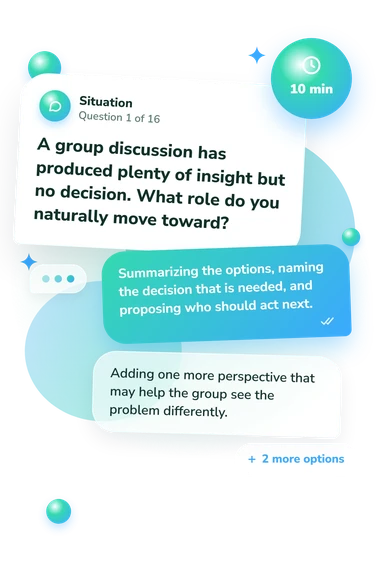
Example Questions From the Test
- Listen for the underlying pattern, weigh both accounts, and offer a clear conclusion with reasons.
- Help each person express their position, but leave the conclusion entirely to them.
- Focus on a workable compromise that lets everyone move forward quickly.
- Suggest a neutral process or another mediator rather than becoming the decision-maker.
- Summarizing the options, naming the decision that is needed, and proposing who should act next.
- Adding one more perspective that may help the group see the problem differently.
- Checking privately with others before supporting the direction with the widest agreement.
- Taking responsibility for one useful task without trying to steer the whole group.
- Helping the affected people organize and speak collectively rather than becoming their representative.
- Preparing a persuasive case and using my access, even though doing so may put my position at risk.
- Contributing practical help after the decision rather than entering a political situation.
- Challenging the decision immediately so that my opposition is unmistakable.
Which Woman of the Bible Are You Quiz - Description and methodology of the test
Readers who enjoy biblical narratives and want to connect them with everyday choices may find this exercise useful when considering their responses to complex situations. The Which Woman of the Bible Are You Quiz lets readers compare its result with everyday choices, relationships, decisions, and responses to changing circumstances. As a Bible character quiz, it helps readers consider how they handle pressure, relationships, and change.
What This Assessment Explores
The situations cover judgment, group direction, personal risk, testimony, devotion, adaptation, caregiving, and quiet presence during hardship. The result from this woman of the Bible quiz offers a symbolic reflection on leadership, courage, conviction, and commitment.
These are the four result dimensions:
- Deborah - Decisive Leadership (0-12) measures clear judgment and responsibility; bands are Supporting Influence 0-4, Situational Leader 5-8, and Deborah Affinity 9-12.
- Esther - Strategic Courage (0-12) measures timing, influence, and purposeful courage; bands are Direct Path 0-4, Emerging Strategist 5-8, and Esther Affinity 9-12.
- Mary Magdalene - Devoted Witness (0-12) measures faithful presence and speaking about transformative truths; bands are Private Conviction 0-4, Steady Believer 5-8, and Mary Magdalene Affinity 9-12.
- Ruth - Steadfast Commitment (0-12) measures loyalty, adaptation, and practical care; bands are Independent Route 0-4, Reliable Companion 5-8, and Ruth Affinity 9-12.
Methodology and Evidence Base
The questionnaire presents self-report scenarios with four response options. They cover disputes, uncertain group decisions, costly advocacy, profound experiences, relocation, caregiving, and sustained commitment. Choosing the response closest to your usual approach lets the result compare patterns across the profiles without a single correct answer.
Each profile shows a 0-12 total and named band; item-to-score weighting is not stated. Scores within one point indicate a blended affinity; for Esther, the highest is the strongest affinity.
The approach is a biblical-character affinity quiz using narrative reflection across four profiles. Conceptually, the questionnaire is consistent with Wolmark and Friedman (2021), who discuss Deborah, Esther, and Ruth in biblical leadership; this questionnaire is not an adaptation of that study. Biblical narratives provide the interpretive frame. Schroeder (2014) helps situate Deborah’s leadership within changing debates about women’s authority, and Kitzberger (1995) supports a narrative-critical reading of Mary Magdalene as a characterized witness.
The online self-report tool has no stated standardised norms, reliability estimate, or diagnostic cutoff. Results may reflect current context, self-awareness, and response style alongside more enduring tendencies.
- Wolmark, Miles, and Linda Weiser Friedman. “Lessons in Leadership: Female Leaders in the Bible.” SSRN, 2021. 10.2139/ssrn.3790051.
- New Revised Standard Version Updated Edition. National Council of the Churches of Christ in the United States of America, 2021.
- Schroeder, Joy A. Deborah’s Daughters: Gender Politics and Biblical Interpretation. Oxford University Press, 2014. 10.1093/acprof:oso/9780199991044.001.0001.
- Kitzberger, Ingrid Rosa. “Mary of Bethany and Mary of Magdala-Two Female Characters in the Johannine Passion Narrative: A Feminist, Narrative-Critical Reader-Response.” New Testament Studies, vol. 41, no. 4, 1995, pp. 564-586. 10.1017/S0028688500021706.