
What Rapper Am I Quiz
How the Scales are Structured
Who Usually Takes This Test?
See How You Compare
Below is a preview of how scores are typically distributed across each scale.
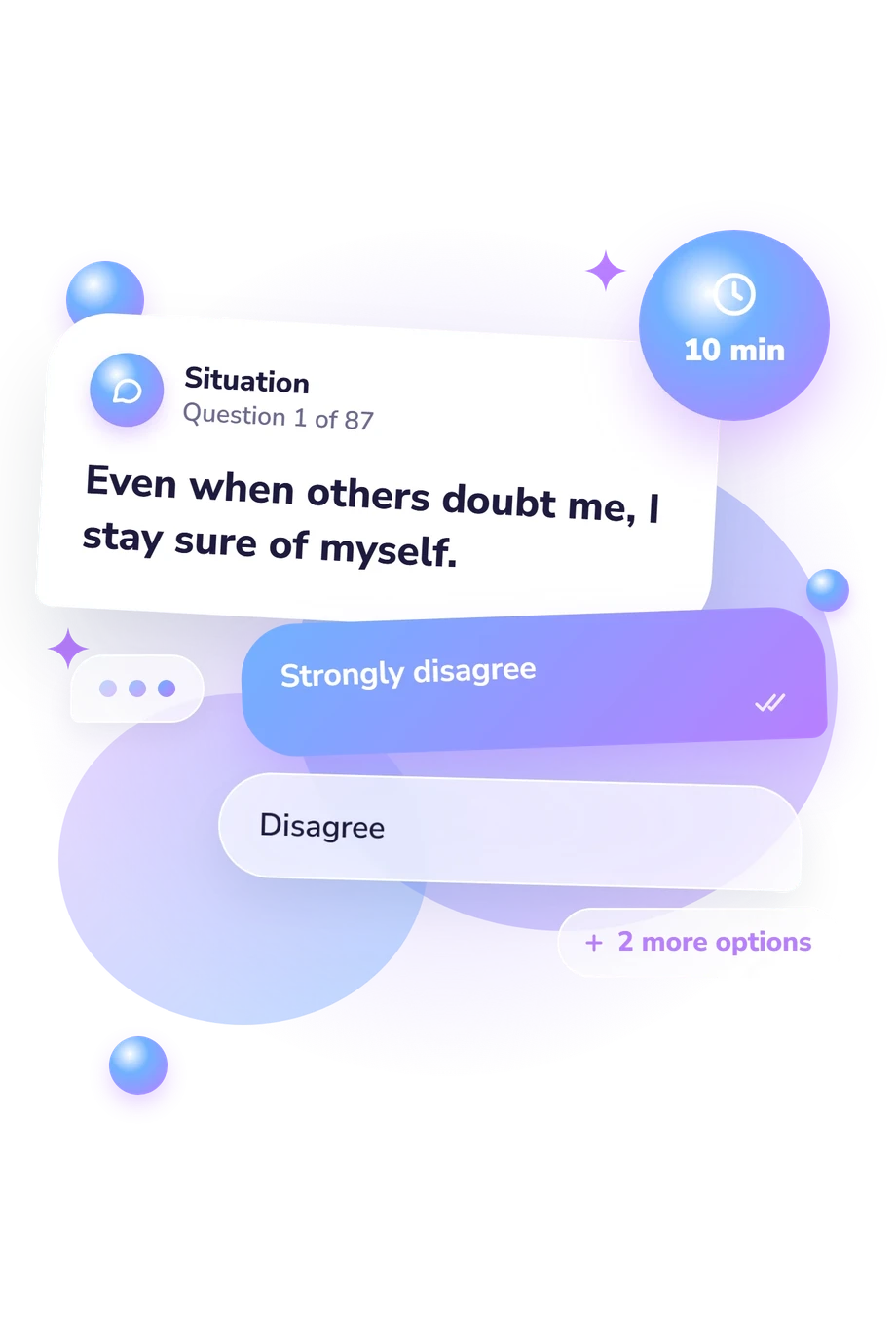
Example Questions From the Test
- Strongly disagree
- Disagree
- Not sure
- Agree
- Strongly disagree
- Disagree
- Not sure
- Agree
- Strongly disagree
- Disagree
- Not sure
- Agree
What Rapper Am I Quiz - Description and methodology of the test
People drawn to rap culture, self-expression, or playful personality results can use the What Rapper Am I Quiz to explore the qualities behind an imagined artist persona. It is designed for anyone curious about how confidence, originality, and social involvement combine in their responses. Framed as a what rapper are you quiz, it offers a light starting point for reflecting on the style and presence you project.
What This Assessment Explores
The statements examine how you present yourself, generate ideas, and connect with other people. They touch on self-belief, originality, imagery, brainstorming, collaboration, social plans, crowds, and community involvement. The result describes a playful rap personality quiz profile, not musical ability or a prediction of success.
The displayed dimensions are:
- Confidence & Swagger (0-30) measures bold, self-assured, and unbothered energy; Low-Key (0-10), Confident (11-20), and Big Swagger (21-30) indicate progressively stronger presence.
- Creative Expression (0-30) measures originality, artistry, and self-expression; Straightforward (0-10), Expressive (11-20), and Highly Original (21-30) indicate increasingly distinctive styles.
- Social Energy (0-30) measures outgoing, networked, and community-oriented tendencies; Low Social Energy (0-12), Moderate Social Energy (13-22), and High Social Energy (23-30) indicate increasing sociability.
Together, the profile shows which qualities are most prominent in your answers and how your imagined artist identity balances presence, creativity, and connection.
Methodology and Evidence Base
The response format uses four choices, from stronger disagreement toward agreement, with the middle wording varying between Not sure, Agree, and Strongly agree. This self-report method captures perceived tendencies rather than observed performance. Answers are combined into the three displayed dimensions, but no item-weighting formula is stated, so the ranges and bands describe the questionnaire’s reporting structure rather than a norm system.
Its evidence base is conceptual. Rentfrow and Gosling (2003) connect music preferences with broader personality-related patterns; Soto and John (2009) demonstrate how self-report personality facets can be distinguished; and Rosenberg (1965) provides a relevant reference for self-image and social presentation. This questionnaire is conceptually consistent with those works, not an adaptation or validation of them.
For someone taking the rapper personality test, the result is best read as a snapshot of current self-perception. Higher or lower profiles indicate stronger or weaker tendencies on the named dimensions, not lyrical skill, career potential, or a fixed identity. Honest responding, self-awareness, mood, and context can influence the outcome, and these scores are not presented with population norms or clinical validation.
- Rentfrow, Peter J., and Samuel D. Gosling. (2003). The Do Re Mi's of Everyday Life: The Structure and Personality Correlates of Music Preferences. Journal of Personality and Social Psychology, 84(6), 1236-1256. 10.1037/0022-3514.84.6.1236
- Soto, Christopher J., and Oliver P. John. (2009). Ten Facet Scales for the Big Five Inventory: Convergence with NEO PI-R Facets, Self-Peer Agreement, and Discriminant Validity. Journal of Research in Personality, 43(1), 84-90. 10.1016/j.jrp.2008.10.002
- Rosenberg, Morris. (1965). Society and the Adolescent Self-Image. Princeton University Press.
Updated: