
What Pizza Am I Quiz
How the Scales are Structured
Who Usually Takes This Test?
See How You Compare
Below is a preview of how scores are typically distributed across each scale.
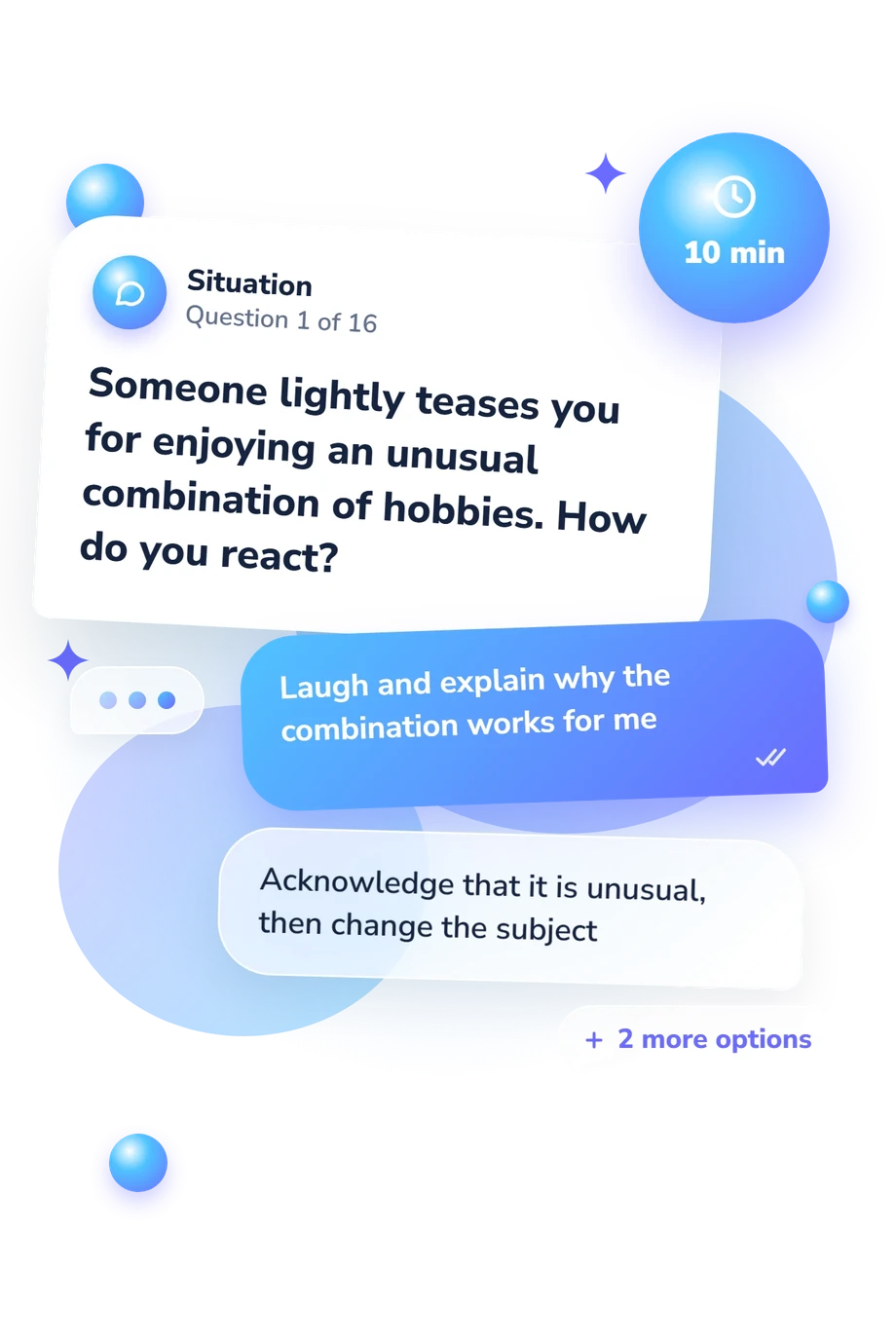
Example Questions From the Test
- Laugh and explain why the combination works for me
- Acknowledge that it is unusual, then change the subject
- Share one interesting connection between the hobbies
- Keep the hobbies separate when talking with that person
- A reliable item from a brand they already like
- A useful gift with a subtle personal reference
- A quirky surprise tied to an inside joke
- A gift card presented with a thoughtful note
- A tasting-style experience with several regional dishes
- One renowned local specialty served at a focused restaurant
- A neighborhood place offering a broad but manageable menu
- A popular spot chosen mainly for its atmosphere
What Pizza Am I Quiz - Description and methodology of the test
For readers who enjoy playful personality-style questions, the What Pizza Am I Quiz turns familiar choices into a symbolic profile of their tastes and tendencies. People wondering what pizza they are may especially enjoy its scenario-based format, making it a what pizza are you quiz for light self-reflection rather than specialist knowledge.
What This Assessment Explores
Scenarios about novelty, social energy, simplicity, creativity, and variety connect preferences with symbolic pizza styles. Together, they make this a what kind of pizza am i quiz about everyday tendencies, not personality itself.
The four displayed scales and their bands are:
- Hawaiian (0-12) measures openness: Familiar Recipe (0-4) favors convention, Unexpected Twist (5-8) welcomes originality, and Playful Hawaiian (9-12) embraces surprise.
- Margherita (0-12) measures a continuum from stimulation, novelty, and complexity to stripped-back authenticity: Extra Toppings (0-4) favors the stimulating side, Balanced Slice (5-8) welcomes variety with comfort, and Classic Margherita (9-12) favors authenticity and calm confidence.
- Pepperoni (0-12) measures social energy: Mellow Flavor (0-4) is measured, Social Spark (5-8) is warm, and Bold Pepperoni (9-12) is expressive.
- Veggie Supreme (0-12) measures variety: Focused Selection (0-4) favors clarity, Curious Mix (5-8) welcomes variety, and Veggie Supreme (9-12) embraces exploration.
Methodology and Scientific Basis
Each item presents an everyday scenario with four response options. Choices differ in emphasis rather than correctness, allowing respondents to answer from recognition instead of calculating a socially desirable result.
The result displays four outcome scores. The highest is the strongest pizza affinity; any outcome within one point contributes to a blended result. The displayed ranges and bands describe this questionnaire’s own interpretive scheme.
The four displayed scales function as a questionnaire-specific profile; the cited studies do not define its scales or scoring. Eertmans et al. (2005) examine food-related personality traits and intake; Nezlek and Forestell (2019) address food neophobia and personality; and Goldberg and Strycker (2002) examine food preferences alongside individual differences. Together, these studies provide context but do not establish validity or norms for this online questionnaire.
As a pizza personality quiz, it is most useful when answers reflect usual tendencies rather than one unusual day. Self-report can be shaped by mood, memory, self-awareness, and the wish to present oneself favorably, so an unexpected result invites reflection rather than defining you. It is not a clinical diagnosis.
- Eertmans, A., Victoir, A., Vansant, G., & Van den Bergh, O. (2005). Food-related personality traits, food choice motives and food intake: Mediator and moderator relationships. Food Quality and Preference, 16(8), 714-726. 10.1016/j.foodqual.2005.04.007
- Nezlek, J. B., & Forestell, C. A. (2019). Food neophobia and the Five Factor Model of personality. Food Quality and Preference, 73, 210-214. 10.1016/j.foodqual.2018.11.007
- Goldberg, L. R., & Strycker, L. A. (2002). Personality traits and eating habits: The assessment of food preferences in a large community sample. Personality and Individual Differences, 32(1), 49-65. 10.1016/S0191-8869(01)00005-8
Updated: