
What Meme Are You Quiz
How the Scales are Structured
Who Usually Takes This Test?
See How You Compare
Below is a preview of how scores are typically distributed across each scale.
Example Questions From the Test
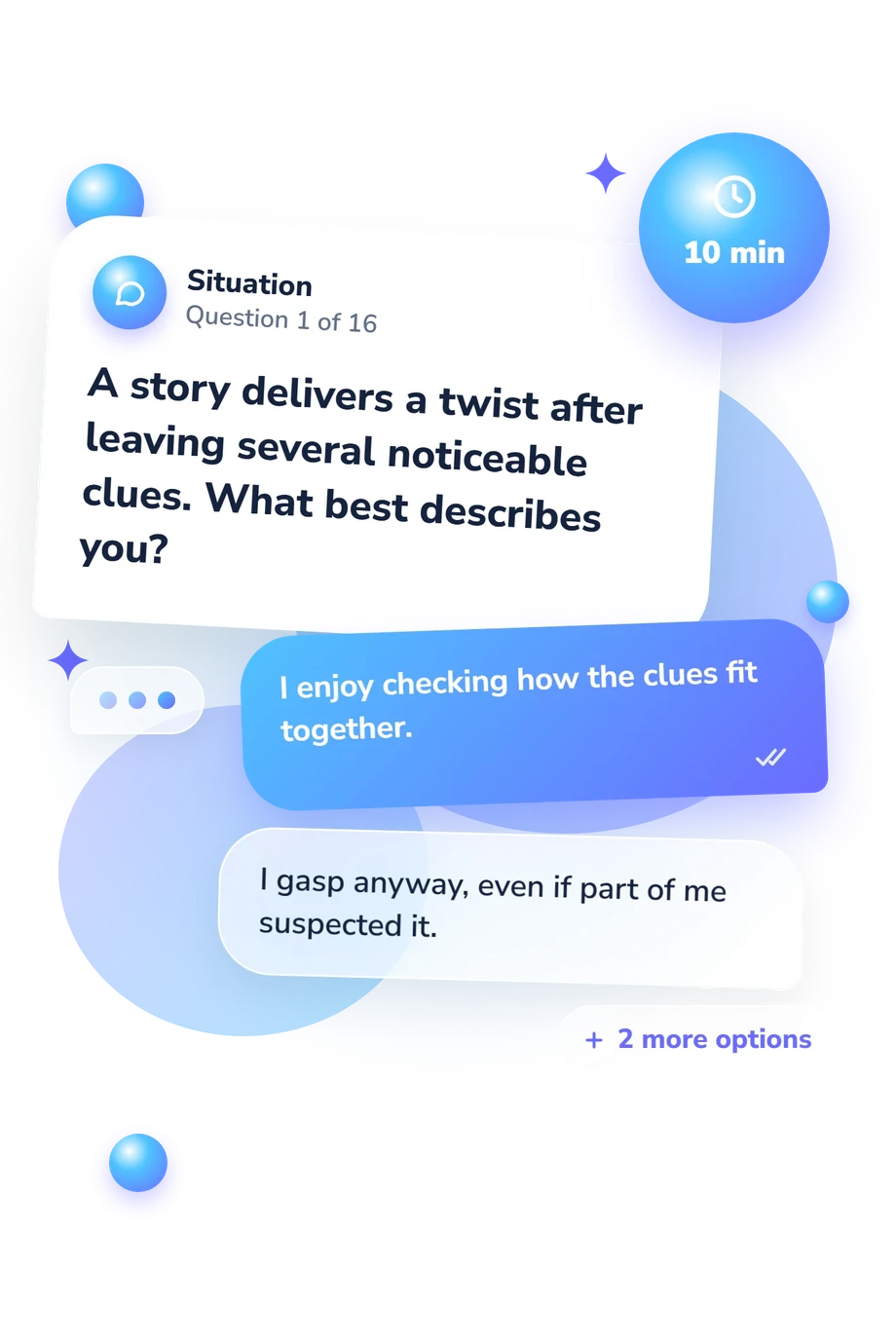
- I enjoy checking how the clues fit together.
- I gasp anyway, even if part of me suspected it.
- I react strongly at first and then explain what I had predicted.
- I appreciate the reveal without much outward reaction.
- As a practical lesson about preparing earlier next time.
- As a dramatic sequence in which everything went wrong.
- As a manageable mishap that was annoying in the moment.
- As a deadpan scene where I calmly watched my evening collapse.
- A small burst of triumph before I finish the remaining details.
- Relief, followed by checking whether the result is reliable.
- I simply continue; solving it was the point.
- I tell someone it worked, but keep the celebration modest.
What Meme Are You Quiz - Description and methodology of the test
People curious about how they come across in ordinary social moments may find this lighthearted what meme am i quiz a useful prompt for noticing expressive habits. The What Meme Are You Quiz draws attention to quick reactions, ways of handling disruption, responses to small wins, and the degree of contrast in personal preferences. Its profile gives these patterns a playful vocabulary for reflection and conversation.
What This Assessment Explores
The questionnaire explores reactions to surprise, chaos, frustration, small success, and sharply contrasting preferences. Its result groups situations by expressive tendencies: visible surprise, progress celebration, decisive taste, and understatement during disruption. Four displayed meme styles organize this meme personality quiz around distinct expressive patterns:
- Drake Hotline Bling (0-12) reflects approval-versus-rejection reactions and confident taste, from Nuanced Chooser (0-4) through Selective Reactor (5-8) to Drake Energy (9-12).
- Success Kid (0-12) reflects determined effort and satisfaction in small wins, from Quiet Progress (0-4) through Steady Achiever (5-8) to Success Kid Energy (9-12).
- Surprised Pikachu (0-12) reflects visible astonishment, including when an outcome was partly expected: Measured Observer (0-4), Expressive Witness (5-8), and Surprised Pikachu Energy (9-12).
- This Is Fine (0-12) reflects dry understatement and composure during disruption, from Direct Responder (0-4) to Calm Commentator (5-8) and This Is Fine Energy (9-12).
Methodology and Scientific Basis
Each item presents an everyday situation with four response choices. Selecting the most natural reaction distinguishes patterns such as visible surprise, practical adjustment, dramatic contrast, quiet observation, and deadpan humor.
The questionnaire reports four displayed affinity scales, with each result band showing a degree of stylistic fit within its scale. As a meme style quiz, the format turns everyday reactions into a readable profile of expressive tendencies.
The questionnaire has conceptual parallels with work by Vandelanotte on emotional dimensions in memes and Schiazza on individual differences in meme engagement. Wong and Holyoak's work, alongside Shifman's research, further situates memes as carriers of emotional, cognitive, and social meaning. These publications provide conceptual background; they do not establish a named framework, validate this questionnaire, or support its four custom scales.
It is an original self-reflection format without established population norms. Readers can compare the profile with their reactions in ordinary situations and notice which expressive patterns feel most characteristic.
- Vandelanotte, Lieven. 2026. "Emotional dimensions in the linguistic analysis of internet memes." Language Sciences 116: 101829. 10.1016/j.langsci.2026.101829
- Schiazza, Giovanni. 2023. "Measuring Internet Meme engagement and individual differences: a novel scale and its correlates." International Journal of Population Data Science 8(3), Article 11. 10.23889/ijpds.v8i3.2276
- Wong, Emily F., and Keith J. Holyoak. 2021. "Cognitive and motivational factors driving sharing of internet memes." Memory & Cognition 49(5): 863-872. 10.3758/s13421-020-01134-1
- Shifman, Limor. 2013. Memes in Digital Culture. Cambridge, MA: The MIT Press.
Updated: