
What Boat Is Right for Me Quiz
How the Scales are Structured
Who Usually Takes This Test?
See How You Compare
Below is a preview of how scores are typically distributed across each scale.
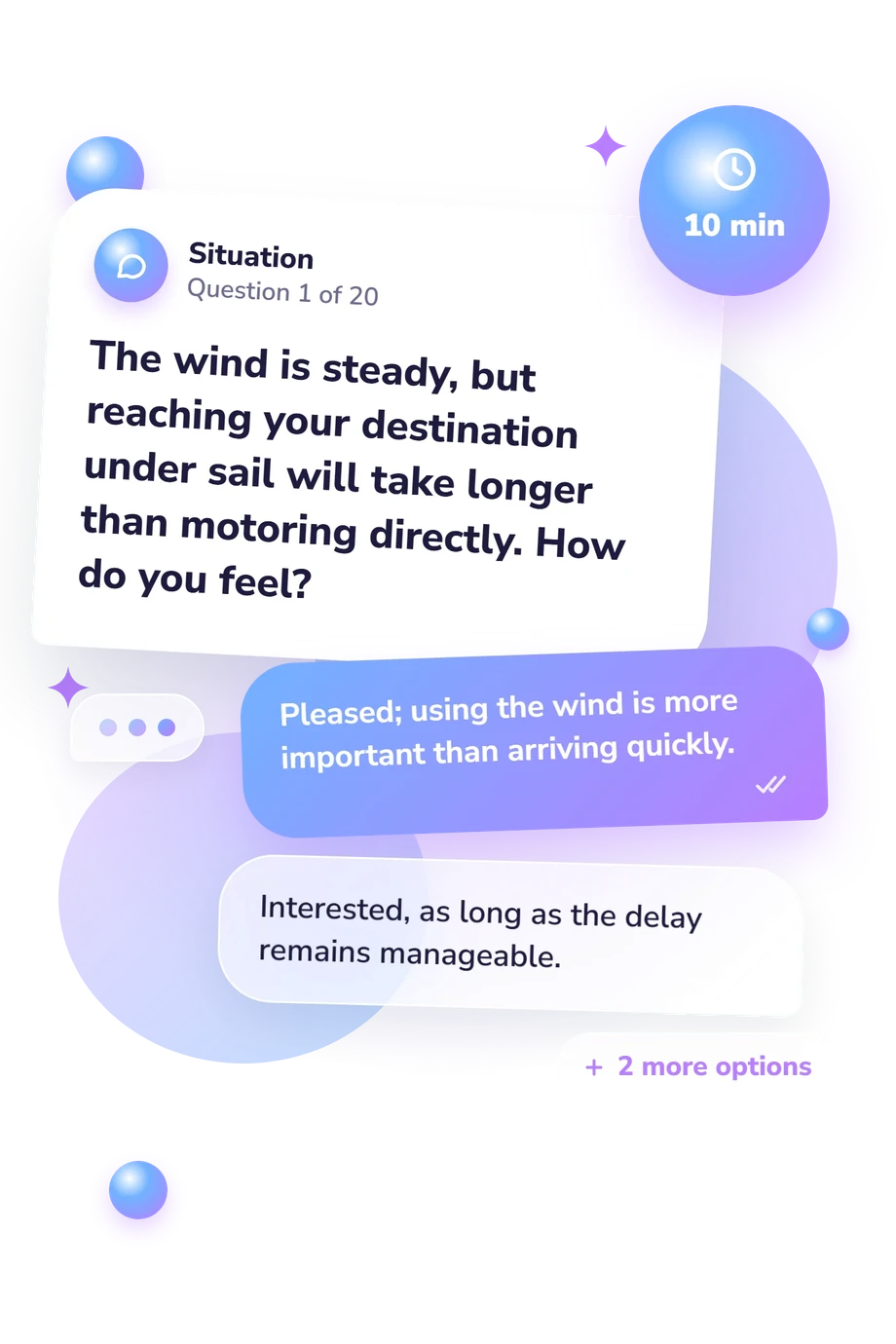
Example Questions From the Test
- Sleep aboard and turn the journey into a short getaway.
- Spend one night aboard if the cabin is comfortable enough.
- Take a long day trip and return home to sleep.
- Keep each outing brief and avoid planning around accommodation.
- A broad lounge layout with abundant casual seating.
- Mostly social seating, with a small area available for casting.
- A workable balance of seating and open fishing space.
- Washable, uncluttered deck space with dedicated fishing features.
- Rarely; I prefer open deck space and simple systems.
- Occasionally, mainly for convenience on longer days.
- Regularly enough that several of those amenities would matter.
- Frequently; they are central to the experience I want.
What Boat Is Right for Me Quiz - Description and methodology of the test
For people comparing preferences, the What Boat Is Right for Me Quiz helps you compare boat types whose features align with your stated priorities. It is useful when you are deciding what kind of boat to buy and want to compare social outings, fishing, sailing, speed, or overnight comfort. The result gives you a preference profile showing how those priorities align with different boating experiences.
What This Assessment Explores
As a what kind of boat should I buy quiz, your result maps social, fishing, sailing, speed, and overnight comfort.
Profiles include:
- Bowrider (0-12) rates open-bow interest; Different Priorities (0-4), Possible Match (5-8), and Strong Match (9-12) indicate social cruising and watersports.
- Cabin Cruiser (0-12) rates overnight comfort; Different Priorities (0-4), Possible Match (5-8), and Strong Match (9-12) indicate cabin use and shelter.
- Center Console (0-12) rates fishing utility; Different Priorities (0-4), Possible Match (5-8), and Strong Match (9-12) indicate angling access.
- Pontoon (0-12) rates group comfort; Different Priorities (0-4), Possible Match (5-8), and Strong Match (9-12) indicate spacious social days.
- Sailboat (0-12) rates sailing affinity; Different Priorities (0-4), Possible Match (5-8), and Strong Match (9-12) indicate technical enjoyment.
Methodology and Evidence Base
Each item presents a boating situation with four response options. Choices weigh speed against sailing, open space against shelter, and fishing utility against group comfort, so the method matches preferences rather than technical knowledge.
Responses combine into five affinity profiles, not one universally correct answer. Labels indicate lower, intermediate, or higher alignment; scores within one point form a blended result. The questionnaire has no population norms or standardized cutoffs, so its displays and bands organize personal preferences for comparison. The boat type quiz should therefore be read in light of the situations it covers.
Conceptually, the structure is consistent with Kyle's study of recreational boating motivations, Potts's work on lifestyle segmentation, and Dalton's research on trip preferences. It is not an adaptation or validation of those studies or instruments. Self-report answers may shift with plans, companions, budget, experience, or imagined use, so priorities should guide interpretation.
- Kyle, Gerard T., Scott Shafer, Michael A. Schuett, Yung Ping Tseng, Tim Bradle, Jim Richardson, Alan Graefe, Mark Ivy, and James Absher. (2009). A Study of Recreational Boating on Lake Travis, Texas. Lower Colorado River Authority, Austin, TX.
- Potts, Thomas D. (1992). Recreational Boaters: A Life Style Segmentation Analysis. Visions in Leisure and Business, 10(4), Article 4.
- Dalton, Tracey, Michael Weir, Aislyne Calianos, Nelle D'Aversa, and Julia Livermore. (2020). Recreational boaters' preferences for boating trips associated with offshore wind farms in US waters. Marine Policy, 122, 104216. 10.1016/j.marpol.2020.104216
Updated: