
Veterans Day Quiz
How the Scales are Structured
Who Usually Takes This Test?
See How You Compare
Below is a preview of how scores are typically distributed across each scale.
Example Questions From the Test
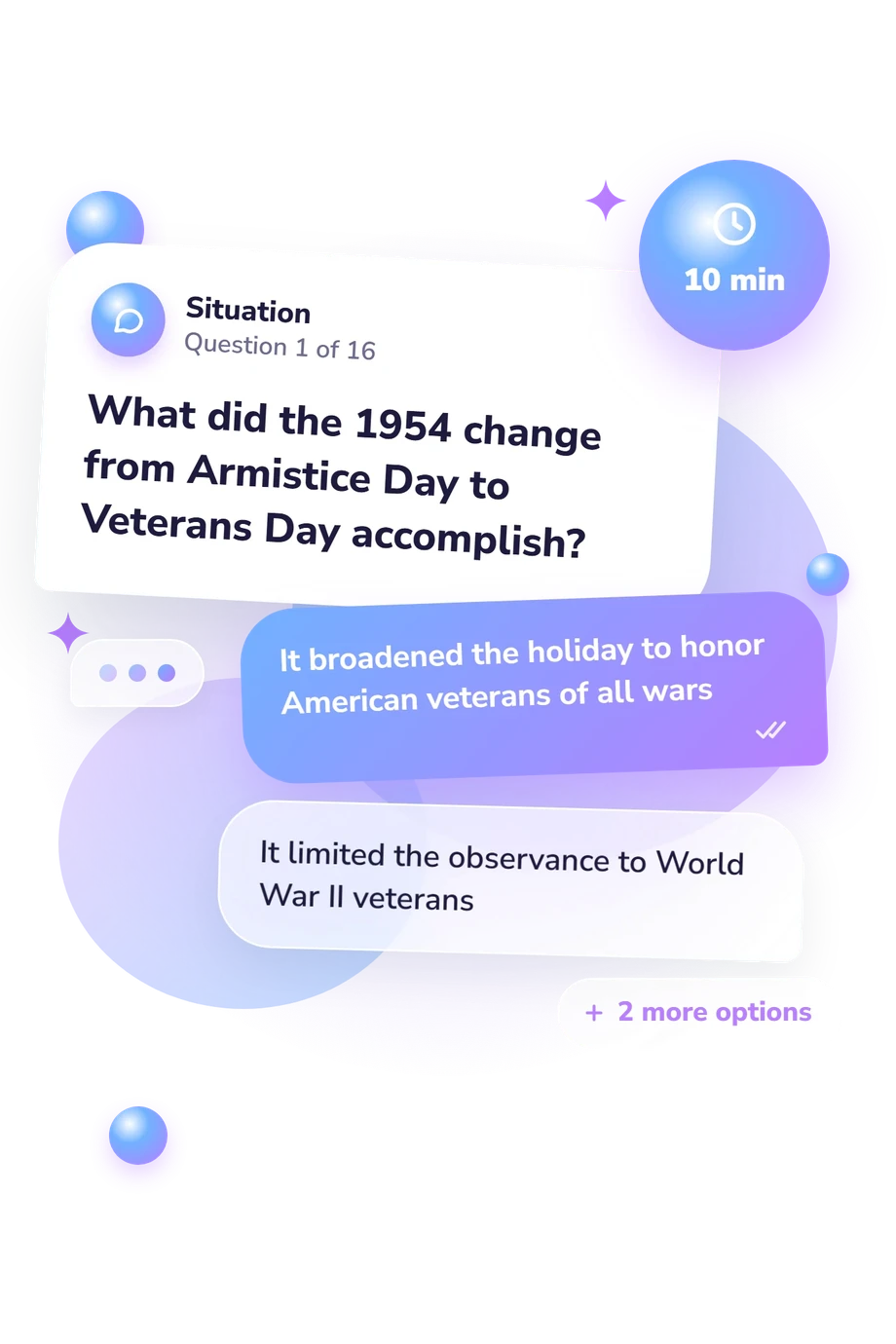
- It broadened the holiday to honor American veterans of all wars
- It limited the observance to World War II veterans
- It turned the observance into a state holiday only
- It moved the holiday permanently to a Monday
- Armistice Day
- Decoration Day
- Victory Day
- Remembrance Sunday
- July 4
- The last Monday in May
- The third Saturday in May
- November 11
Veterans Day Quiz - Description and methodology of the test
Readers who want to understand the U.S. holiday can use the Veterans Day Quiz to review its history, purpose, and place in the federal calendar. It suits students, educators, veterans, families, and anyone preparing for a respectful observance. As a Veterans Day history quiz, it shows which facts you recognize and which parts of the tradition merit another look.
What the Questionnaire Measures
The questionnaire checks how Veterans Day developed, what it commemorates, when it is observed, and how it differs from Memorial Day and Armed Forces Day. It also covers federal-holiday practice, Arlington National Cemetery, the Tomb of the Unknown Soldier, 11:00 a.m. symbolism, the 1918 armistice, and remembrance traditions.
Its quiz-and-answers format about Veterans Day uses short scenarios with four alternatives. Respondents select the best-supported answer rather than express an opinion or recall personal experience, making it suitable for learners and adults checking U.S. holiday knowledge.
The result reports Veterans Day Knowledge: 0-16, with these displayed levels:
- Foundation to build (0-6) indicates familiarity with some ideas but confusion about purpose or related observances.
- Developing knowledge (7-12) shows the main meaning and traditions with historical details to strengthen.
- Strong knowledge (13-16) reflects broad understanding of origins, purpose, date, and observance.
Methodology and Scientific Basis
Methodologically, this is a factual self-report questionnaire rather than a personality or attitude measure. Each item offers four choices, and the displayed total reflects how many answers were recognized as correct across the set; no separate norm group, diagnostic threshold, or clinical meaning is assigned. In that sense, it functions as Veterans Day trivia with an educational focus, not as a measure of character or patriotism.
Its factual framework is anchored first in Veterans Affairs (2024), which covers the holiday’s origins, observance, and distinction from related days. Macleod and Inall (2020) place Armistice Day in the wider history of postwar remembrance. Stathis (1999) supports the treatment of federal-holiday status and the 1971-1978 scheduling change, while Public Law 83-380 documents the 1954 renaming and broadened purpose.
The questionnaire is conceptually consistent with these sources, but it is not presented as an adaptation of them or as a validated standardized instrument. Performance may reflect education, familiarity with U.S. history, current attention, or guessing, so the result describes this factual set at completion rather than total knowledge.
- U.S. Department of Veterans Affairs. History of Veterans Day. Updated June 10, 2024.
- Macleod, Jenny, and Yvonne Inall. “A century of Armistice Day: memorialisation in the wake of the First World War.” Mortality, vol. 25, no. 1, 2020, pp. 48-68. 10.1080/13576275.2019.1611752.
- Stathis, Stephen W. Federal Holidays: Evolution and Application. Congressional Research Service Report 98-301, February 8, 1999.
- United States Congress. An Act to honor veterans on the 11th day of November of each year, a day dedicated to world peace. Public Law 83-380, 68 Stat. 168, June 1, 1954.
Updated: