
US Constitution Quiz
How the Scales are Structured
Who Usually Takes This Test?
See How You Compare
Below is a preview of how scores are typically distributed across each scale.
Example Questions From the Test
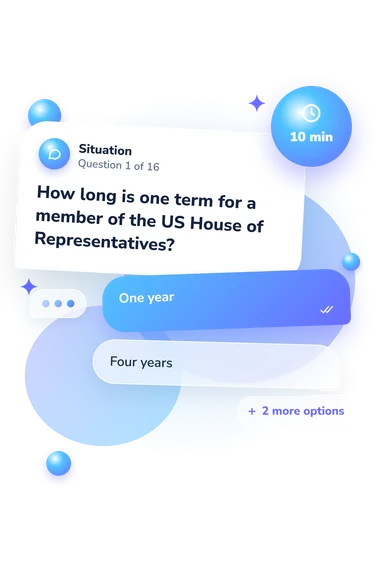
- One year
- Four years
- Two years
- Six years
- The US Constitution
- The Declaration of Independence
- The Articles of Confederation
- The Federalist Papers
- Each state receives the same number of House seats
- Each state casts one combined vote in Congress
- Each state appoints the same number of committee chairs
- Each state has two senators
US Constitution Quiz - Description and methodology of the test
Readers who want to understand how federal institutions, amendments, and individual rights fit together can use this assessment for guided civic review. In a constitution quiz, students, voters, and curious adults apply constitutional rules to practical situations rather than merely recalling isolated terms. A quiz for Constitution Day can also support classroom discussion, independent study, or a focused refresher before civic participation.
What the Test Measures
The questions examine federal structure, powers, procedures, and individual protections in practical situations. They cover branches, federalism, lawmaking, amendments, speech, counsel, privacy, equality, self-incrimination, treaties, elections, and the Supremacy and Necessary and Proper Clauses.
Several scenarios form a quiz covering the Constitution's articles, asking respondents to connect provisions with the institutions or processes they govern. The main content areas are:
- Branches and separation of powers show recognition of legislative, executive, and judicial functions.
- Federal powers and procedures show understanding of amendments, treaties, lawmaking, elections, and implied powers.
- Rights and protections show how fact patterns relate to speech, counsel, searches, equality, and self-incrimination.
The displayed US Constitution Knowledge scale runs from 0-16: Foundations to Build (0-6) marks topics to review; Developing Knowledge (7-12) shows core familiarity with application gaps; Strong Knowledge (13-16) indicates solid command of structure, procedures, and protections.
Methodology and Evidence Base
Each item uses four-option multiple choice. The questions testing constitutional knowledge ask the respondent to select the provision, rule, or process that best fits a fact pattern, combining recall with basic application. The displayed total summarizes performance across the quiz’s knowledge items; it does not measure legal expertise.
The questionnaire is conceptually consistent with the Owen and Riddle (2017) civic knowledge assessment and fits the political-knowledge framework described by Delli Carpini and Keeter (1996). It is not presented as an adaptation of either source. Annenberg’s 2023 Constitution Day survey methodology and Barabas, Jerit, Pollock, and Rainey (2014) support cautious interpretation because wording, guessing, prior exposure, and question selection can affect results.
As a quiz on the US Constitution, this tool is a separate online self-reflection assessment rather than a standardized instrument with population norms. Results describe performance on the included material and may shift with attention, memory, guessing, and familiarity with civics. Treat an uncertain result as a prompt to review the relevant article, amendment, or governmental process.
- Owen, Diana, and G. Isaac W. Riddle. “Active Learning and the Acquisition of Political Knowledge in High School.” In Teaching Civic Engagement Across the Disciplines, edited by Elizabeth C. Matto, Alison Rios Millett McCartney, Elizabeth A. Bennion, and Dick Simpson, 103-121. Washington, DC: American Political Science Association, 2017.
- Delli Carpini, Michael X., and Scott Keeter. What Americans Know about Politics and Why It Matters. New Haven, CT: Yale University Press, 1996.
- Annenberg Public Policy Center. Annenberg Constitution Day Survey 2022-2023: Methodology and Topline. University of Pennsylvania, 2023.
- Barabas, Jason, Jennifer Jerit, William Pollock, and Carlisle Rainey. “The Question(s) of Political Knowledge.” American Political Science Review 108, no. 4 (2014): 840-855. 10.1017/S0003055414000392.