
Trojan War Quiz
How the Scales are Structured
Who Usually Takes This Test?
See How You Compare
Below is a preview of how scores are typically distributed across each scale.
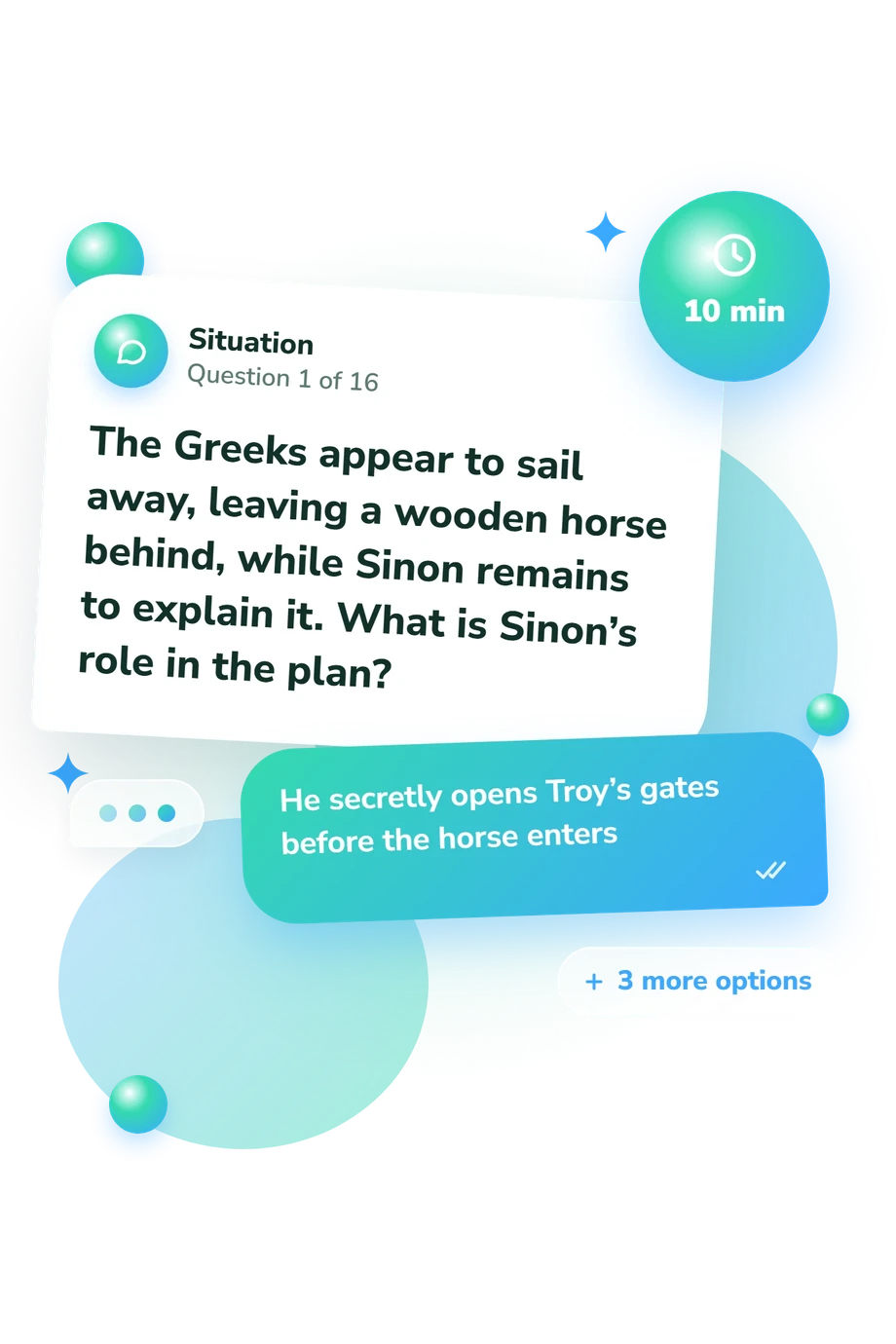
Example Questions From the Test
- His heel
- His chest
- His sword hand
- His shoulder
- Laomedon, requesting the return of Troy’s sacred image
- Priam, requesting Hector’s body for burial
- Antenor, requesting safe passage for Helen
- Anchises, requesting protection for Aeneas
- Ajax
- Menelaus
- Odysseus
- Diomedes
Trojan War Quiz - Description and methodology of the test
Readers deciding whether to revisit Homer or explore later retellings can use this questionnaire, described here as a Trojan quiz, to check their readiness for the subject. The Trojan War quiz helps learners identify gaps before choosing what to review. Its result offers a focused snapshot of recall rather than a judgment of overall humanities knowledge.
What This Test Measures
Questions focus on recognition and relationships within the Trojan War tradition, making this quiz about Trojan mythology and literature useful for readers checking myths, Homeric episodes, Roman aftermath, and reception. The result is a descriptive knowledge profile: it shows how securely someone identifies figures, motives, sequences, and literary contexts.
Results appear on the Trojan War Knowledge scale (0-16), with Foundations to build (0-6), Developing command (7-12), and Strong command (13-16). The bands move from recognizing isolated elements to connecting major characters, events, narrative stages, and literary settings.
The item themes can be grouped into three practical areas:
- Mythic origins and motives show whether you recognize the promises, relationships, and decisions behind the conflict.
- Greek and Trojan figures show whether you distinguish commanders, families, heroes, alliances, and sides.
- Episodes and context show whether you connect chronology, the Iliad’s scope, Troy’s fall, Roman tradition, and archaeology.
Methodology and Evidence Base
Each item presents a historical or literary prompt with four answer choices. The respondent selects the option that best fits the episode, figure, relationship, or source tradition. A single total summarizes performance across the questionnaire rather than producing separate personality dimensions.
As a Trojan War knowledge test, its questions are conceptually consistent with Thomas and Conant (2007) as a historical and mythographic reference work, Homer’s narrative of Achilles and Hector, Virgil’s account of Troy’s later Roman ancestry, and Burgess’s treatment of the wider epic tradition. This is an online content quiz, not a published standardized instrument or an adaptation of those works.
The displayed bands function as descriptive quiz levels for this questionnaire. The items ask readers to identify a figure’s role, place events in sequence, distinguish the Iliad’s scope from later traditions, and connect Troy with Roman reception. Performance may reflect prior reading, familiarity with later retellings, and chance among plausible alternatives. Use the outcome to choose topics for review, while remembering that one self-administered knowledge check cannot represent the whole field.
- Carol G. Thomas and Craig Conant. The Trojan War. Norman: University of Oklahoma Press, 2007.
- Homer. The Iliad: A New Translation by Caroline Alexander. New York: Ecco, 2015.
- Virgil. The Aeneid. Translated by Robert Fagles; introduction by Bernard Knox. New York: Viking, 2006.
- Jonathan S. Burgess. The Tradition of the Trojan War in Homer and the Epic Cycle. Baltimore: Johns Hopkins University Press, 2001. 10.56021/9780801866524
Updated: