
Tibia and Fibula Labeling Quiz
How the Scales are Structured
Who Usually Takes This Test?
See How You Compare
Below is a preview of how scores are typically distributed across each scale.
Example Questions From the Test
- Medial malleolus
- Tibial tuberosity
- Lateral malleolus
- Head of the fibula
- Soleal line
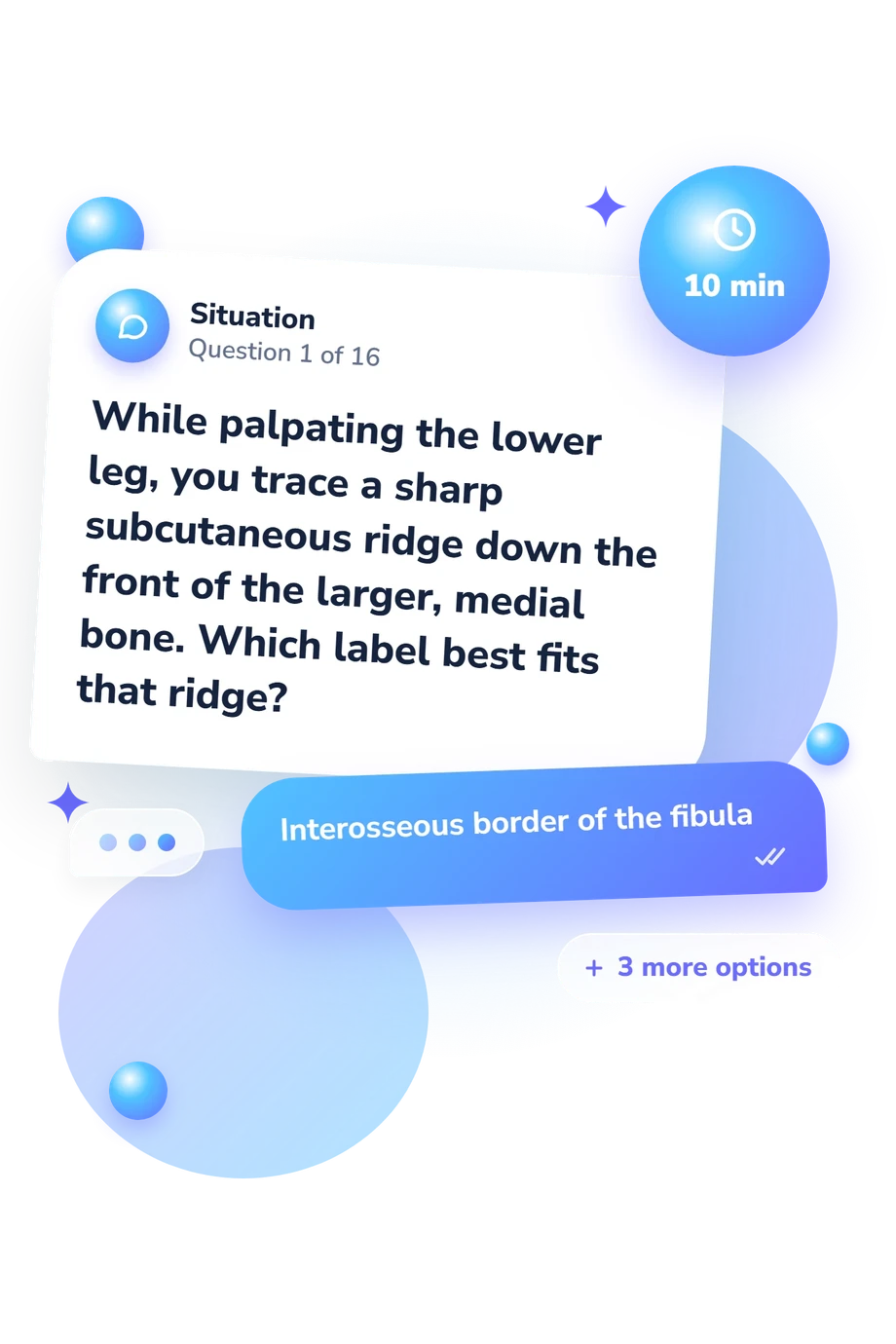
- Interosseous border
- Anterior border
- Tibial tuberosity
- The tibial tuberosity and the fibular head
- The medial tibial condyle and the fibular neck
- The fibular notch of the tibia and the distal fibula
- The medial malleolus and the fibular head
Tibia and Fibula Labeling Quiz - Description and methodology of the test
Students, trainees, and curious learners who want to check their grasp of lower-leg anatomy can use this tibia and fibula labeling quiz as a focused identification exercise. It turns written anatomical clues into a practical check of whether you can distinguish the two bones, orient their surfaces, and recognize landmarks around the knee and ankle. Because the tibia and fibula quiz uses landmark clues, its result guides targeted review.
What This Assessment Explores
The questions connect position, surface, attachment, and articulation with the correct name. The tibia is the larger medial, weight-bearing bone; the fibula is lateral, with distinctive proximal and distal features. Results show whether you can translate anatomical clues into labels.
These are the main dimensions represented in the result:
- Orientation shows whether you place each bone correctly in anatomical position.
- Proximal landmarks show whether you identify the condyles, tibial tuberosity, intercondylar eminence, fibular head, and fibular neck.
- Shaft landmarks test recognition of the anterior border and soleal line.
- Distal relationships check ankle and tibiofibular landmarks.
When you take the tibia labeling quiz, its displayed scale is Tibia and Fibula Labeling Knowledge: 0-16. Foundation to build (0-6) indicates review is needed; Developing knowledge (7-12) reflects partial recognition; Strong labeling knowledge (13-16) indicates accurate identification of most major structures from textual clues.
Methodology and Evidence Base
Conceptually, the questionnaire is consistent with Conti et al.'s (2008) anatomical-orientation framework, but that paper is not a source for the quiz's validity, items, or scoring. The items use standard anatomical names and relationships, asking the respondent to match those terms with positional, attachment, and articulation clues.
Each item presents an anatomical or clinical clue followed by four answer choices, with one structure best matching the description. The prompts require reasoning from location, surface, attachment, or articulation rather than an unlabeled image. In the tibia quiz, four-choice clues can reveal confusion about orientation, similar landmark names, or proximal and distal features.
The result is one educational total on the displayed scale, not a clinical assessment. With one best label per question, the exercise measures success in matching a clue to the appropriate structure.
In the tibia anatomy quiz, review centres on terminology and spatial relationships. Attention, prior study, familiarity with anatomical terminology, and interpretation of closely related landmarks can affect performance.
- Conti G, Cristofolini L, Juszczyk M, Leardini A, Viceconti M. Comparison of three standard anatomical reference frames for the tibia-fibula complex. Journal of Biomechanics. 2008;41(16):3384-3389. 10.1016/j.jbiomech.2008.09.009.
- Drake RL, Vogl AW, Mitchell AWM, Tibbitts R, Richardson P. Gray's Atlas of Anatomy. 4th ed. Elsevier; 2026. ISBN 9780443284663.
- Drake RL, Vogl AW, Mitchell AWM. Gray's Anatomy for Students. 5th ed. Elsevier; 2024. ISBN 9780323934237.
- Federative International Programme for Anatomical Terminology. Terminologia Anatomica: International Anatomical Terminology. 2nd ed. Federative International Programme for Anatomical Terminology; 2019.
Updated: