
Theriotype Quiz
How the Scales are Structured
Who Usually Takes This Test?
See How You Compare
Below is a preview of how scores are typically distributed across each scale.
Example Questions From the Test
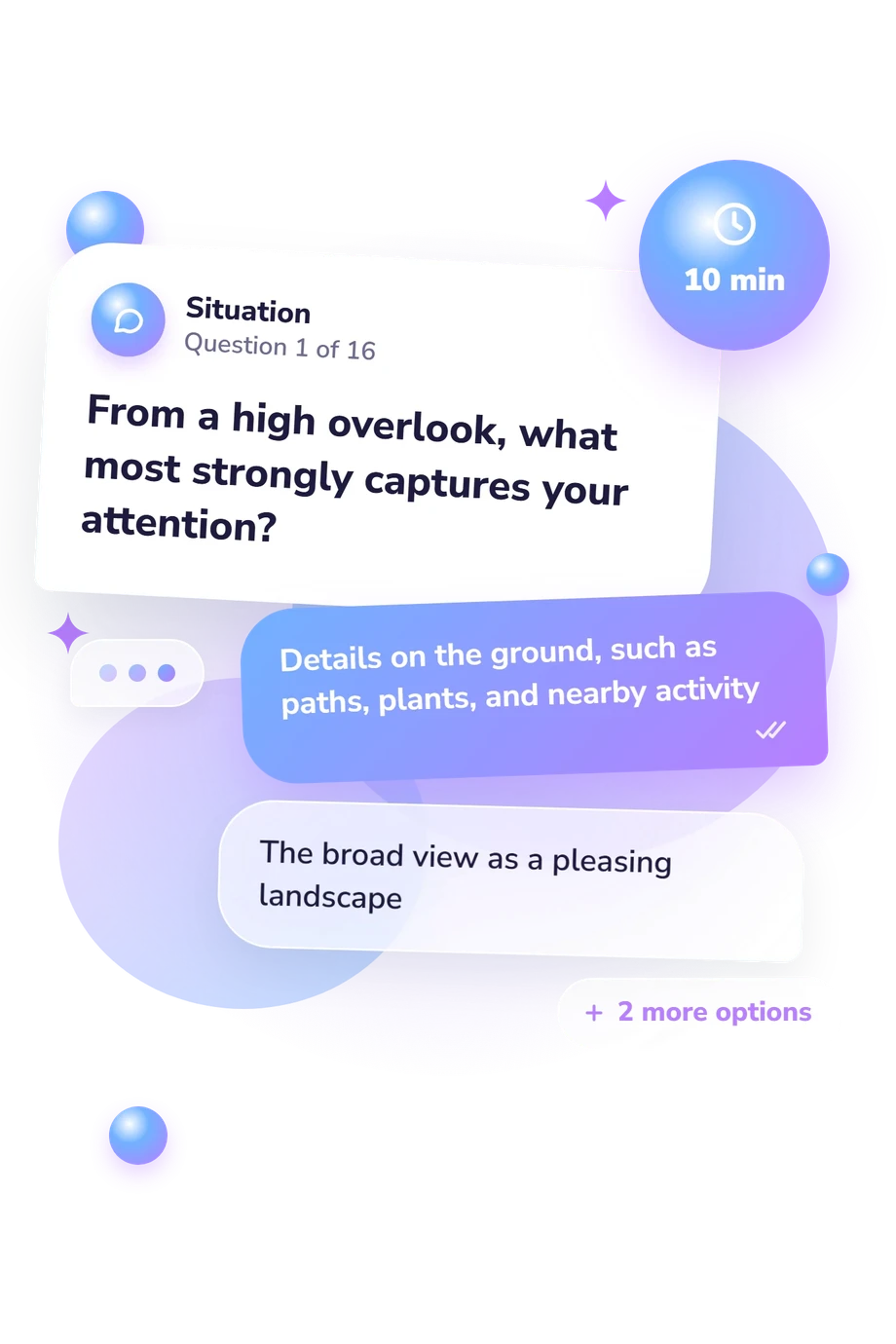
- Details on the ground, such as paths, plants, and nearby activity
- The broad view as a pleasing landscape
- Air currents, distant routes, and how the terrain connects from above
- A vivid sense of launch, lift, and moving through the open air
- My movement feels entirely human and practical in those moments.
- A feline comparison may occur if I deliberately think about it.
- Paw placement, a tail-like sense of balance, or feline stretching sometimes appears spontaneously.
- Feline posture and body-map impressions recur vividly across many ordinary movements.
- Animal movement is rarely part of my spontaneous imagery.
- I occasionally imagine running, but without a distinctly canine quality.
- Bounding, chasing, or ranging across ground has a recognizable canine flavor.
- Ground-covering pursuit and four-pawed momentum are vivid, recurring patterns for me.
Theriotype Quiz - Description and methodology of the test
People who notice recurring animal imagery, movement patterns, or body-map sensations may want a structured way to reflect on those experiences. The theriotype quiz is designed for readers exploring how particular animal-associated themes resonate with their self-observation. An animal affinity quiz result is most useful as a comparative profile rather than a fixed answer.
What This Assessment Explores
Prompts examine imagery, movement, surroundings, social rhythm, sound, rest, and imagined body shape. A therian type quiz compares recurring patterns without forcing one label.
The four profiles are:
- Avian Affinity (0-12) reflects sky, flight, calls, nesting, and winged imagery: Faint signal (0-4) is limited; Possible thread (5-8) is familiar; Strong resonance (9-12) recurs.
- Canine Affinity (0-12) reflects trails, pursuit, group movement, and canine imagery: Faint signal (0-4) is slight; Possible thread (5-8) is familiar; Strong resonance (9-12) recurs.
- Feline Affinity (0-12) reflects stealth, climbing, pouncing, social autonomy, and feline imagery: Faint signal (0-4) is low; Possible thread (5-8) is familiar; Strong resonance (9-12) recurs.
- Hoofed-Animal Affinity (0-12) reflects herds, open land, alert stillness, grazing, and hoofed imagery: Faint signal (0-4) is limited; Possible thread (5-8) is emerging; Strong resonance (9-12) recurs.
The highest score leads; scores within one point blend.
Methodology and Scientific Basis
Each prompt presents a concrete situation and four response choices, moving from no comparable experience through deliberate imagination to spontaneous, vivid, or integrated resonance. This self-report format asks the respondent to judge personal familiarity rather than endorse a factual statement about species or identity.
The responses are combined into separate affinity scores rather than one universal total. Comparative scoring preserves multiple possible resonances, while the displayed bands describe the apparent strength of a theme instead of a probability, population rank, or fixed identity.
Conceptually, the questionnaire is consistent with Luiggi-Hernández et al. (2025), whose phenomenological research examines embodied animal experience among therians and otherkin. Grivell et al. (2014) adds context on identity experiences in the therian community, while Roberts et al. (2015) examines connections to nonhuman animals in furry fandom. The theriotype test is conceptually consistent with these studies, but it is not presented as an adaptation of their published measures.
The displayed bands function as interpretive categories, not population norms or established clinical cutoffs. Self-report can vary with current context, attention, self-awareness, and willingness to describe imagery or body sensations, so the result cannot establish a species or identity.
- Luiggi-Hernández, J. G., Fein, E., Bradley, J., Pelly, J., Roberts, S. E., & Gerbasi, K. C. (2025). The jackal in the city: An empirical phenomenological study of embodied experience among therians and otherkin. The Humanistic Psychologist, 53(1), 40-58. 10.1037/hum0000350
- Grivell, T., Clegg, H., & Roxburgh, E. C. (2014). An interpretative phenomenological analysis of identity in the therian community. Identity, 14(2), 113-135. 10.1080/15283488.2014.891999
- Roberts, S. E., Plante, C. N., Gerbasi, K. C., & Reysen, S. (2015). The anthrozoomorphic identity: Furry fandom members’ connections to nonhuman animals. Anthrozoös, 28(4), 533-548. 10.1080/08927936.2015.1069993
Updated: