
The Crucible Act 4 Quiz
How the Scales are Structured
Who Usually Takes This Test?
See How You Compare
Below is a preview of how scores are typically distributed across each scale.
Example Questions From the Test
- She orders him to confess because his family needs him
- She urges him to refuse because any confession would shame her
- She leaves the choice to John and refuses to judge his conscience
- She asks Hale to decide which choice is morally correct
- remain alive
- restore Parris’s authority
- become a witness for the court
- prove that Rebecca Nurse is innocent
- In the Proctor home on the evening after the trials begin
- In a Salem jail cell shortly before dawn
- In the meeting house during Rebecca Nurse’s examination
- In the forest after Abigail leaves Salem
The Crucible Act 4 Quiz - Description and methodology of the test
Useful when preparing for discussion or a focused rereading, The Crucible Act 4 Quiz directs attention to the act’s moral conflicts and turning points. The act’s close reading suits students, book-club members, and independent readers who want to examine how authority, reputation, confession, and integrity shape the ending. It can also help organize notes around character choices and institutional pressure as readers work through The Crucible Act IV Quiz.
What This Assessment Explores
The questionnaire measures comprehension of jail scenes, reported developments, and final decisions rather than general literary ability. Prompts ask what happens, why characters act, and how details reveal conflicts over authority, reputation, confession, and integrity. Questions about Act 4 of The Crucible require accurate recall and brief literary inference.
The result appears on one knowledge scale, The Crucible Act 4 Knowledge, ranging from 0 to 16. Its bands describe current grasp:
- Foundation to revisit (0-6) calls for review of the jail setting, reported events, and final choices.
- Developing analysis (7-12) indicates command of the action and major conflicts, with some motives or themes needing review.
- Strong command (13-16) reflects accurate connections between Act 4 details and authority, reputation, confession, and integrity.
This profile identifies whether to review plot sequence, motivation, or thematic interpretation.
Methodology and Evidence Base
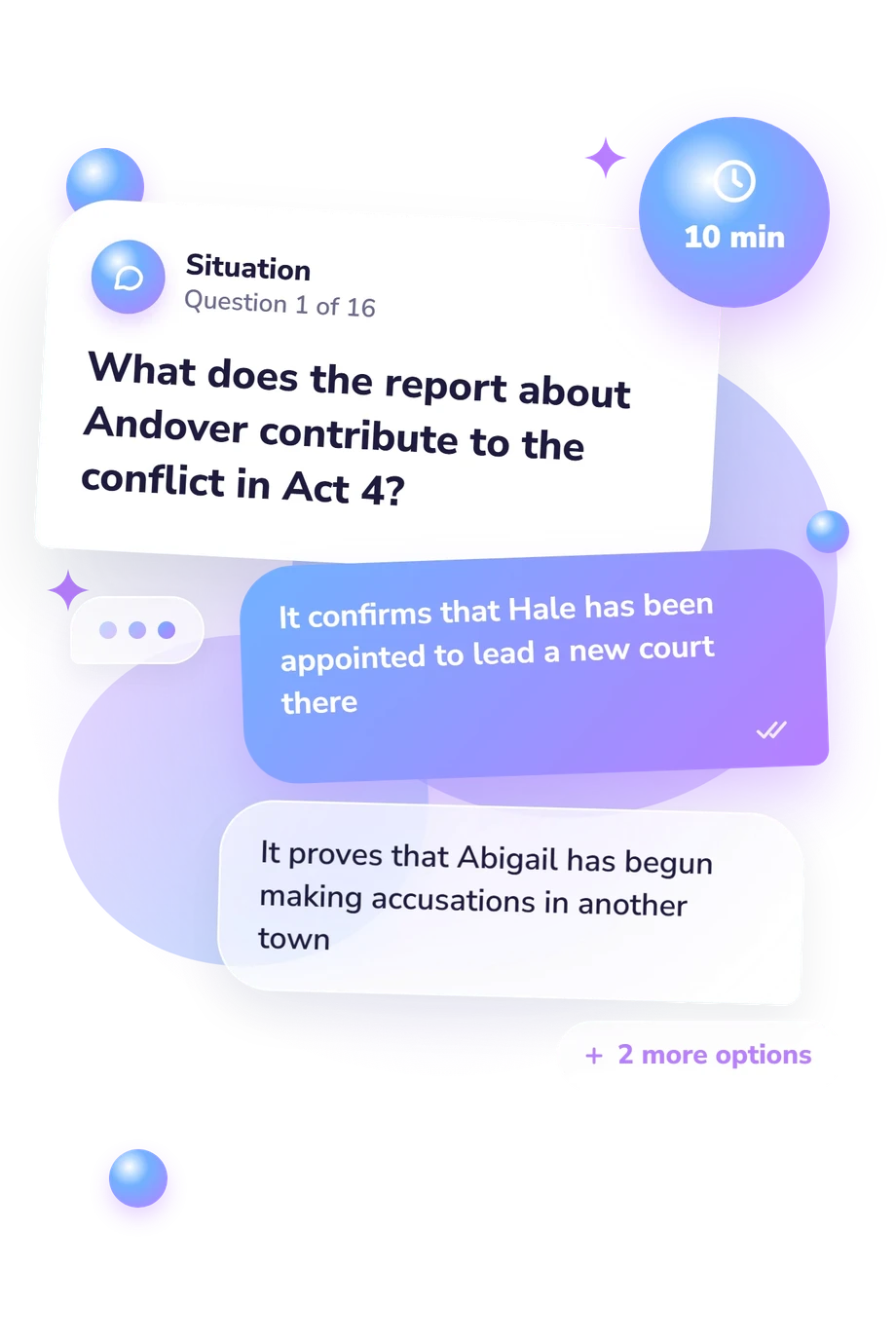
Each item uses four-option multiple choice. The set moves from concrete details-Andover, the jail setting, Giles Corey’s refusal to plead, and the signed confession-to interpretive questions about motives, institutional power, and moral choice. The result is displayed as a single knowledge score, and the accompanying bands describe levels of performance.
Methodologically, this Act 4 comprehension quiz is a text-based comprehension exercise rather than a published psychological instrument. Arthur Miller’s play supplies the primary textual anchor for the events, choices, and situations addressed. Sheikh-Farshi, Ghorban-Sabbagh, and Sharifi’s cognitive-stylistic study offers a compatible lens for attention to characterization, perspective, and decision-making, but this questionnaire is not an adaptation of that study. Miller’s 1996 essay provides context for politics, authority, and moral pressure. These works support the interpretive frame rather than validating the online questionnaire.
The result is a snapshot of current recall and interpretation. Performance may change after rereading, classroom discussion, or closer attention to disputed motives, so it is most useful for identifying topics to review.
- Miller, Arthur. The Crucible: A Play in Four Acts. Viking Press, 1953.
- Sheikh-Farshi, Shirin, Mahmoud Reza Ghorban-Sabbagh, and Shahla Sharifi. "Studying characterization in Arthur Miller’s The Crucible: A cognitive stylistic analysis." Pragmatics & Cognition, vol. 25, no. 2, 2018, pp. 310-336. 10.1075/pc.17029.far.
- Miller, Arthur. "Why I Wrote ‘The Crucible’: An Artist’s Answer to Politics." The New Yorker, October 21 and 28, 1996, pp. 158-164.
Updated: