
The Adventure of the Speckled Band Quiz
How the Scales are Structured
Who Usually Takes This Test?
See How You Compare
Below is a preview of how scores are typically distributed across each scale.
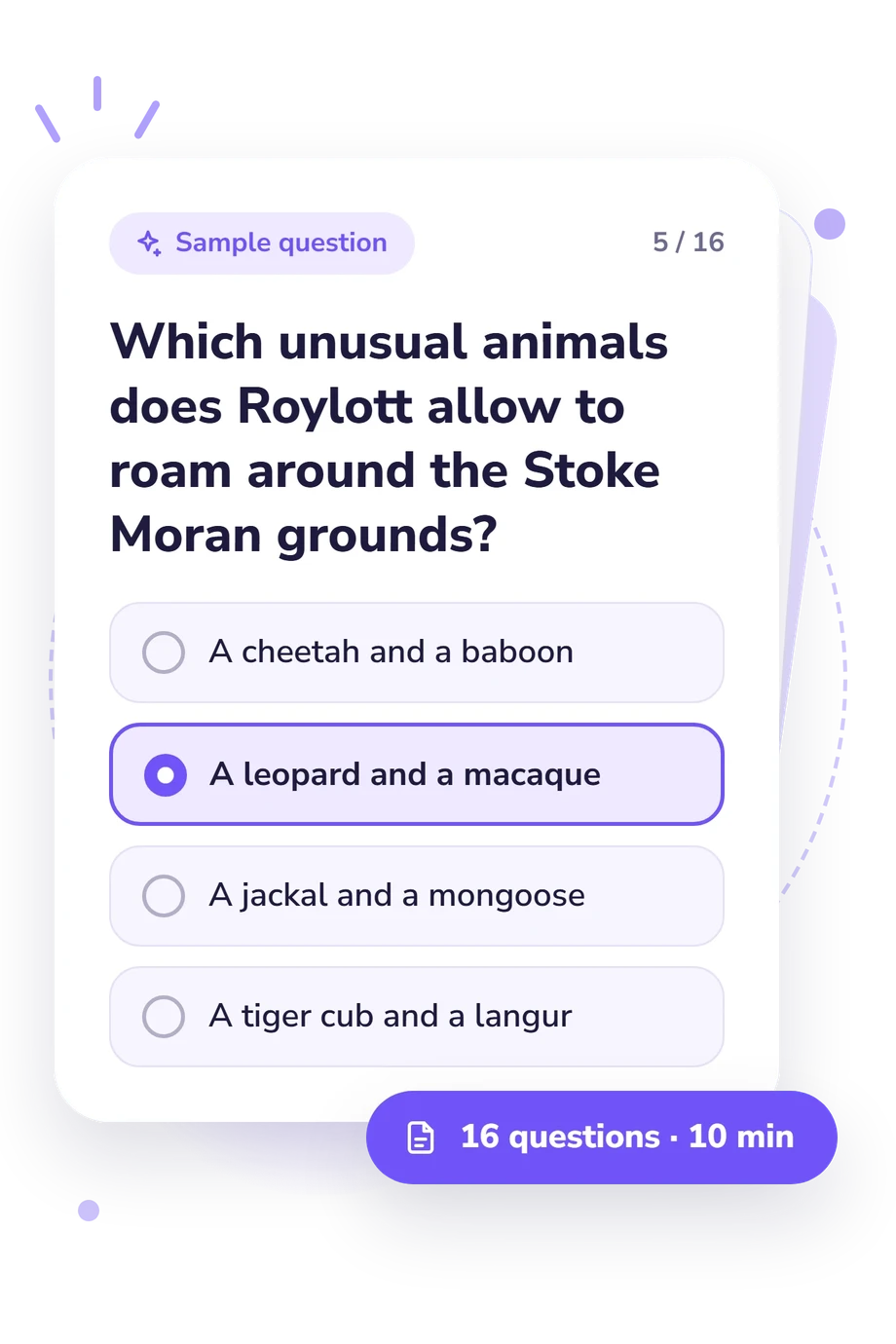
Example Questions From the Test
- She was planning to marry
- She was about to inherit the entire estate
- She was preparing to leave for India
- She was taking legal action against her stepfather
- A heavy wardrobe blocks the other side of the room
- The door is locked from the corridor
- The bed is fastened to the floor
- The window shutters can only be opened from outside
- It rings a bell in Roylott’s room rather than the servants’ area
- It has recently been cut and retied
- It is a dummy rope that is not connected to a bell
- It is positioned too far from the bed to reach
The Adventure of the Speckled Band Quiz - Description and methodology of the test
Readers returning to Arthur Conan Doyle’s mystery, or checking what they remember after a recent reading, can use The Adventure of the Speckled Band Quiz to identify which story details remain clear. The speckled band quiz shows whether the reader’s result reflects secure recall or areas worth revisiting. It offers a focused way to reconnect with the narrative while identifying the parts of the story that deserve another look.
What This Test Measures
The questionnaire measures how accurately a reader reconstructs Doyle’s case. Readers answering The Adventure of the Speckled Band questions move from story facts to relationships, physical clues, motive, and Holmes’s explanation, so the result reflects recall of events and attention to causal detail. The main knowledge areas represented by the items are:
- Plot sequence shows whether you can place the deaths, room changes, visits, and investigation correctly.
- Characters and relationships indicate whether you remember who seeks help and how the household is connected.
- Clues and setting measure recall of Stoke Moran, the ventilator, bell rope, animals, and other evidence.
- Motive and solution show whether you connect marriage, inheritance, the method, and Holmes’s conclusion.
The displayed scale is The Adventure of the Speckled Band Knowledge: 0-16. Its bands are Revisit Stoke Moran (0-6), Capable Investigator (7-12), and Baker Street Expert (13-16), describing increasing command of plot, evidence, motive, and solution.
Methodology and Scientific Basis
Each item presents a question with four answer choices, asking the reader to select the detail that matches the narrative. The format tests recognition and recall rather than open-ended literary argument; distractors distinguish a true clue from a plausible alternative. Each correct choice contributes to the total, which is interpreted through the stated descriptive bands.
Arthur Conan Doyle’s original story supplies the plot, clues, and solution that form the factual basis for each item. Emmett’s 2020 analysis gives critical context for Helen Stoner’s role, but the questionnaire is not an adaptation of that study. As an Arthur Conan Doyle quiz, it remains a text-specific knowledge exercise: the items ask readers to retrieve details and connect them to the narrative’s final explanation.
This is an informal literary knowledge result, not presented as a normed psychological measure or a clinical assessment. Performance may vary with reading recency, memory for minor details, and judgments about plausible distractors. A strong result indicates command of this narrative, not general intelligence, investigative ability, or literary judgment.
- Doyle, Arthur Conan. “The Adventure of the Speckled Band.” The Strand Magazine, vol. 3, no. 14, 1892, pp. 142-157.
- Emmett, Paul James. “Helen Stoner: The Unresolved Murder in Arthur Conan Doyle’s ‘The Adventure of the Speckled Band.’” The Explicator, vol. 78, no. 2, 2020, pp. 62-65. 10.1080/00144940.2020.1732279
- Ugai, Takanori, Yusuke Koyanagi, and Fumihito Nishino. “A Logical Approach to Criminal Case Investigation.” In Proceedings of KGR4XAI 2021: The 1st International Workshop on Knowledge Graph Reasoning for Explainable Artificial Intelligence, December 6, 2021, online.
Updated: