
Ted Lasso Character Quiz
How the Scales are Structured
Who Usually Takes This Test?
See How You Compare
Below is a preview of how scores are typically distributed across each scale.
Example Questions From the Test
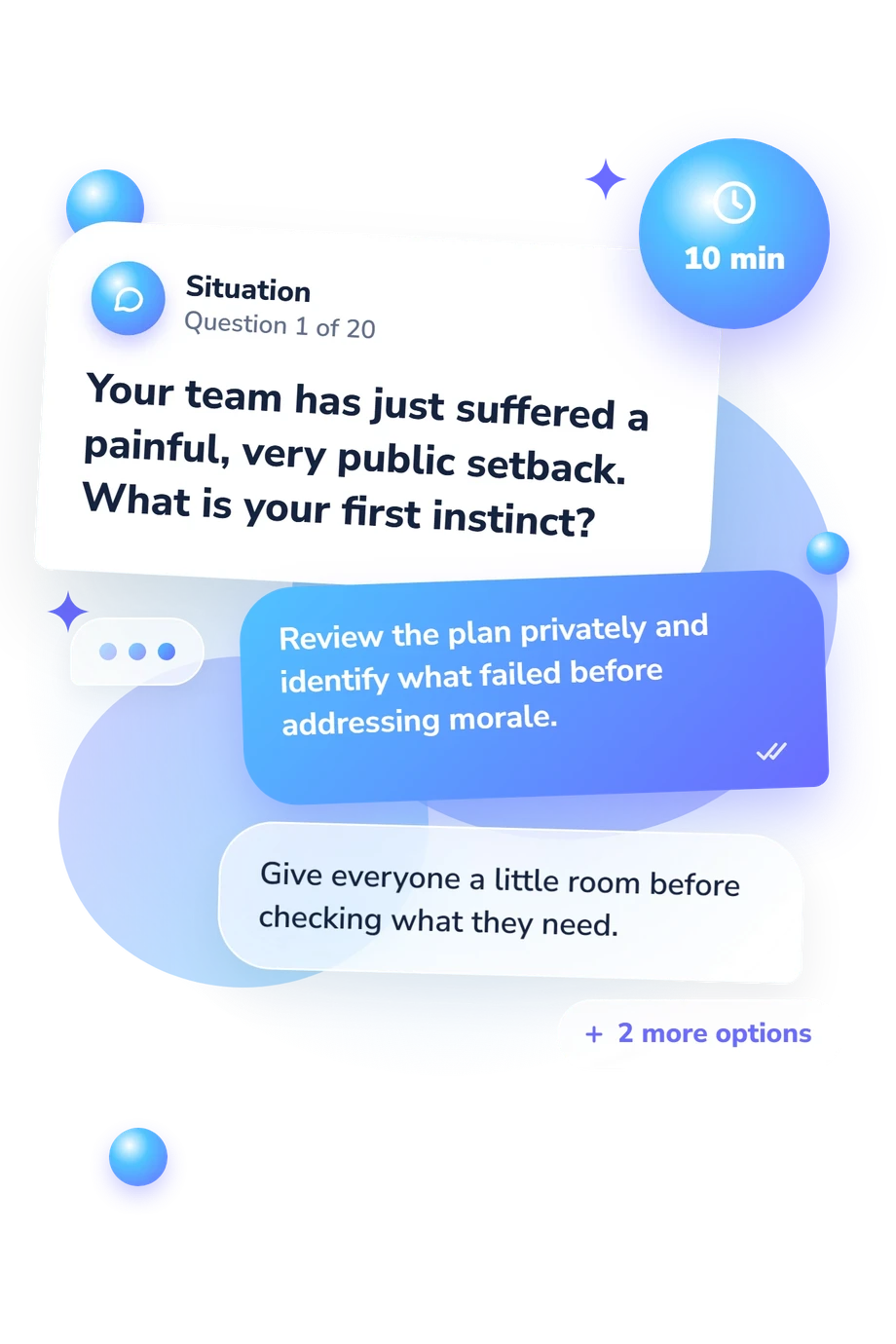
- Review the plan privately and identify what failed before addressing morale.
- Give everyone a little room before checking what they need.
- Name the disappointment, add a little humor, and remind everyone why they still matter.
- Set a concrete next target so the group can regain momentum.
- I ask questions that help them reach their own conclusion.
- I begin with encouragement and carefully introduce the difficult part.
- I focus on the result and leave personal reactions out of it.
- I tell them exactly what is not working because honesty shows I take them seriously.
- Seeing whether preparation holds up under real pressure.
- Having a stage big enough to show exactly what I can do.
- Helping my side perform well against a demanding opponent.
- Learning from the experience without attaching too much importance to the result.
Ted Lasso Character Quiz - Description and methodology of the test
Viewers deciding how they respond to challenge, relationships, responsibility, and change may find this assessment a useful lens for examining everyday choices. This Ted Lasso personality quiz connects those choices with familiar character qualities without requiring a single ideal style. The Ted Lasso Character Quiz invites comparison among different ways of handling motivation, leadership, loyalty, confidence, and connection.
What This Assessment Explores
Setbacks, feedback, ambition, conflict, friendship, responsibility, and change frame this Ted Lasso character match quiz. The scales are:
- Jamie Tartt (0-12) reflects competitive flair, confidence, excellence, and team commitment: Shared Spotlight (0-4), Rising Star (5-8), or Tartt Momentum (9-12).
- Keeley Jones (0-12) reflects confidence, social intuition, creative adaptability, and enthusiasm for potential: Understated Connector (0-4), Bright Spark (5-8), or Keeley Energy (9-12).
- Rebecca Welton (0-12) reflects strategic presence, ambition, composure, and openness: Informal Influence (0-4), Growing Authority (5-8), or Welton Presence (9-12).
- Roy Kent (0-12) reflects direct honesty, protective loyalty, intensity, and decisive action: Softer Delivery (0-4), Quietly Fierce (5-8), or Full Kent Mode (9-12).
- Ted Lasso (0-12) reflects hopeful curiosity and relationship-centred leadership: Different Playbook (0-4), Touch of Lasso (5-8), or Believe Energy (9-12).
Methodology and Evidence Base
Each item presents a short scenario with four response options. The choices ask about leadership, social intuition, competition, loyalty, openness, and recovery after setbacks. The Ted Lasso character test compares character profiles rather than producing one general personality score.
Interpretation is comparative: the highest character score marks the strongest affinity, while scores within one point indicate a blended result. The displayed bands describe the profile.
Research by Rarity and colleagues links identification with parasocial characters to sharing their personality traits, while Huang and Fung treat identification with narrative characters as measurable. Those studies offer conceptual context; this questionnaire is a distinct online self-report tool with its displayed bands.
Self-report results may vary with mood, recent experiences, familiarity with the series, and the wish to resemble a favorite character, making the profile a structured snapshot rather than a fixed trait measure.
- Rarity, Erica C., Matthew R. Leitao, and Abraham M. Rutchick. (2022). Identification With Characters in Parasocial Relationships Predicts Sharing Their Personality Traits. Psychology of Popular Media, 11(2), 111-116. 10.1037/ppm0000389
- Huang, Kate Y., and Helene H. Fung. (2024). Measuring identification with narrative characters: the development and validation of a new scale. Current Psychology, 43, 24835-24849. 10.1007/s12144-024-06191-2
- Jorgenson, Eric. (2020; updated 2026). Development of the Statistical “Which Character” Personality Quiz. Open-Source Psychometrics Project.
Updated: