
Signs You Need Glasses Quiz
How the Scales are Structured
Who Usually Takes This Test?
See How You Compare
Below is a preview of how scores are typically distributed across each scale.
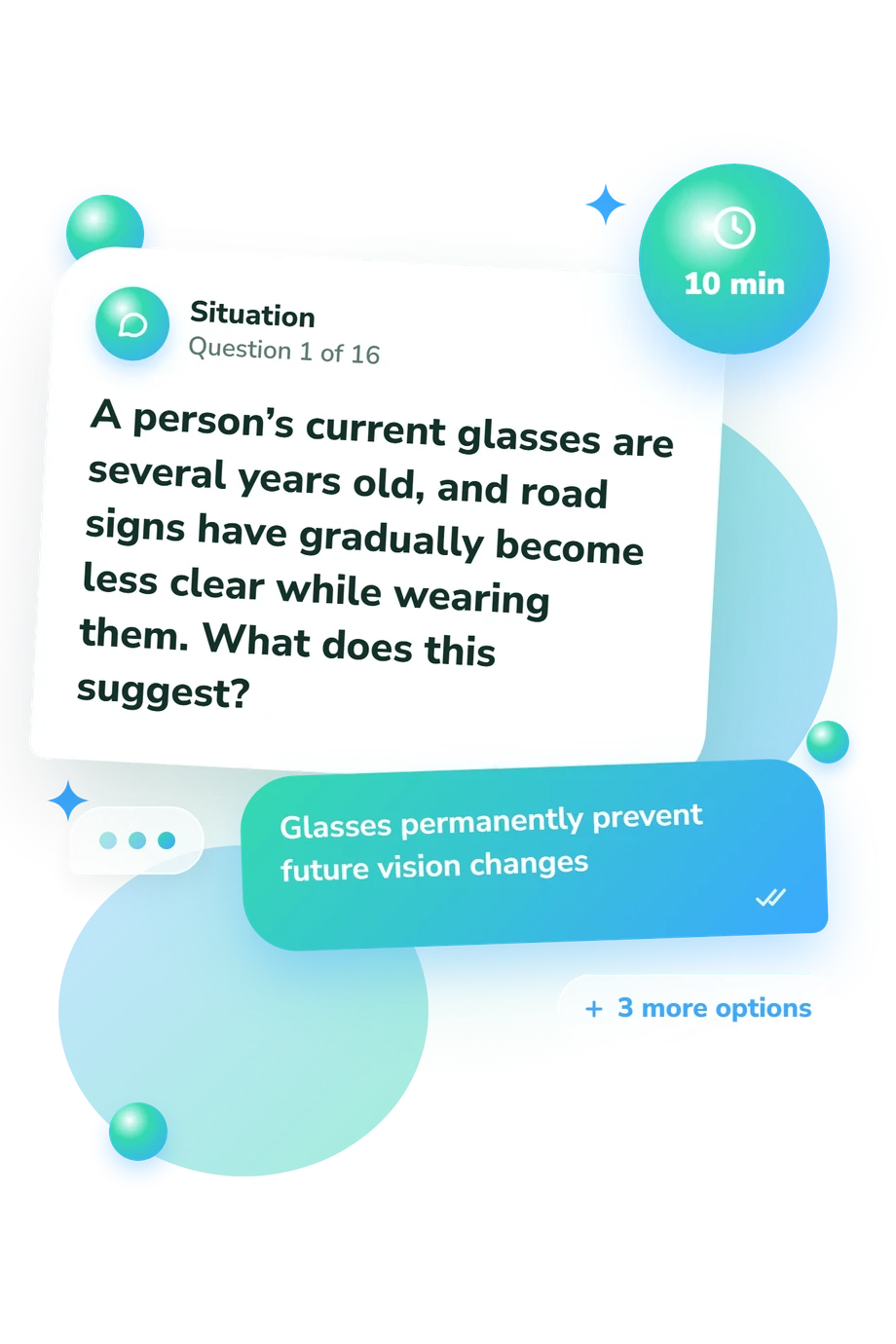
Example Questions From the Test
- Seek urgent medical or eye care
- Rest the eye overnight before deciding
- Treat it as a normal prescription change
- Test several pairs of reading glasses first
- New flashes, many floaters, or a curtain-like shadow
- Mild fatigue after prolonged close work
- A distant sign that has slowly become less sharp
- Gradual difficulty reading small print
- Presbyopia
- Myopia (nearsightedness)
- Hyperopia (farsightedness)
- Color vision deficiency
Signs You Need Glasses Quiz - Description and methodology of the test
People who notice blur, glare, eye strain, or trouble focusing can use the Signs You Need Glasses Quiz to organize observations and build practical knowledge about refractive clues. It suits readers who want a quiz about signs considered in an eye test while separating common refractive patterns from the limits of symptom checklists. The result reflects knowledge of vision clues, not an individual prescription.
What This Assessment Explores
Rather than deciding whether lenses are needed, the questionnaire tests recognition of myopia, hyperopia, astigmatism, presbyopia, changing prescriptions, screen discomfort, fluctuating blur, and urgent warning signs. It helps readers connect blur, glare, headaches, and focusing changes with possible explanations without treating any symptom as proof. The knowledge quiz explores how to tell if you need glasses from possible refractive signs, separating routine clues from sudden double vision or a curtain-like shadow that needs prompt care.
The result appears on the Signs You Need Glasses Knowledge scale, scored 0-16. Its three displayed bands are:
- Foundations to build (0-6) indicates that refractive signs, screening limits, and urgent warnings need review.
- Developing recognition (7-12) means typical patterns may be confused with symptoms needing broader evaluation.
- Strong recognition (13-16) reflects solid knowledge of refractive clues and reasons to seek care.
Methodology and Scientific Basis
Each item presents a short scenario with four answer choices. The situations cover near-versus-distance blur, glare, headaches, fluctuating vision, double vision, changing prescriptions, beliefs about glasses, and signs requiring prompt care. The result is an unvalidated knowledge score in descriptive categories; it does not calculate lens power, confirm eye disease, or determine whether glasses would help.
It addresses the practical question behind this do i need glasses quiz by linking signs with why an eye examination is needed. Conceptually, it is consistent with the Eye Health Literacy Scale (Yılmaz et al., 2019) on health information and responses; it is not an adaptation. Readers asking do you need glasses can use quiz results to distinguish refractive clues from urgent symptoms.
Breslin, O’Donoghue, and Saunders (2014) show why self-reported refractive status is an imperfect guide, while American Academy of Ophthalmology guidance supports comprehensive evaluation when vision changes or urgent symptoms appear. Attention, memory, current symptoms, and self-awareness can affect performance. Sudden vision loss, a curtain-like shadow, new flashes or many floaters, severe eye pain, injury, or persistent new double vision should prompt urgent eye care.
- Yılmaz U, Gökler E, Güneş CE, Parça O. Eye health literacy scale. Pamukkale Medical Journal. 2019;12(1):83-91. 10.31362/patd.457969
- Breslin KMM, O'Donoghue L, Saunders KJ. An investigation into the validity of self-reported classification of refractive error. Ophthalmic and Physiological Optics. 2014;34(3):346-352. 10.1111/opo.12113
- Chuck RS, Dunn SP, Flaxel CJ, Gedde SJ, Mah FS, Miller KM, Wallace DK, Musch DC; American Academy of Ophthalmology Preferred Practice Pattern Committee. Comprehensive Adult Medical Eye Evaluation Preferred Practice Pattern. Ophthalmology. 2021;128(1):P1-P29. 10.1016/j.ophtha.2020.10.024
Updated: