
Separating Mixtures Quiz
How the Scales are Structured
Who Usually Takes This Test?
See How You Compare
Below is a preview of how scores are typically distributed across each scale.
Example Questions From the Test
- Sieving
- Decantation
- Separating-funnel separation
- Paper chromatography
- Sieving
- Simple distillation
- Evaporation
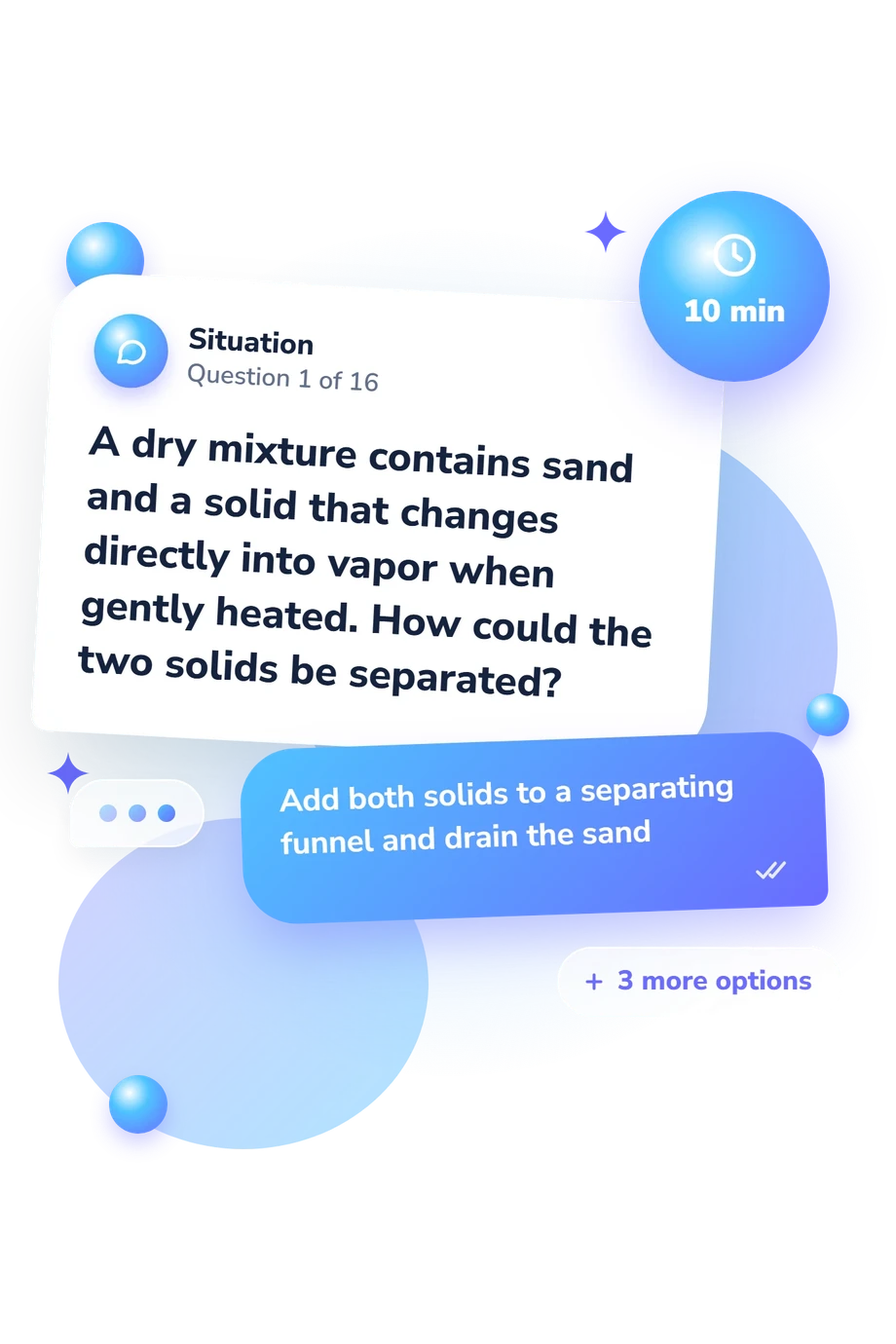
- Sublimation
- Evaporation
- Decantation
- Magnetic separation
- Sieving
Separating Mixtures Quiz - Description and methodology of the test
Students reviewing chemistry or checking whether they can select a laboratory method can use this separation of mixtures quiz to turn familiar procedures into practical decisions. The separating mixtures quiz focuses on choosing, comparing, and explaining techniques rather than recalling names alone. Its questions help learners apply separation-of-mixtures principles in unfamiliar situations, showing how accurately they apply knowledge of physical properties when choosing methods.
What This Assessment Explores
The questions connect physical properties with separation methods. They address particle size, solubility, magnetism, boiling point, miscibility, density, and behavior during heating or movement through a medium. The result reflects practical knowledge: it shows whether a person can select an appropriate method and recognize the reasoning behind it, rather than merely recall its name.
This separation techniques quiz measures:
- Particle size and insolubility guide choices between sieving and filtration.
- Solubility and solvent removal distinguish evaporation from crystallization.
- Boiling point and condensation determine when simple or fractional distillation is appropriate.
- Miscibility, density, magnetism, and component movement support decisions about separating funnels, decantation, magnetic separation, centrifugation, and chromatography.
The result is Separating Mixtures Knowledge (0-16): Foundations to Review (0-6), Developing Knowledge (7-12), or Strong Knowledge (13-16). The result therefore shows how consistently a learner applies separation techniques to concrete cases.
Methodology and Scientific Basis
Each item offers four answer choices around a concrete mixture, apparatus, procedure, or calculation. Tasks require choosing a method, interpreting a setup, identifying equipment, or calculating an Rf value. Responses are condensed into one knowledge score; the bands summarize demonstrated understanding and indicate whether broader review may be useful.
Educationally, the questionnaire is conceptually consistent with the work of dos Santos and colleagues from 2021, which presents separation methods as practical chemical knowledge linked with classroom activities and everyday examples. Its treatment of distillation also aligns with distinctions discussed by Abels, Koliander, and Plotz in 2023, including volatility, boiling behavior, vapor, and condensation. Flowers and colleagues provide general coverage of the procedures represented here. The questionnaire is conceptually consistent with these educational sources but is not an adaptation of them.
As a mixture separation quiz, this questionnaire provides a snapshot of current understanding. Performance can vary with recent instruction, attention, laboratory vocabulary, and unfamiliar examples, so the displayed band is most useful for deciding whether to revisit method selection, apparatus, separation principles, and calculations.
- Gabriel Pereira dos Santos, Danilo Ribeiro de Morais, Clara Iamin Faad Rebouças de Souza, Nicole Aissa Rodrigues Fonseca, and Mayker Lazaro Dantas Miranda. “Mixtures and Their Separation Methods: The Use of Didactic Games, the Jigsaw Method and Everyday Life as Facilitators to Construct Chemical Knowledge in High School.” Orbital: The Electronic Journal of Chemistry, 13(5), 428-433, 2021. 10.17807/orbital.v13i5.1650
- Simone Abels, Brigitte Koliander, and Thomas Plotz. “Are you teaching ‘distillation’ correctly in your chemistry classes? An educational reconstruction.” Chemistry Teacher International, 5(2), 229-237, 2023. 10.1515/cti-2022-0034
- Paul Flowers, Klaus Theopold, Richard Langley, and William R. Robinson. Chemistry 2e. OpenStax, Houston, Texas, 2019.
Updated: