
Scorpio Quiz
How the Scales are Structured
Who Usually Takes This Test?
See How You Compare
Below is a preview of how scores are typically distributed across each scale.
Example Questions From the Test
- Aries, Cancer, and Capricorn
- Gemini, Virgo, and Sagittarius
- Taurus, Leo, and Aquarius
- Cancer, Sagittarius, and Aquarius
- The Moon was in Scorpio at their birth
- The Sun was in the zodiac sign Scorpio at their birth
- Every planet in their birth chart was in Scorpio
- Scorpio was opposite the eastern horizon at their birth
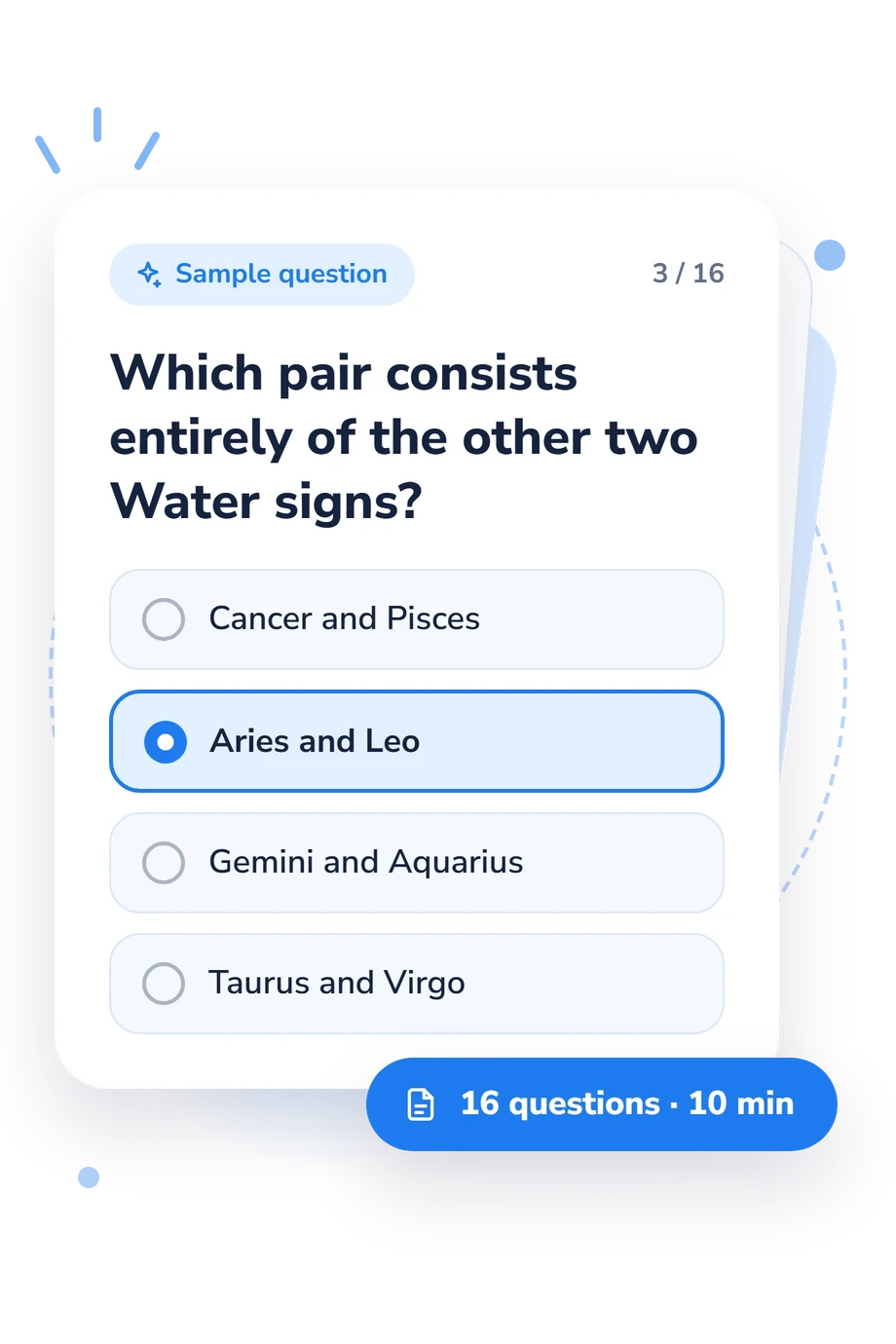
- Cancer and Pisces
- Aries and Leo
- Gemini and Aquarius
- Taurus and Virgo
Scorpio Quiz - Description and methodology of the test
Readers who want to check their understanding of modern Western astrology can use a focused knowledge check. The Scorpio Quiz suits beginners and readers already comfortable with birth-chart language. The questions check recognition of the sign’s classifications, symbols, rulers, and place in the zodiac, so the result gauges modern Western astrology knowledge.
What This Assessment Explores
Scorpio Knowledge is the displayed scale, ranging from 0-16. It measures command of common conventions in modern Western astrology, rather than personality resemblance. Results are classified as Emerging (0-6), Developing (7-12), or Strong (13-16); these bands summarize trivia performance, and astrological traditions may describe some conventions differently.
The questions examine three areas:
- Element and modality show whether you can identify Scorpio as Water and Fixed and keep those systems distinct.
- Zodiac structure indicates whether you know the sign’s order, opposite sign, neighboring signs, and seasonal position.
- Chart language and symbolism reveal whether you recognize the Sun sign and Ascendant, the traditional and modern rulers, the scorpion symbol, and the distinction between Scorpio and Scorpius.
A higher result reflects stronger recall of these conventions, while a lower result indicates that some zodiac sign classifications or relationships may need review.
Methodology and Evidence Base
Each item presents a short prompt with four choices. Choosing the correct option adds one point, so the total counts correct responses rather than forming a weighted personality profile. Items test relationships among signs, elements, modalities, chart angles, and symbols.
The content is conceptually consistent with Sakoian and Acker (1973), whose treatment supports its elements, modalities, rulers, and chart terminology; the questionnaire is not presented as an adaptation of that source.
Ptolemy provides historical context for older astrological conventions, while the International Astronomical Union supports the distinction between an astrological sign and the astronomical constellation Scorpius. Together, these sources clarify the vocabulary and distinction used in the questions; the result remains a descriptive count of correct answers.
Overall, the score describes performance on astrology chart terminology and can reflect prior exposure, wording, or the astrological tradition a reader knows best. The displayed bands are descriptive guides for trivia performance within modern Western astrology, whose traditions can vary.
- Sakoian, Frances, and Louis S. Acker. The Astrologer's Handbook. New York: Harper & Row, 1973.
- Ptolemy. Tetrabiblos. Edited and translated by Frank Egleston Robbins. Loeb Classical Library 435. Cambridge, MA: Harvard University Press, 1940.
- International Astronomical Union. Frequently Asked Questions (FAQs). IAU, accessed September 24, 2026.
- Clements, Paul. "Astrology, modernity and the project of self-identity." Culture and Religion 21, no. 3 (2020): 259-279. 10.1080/14755610.2022.2093234
Updated: