
Safety and Sanitation Quiz
How the Scales are Structured
Who Usually Takes This Test?
See How You Compare
Below is a preview of how scores are typically distributed across each scale.
Example Questions From the Test
- The mixture prevents both products from removing visible dirt.
- The combination can release dangerous toxic gases.
- The products permanently solidify when placed together.
- The mixture becomes harmless but leaves a difficult stain.
- On the top shelf so they are easy to inspect.
- In the refrigerator door, where spills are easier to notice.
- Beside washed produce so all fresh items stay together.
- On the lowest suitable shelf, away from ready-to-eat food.
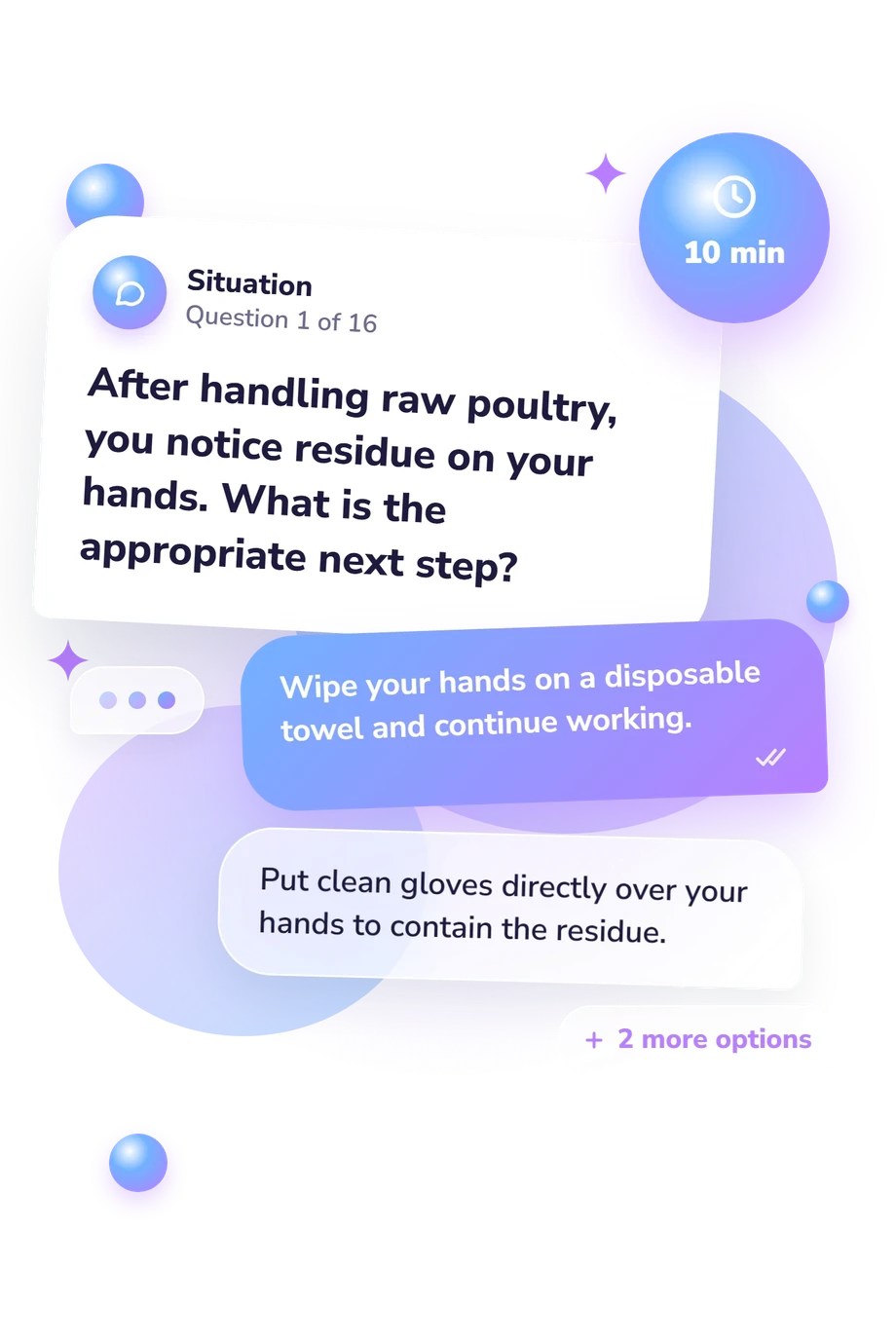
- Discard them appropriately and clean your hands.
- Keep the gloves nearby in case the same task resumes shortly.
- Sanitize the outside of the gloves before touching your skin.
- Put on a second pair to clean any residue from the first pair.
Safety and Sanitation Quiz - Description and methodology of the test
People who handle food, cleaning products, shared facilities, or workplace waste can use the safety and sanitation quiz to check whether everyday decisions match basic protective practice. Learners and workers may use this sanitation quiz to refresh procedures before training or routine duties. It can be useful before onboarding, refresher training, or a shift involving these tasks.
What This Assessment Measures
Questions focus on situations involving hazards, contamination, and approved procedures. One scale, Safety and Sanitation Knowledge (0-16), describes how consistently the respondent identifies sound practices. Its bands are Foundations Needed (0-6), Developing Knowledge (7-12), and Strong Knowledge (13-16).
These item groups show the practical domains reflected in the result:
- Hand hygiene and contamination control show whether washing, separation, and glove use are applied correctly.
- Chemical handling indicates whether labels, hazard information, contact times, and incompatibilities are followed.
- Spill, bodily-fluid, and sharps response reflects use of access controls, protection, and approved disposal.
- Raw-meat storage and surface reuse show whether the respondent applies food safety procedures for cleaning, sanitizing, and cross-contamination control.
- Workplace hazard control captures responses to pests, damaged equipment, waste, and slippery floors.
Methodology and Evidence Base
Each question presents a scenario with four choices. The respondent selects the safest action, such as washing hands, isolating a hazard, labeling a chemical, or using designated disposal equipment.
Each correct answer adds one point, and the total is read through the displayed bands. This supports quick review but does not identify the skill behind a missed item.
Food-handling items are conceptually consistent with the Food Safety Knowledge Instrument, a published food-safety measure; this questionnaire is not an adaptation of it. Ferk, Calder, and Camire offer related evidence on assessing food-safety knowledge. Chemical, sharps, and general workplace-safety items address topics covered by regulatory sources, including the FDA Food Code and OSHA standards for food handling, chemical communication, and bloodborne-pathogen precautions. These sources support the subject matter, not standardized validation of this questionnaire.
The result can guide review of workplace safety procedures. Guessing, memory, current training, and personal interpretation may affect results. The score is educational, not a certification or substitute for local rules, product labels, or required training.
- Byrd-Bredbenner, C., Wheatley, V., Schaffner, D., Bruhn, C., Blalock, L., & Maurer, J. (2007). Development and Implementation of a Food Safety Knowledge Instrument. Journal of Food Science Education, 6(3), 46-55. 10.1111/j.1541-4329.2007.00029.x
- Ferk, C. C., Calder, B. L., & Camire, M. E. (2016). Assessing the Food Safety Knowledge of University of Maine Students. Journal of Food Science Education, 15(1), 14-22. 10.1111/1541-4329.12076
- U.S. Food and Drug Administration. (2026). Food Code 2026. Silver Spring, MD: U.S. Department of Health and Human Services.
- Occupational Safety and Health Administration. (2026). Occupational Safety and Health Standards, 29 C.F.R. Part 1910, including 1910.1200 Hazard Communication and 1910.1030 Bloodborne Pathogens. Washington, DC: U.S. Department of Labor.
Updated: