
Run-On Sentence Quiz
How the Scales are Structured
Who Usually Takes This Test?
See How You Compare
Below is a preview of how scores are typically distributed across each scale.
Example Questions From the Test
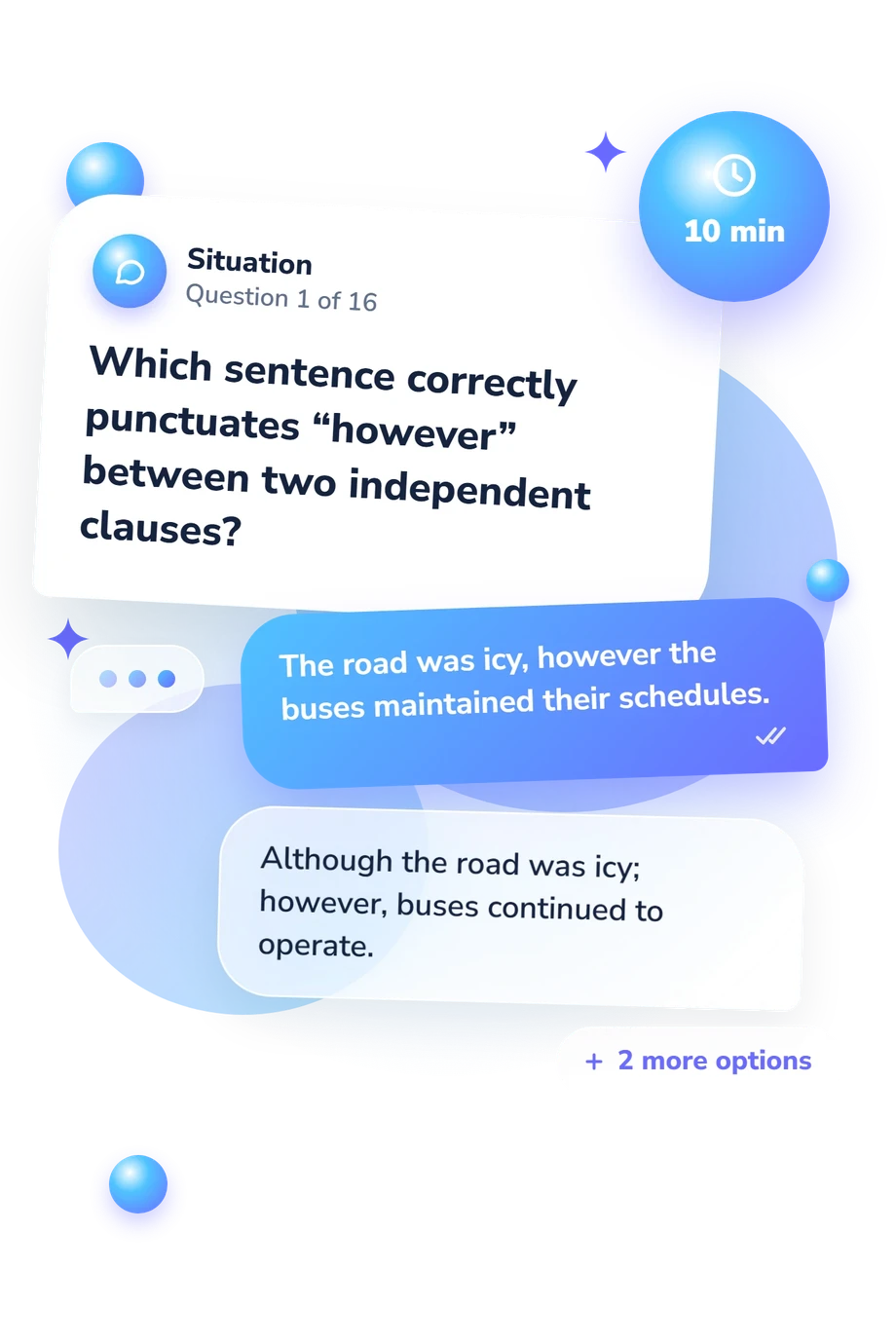
- The road was icy, however the buses maintained their schedules.
- Although the road was icy; however, buses continued to operate.
- The road was icy; however, the buses continued running.
- The icy road. However, did not stop the buses from running.
- As the lights flickered. The screen suddenly went dark.
- The lights flickered. The screen went dark.
- The lights flickered, darkness covered the computer display.
- The flickering lights and the dark screen.
- After Maya finished the draft. She emailed her editor.
- Maya completed the draft, she then sent the document away.
- Maya finished drafting and, sent the work to her editor.
- Maya finished the draft, and she sent it to her editor.
Run-On Sentence Quiz - Description and methodology of the test
Students, writers, and English learners can use this assessment to check whether their sentences express complete thoughts and connect them correctly. The run on sentence quiz focuses on decisions that often separate polished prose from confusing writing. Readers who want targeted editing practice can use this quiz for correcting run-on sentences and see whether they recognize faulty boundaries and choose an effective repair.
What This Assessment Measures
Sentence boundaries are the focus, rather than vocabulary or style. Items ask you to distinguish independent from dependent clauses and choose a clear punctuation mark or connector. The assessment suits grammar learners, writers checking recurring errors, and anyone seeking run-on sentence practice.
The question themes cover four related skills:
- Identifying fused sentences shows whether you can spot complete clauses joined without a suitable boundary.
- Detecting comma splices checks whether you notice a comma joining complete clauses alone.
- Handling fragments tests whether you can distinguish a dependent clause from a complete thought.
- Repairing boundaries shows whether you can preserve meaning with a period, semicolon, conjunction, or subordination.
The displayed scale, Run-On Sentence Knowledge, runs from 0-16 and equals correct answers. Foundations to Build (0-6) calls for review; Developing Control (7-12) shows growing command; Strong Command (13-16) reflects consistent recognition and repair.
Methodology and Evidence Base
Zheng et al. (2018) provides the closest research connection: it examines sentence-boundary problems requiring an acceptable repair. This quiz is conceptually consistent with that work, but it is not the published system or a validated adaptation. Grammar terminology for clauses, coordination, subordination, and punctuation follows Huddleston, Pullum, and Reynolds (2022).
Each item uses selected response. You read a sentence or short question and choose the option that is complete, correctly punctuated, or best repaired; alternatives reflect fused clauses, comma splices, fragments, and faulty conjunctions. The score counts correct answers directly, so the result represents performance on these examples.
As a run-on sentence test, this tool offers a focused knowledge check rather than a normed psychological or educational assessment. It does not establish a percentile, grade-level placement, or general writing ability. Performance can vary with attention, prior instruction, and unfamiliar wording. Use the band to choose what to review next, from clause structure and boundaries to punctuation and connecting choices.
- Zheng, Junchao, Courtney Napoles, Joel Tetreault, and Kostiantyn Omelianchuk. 2018. "How do you correct run-on sentences it’s not as easy as it seems." In Proceedings of the 2018 EMNLP Workshop W-NUT: The 4th Workshop on Noisy User-generated Text, 33-38. Association for Computational Linguistics. 10.18653/v1/W18-6105
- Huddleston, Rodney, Geoffrey K. Pullum, and Brett Reynolds. 2022. A Student’s Introduction to English Grammar. 2nd ed. Cambridge University Press. 10.1017/9781009085748
Updated: