
Roller Coaster Quiz
How the Scales are Structured
Who Usually Takes This Test?
See How You Compare
Below is a preview of how scores are typically distributed across each scale.
Example Questions From the Test
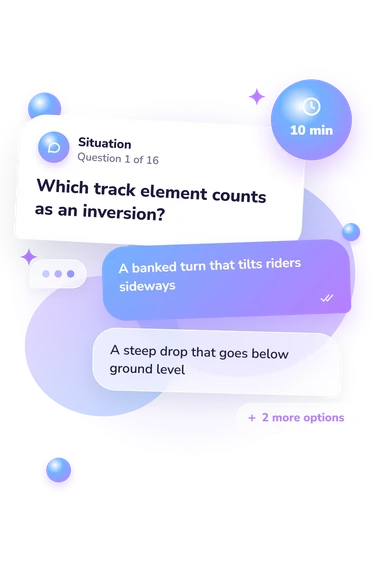
- A banked turn that tilts riders sideways
- A steep drop that goes below ground level
- An element that turns riders upside down
- A spiral that remains upright throughout
- At the bottom of its fastest drop
- Halfway through a level turn
- At the highest point of the course
- Inside the final brake run
- Thermal energy in the braking system and surroundings
- Permanent extra mass in the train
- Magnetic energy stored indefinitely in the track
- Additional gravitational potential energy
Roller Coaster Quiz - Description and methodology of the test
People who enjoy amusement parks, engineering, or ride design can use this roller coaster quiz to check their understanding of the systems behind a ride. It suits curious learners and enthusiasts who want a structured snapshot rather than a personality profile. This roller coaster test turns familiar ride concepts into a focused knowledge check. Its single result reflects overall understanding rather than separate strengths by topic.
What This Assessment Explores
The questionnaire examines how roller coasters are built, propelled, controlled, and operated rather than measuring thrill-seeking or riding confidence. It suits visitors who want to connect familiar ride experiences with basic engineering and physics.
The questions group into three practical areas:
- Terminology identifies inversions, helices, hybrid construction, and other track features.
- Physics explains gravity, potential energy, banking, airtime, acceleration, and braking.
- Systems and operations include lifts, launches, block sections, trim brakes, rollbacks, and related safety and design examples such as weather procedures, restraints, wheels, and height limits.
The Roller Coaster Knowledge scale (0-16) places results in Foundations to build (0-6), Developing knowledge (7-12), or Strong knowledge (13-16). This rollercoaster quiz measures the overall understanding represented by the scale, rather than separate strengths by topic. The band describes overall knowledge, not ride-design or operating ability.
Methodology and Scientific Basis
Each item presents four answer choices about a defined coaster concept, and the respondent selects the best answer. The questions cover terminology, applied physics, ride systems, operations, and safety reasoning. Responses combine into one displayed knowledge score; no separate weighting scheme or clinical cutoff is stated.
Content is conceptually consistent with Coasters 101 (Weisenberger, 2012), which covers coaster design and operating principles. Pendrill and Eager’s 2020 physics treatment supports its focus on velocity, acceleration, forces, vibration, and rider sensations. ASTM F2291-24 and ASTM F770-24 supply professional frameworks for design, operation, maintenance, inspection, and safety. The cited works provide conceptual context; the online questionnaire is not identified as a standardized adaptation of those instruments or standards.
This roller coaster knowledge test offers a structured learning snapshot. Higher results suggest broader command of the represented concepts, while lower results point to topics for review. Performance on this self-administered knowledge test can be affected by guessing, prior ride familiarity, and current attention. The questionnaire has no stated population norms or demonstrated diagnostic validity, so the score is an educational profile rather than a standardized psychological assessment.
- Nick Weisenberger. Coasters 101: An Engineer's Guide to Roller Coaster Design. CreateSpace Independent Publishing Platform, 2012. ISBN 9781468013559.
- Ann Marie Pendrill and David Eager. "Velocity, acceleration, jerk, snap and vibration: Forces in our bodies during a roller coaster ride." Physics Education, vol. 55, no. 6, 2020, article 065012. 10.1088/1361-6552/aba732.
- ASTM International. ASTM F2291-24: Standard Practice for Design of Amusement Rides and Devices. ASTM International, 2024. 10.1520/F2291-24.
- ASTM International. ASTM F770-24: Standard Practice for Ownership, Operation, Maintenance, and Inspection of Amusement Rides and Devices. ASTM International, 2024. 10.1520/F0770-24