
Privilege Quiz
How the Scales are Structured
Who Usually Takes This Test?
See How You Compare
Below is a preview of how scores are typically distributed across each scale.
Example Questions From the Test
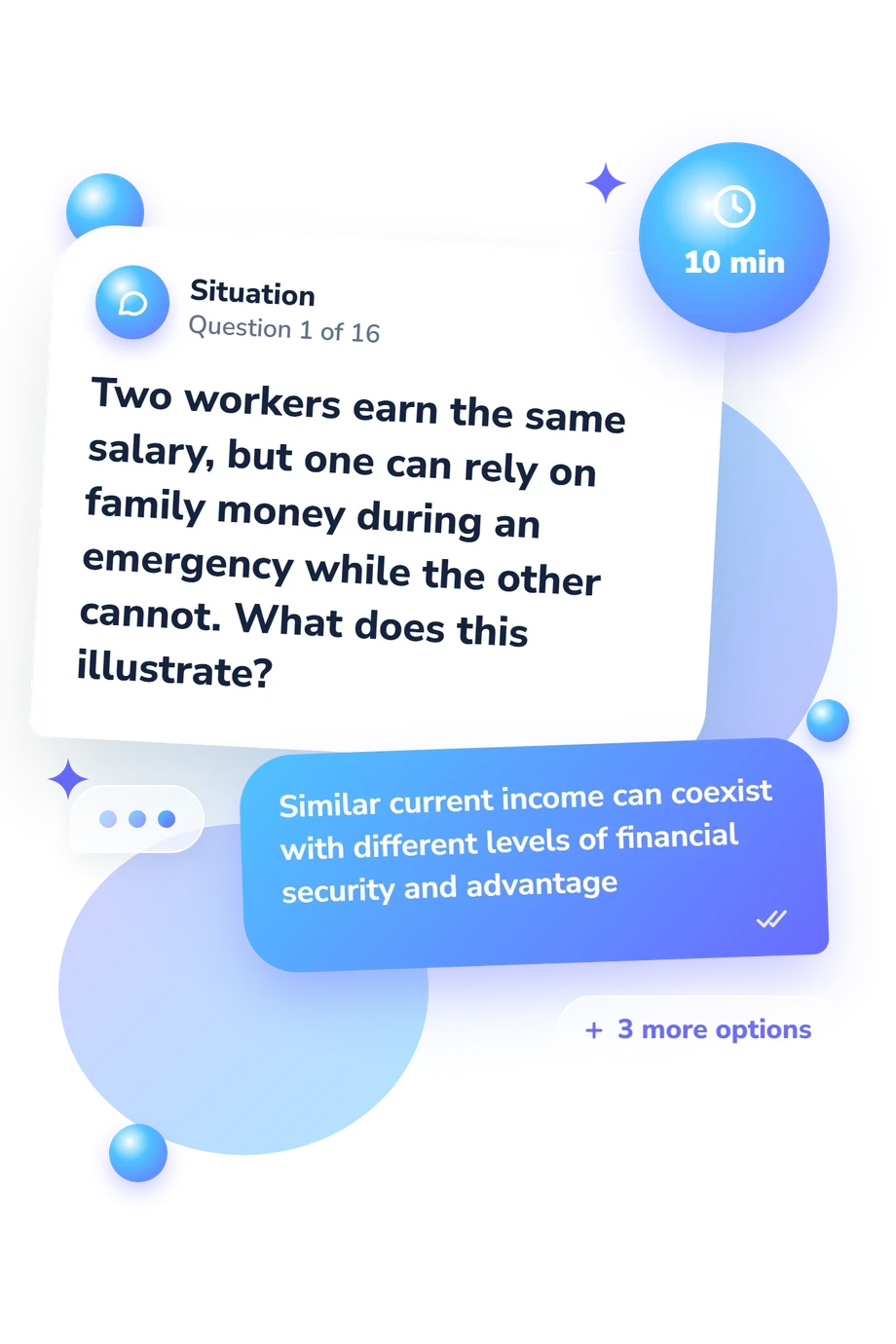
- Similar current income can coexist with different levels of financial security and advantage
- Salary is irrelevant when assessing anyone’s access to opportunity
- Family support always results from better personal planning
- Only the worker without family support experiences economic inequality
- They can face genuine hardships while also being spared certain barriers
- Their hardships were minor compared with everyone else’s
- Their successes resulted entirely from social advantages
- They are personally responsible for every inequality linked to their group
- Assume the difference reflects residents’ motivation unless discrimination is confessed
- Conclude that every resident in the better-served area has an easy life
- Ignore group-level data because individual experiences always vary
- Examine policies, locations, eligibility rules, transport, and other mechanisms producing the pattern
Privilege Quiz - Description and methodology of the test
For readers who want to examine how social advantages and barriers are understood, this privilege quiz offers a focused knowledge check rather than a ranking of personal worth. The questionnaire asks about systems, context, and evidence, and this quiz also examines class privilege rather than treating personal privilege as its subject. The score concerns recognition of concepts, not a measure of how privileged someone is.
What This Assessment Explores
The questions ask whether a respondent can recognize privilege as an unearned advantage or reduced barrier shaped by social positioning, while accepting that hardship and advantage can coexist. As a social privilege questionnaire, it focuses on how institutions, resources, representation, and expectations affect access to opportunity.
Responses contribute to the displayed Privilege Knowledge scale, ranging from 0-16. Foundations to build covers 0-6, Developing understanding 7-12, and Strong understanding 13-16. These bands describe quiz knowledge, not personal virtue or individual privilege.
The main themes are:
- Structural access shows how policies, referrals, eligibility rules, and service distribution can create unequal opportunities.
- Intersectionality explains how identities and systems can combine to produce distinct barriers or advantages.
- Context and representation show how accessibility, visibility, and hidden institutional knowledge shape participation.
- Reflection and allyship responses show recognition of actions that question assumptions, listen, and support equitable action.
Methodology and Evidence Base
Each item offers four choices and asks the respondent to select the response that best fits a concept or situation. Scenarios involving work, education, public services, accessibility, and representation test recognition and application. As a privilege awareness test, the result is knowledge-oriented rather than an estimate of personal privilege.
The items are conceptually consistent with APOS-2 (McClellan et al., 2019), a published measure addressing awareness of privilege and oppression, but this questionnaire is not the APOS-2 or a validated adaptation. Crenshaw's 1989 intersectionality framework helps explain the intersectionality concept used in the questions: overlapping social positions can produce experiences missed when identities are examined separately.
Interpretation should stay close to the displayed bands: a higher result indicates recognition of the concepts represented by the items, not better character or a life free from barriers. No norms or clinical cutoffs are stated, and self-report performance can reflect prior learning, current context, wording interpretation, and the wish to appear socially aware. The score is not a diagnosis or a complete measure of lived privilege.
- McClellan, Michael James, Lori Patricia Montross-Thomas, Pamela Remer, Yoshie Nakai, and Addison D. Monroe. "Development and Validation of the Awareness of Privilege and Oppression Scale-2." SAGE Open, vol. 9, no. 2, 2019, pp. 1-15. 10.1177/2158244019853906
- Crenshaw, Kimberle. "Demarginalizing the Intersection of Race and Sex: A Black Feminist Critique of Antidiscrimination Doctrine, Feminist Theory and Antiracist Politics." University of Chicago Legal Forum, vol. 1989, no. 1, 1989, pp. 139-167. 10.2307/2295397
Updated: