
Newlywed Quiz
How the Scales are Structured
Who Usually Takes This Test?
See How You Compare
Below is a preview of how scores are typically distributed across each scale.
Example Questions From the Test
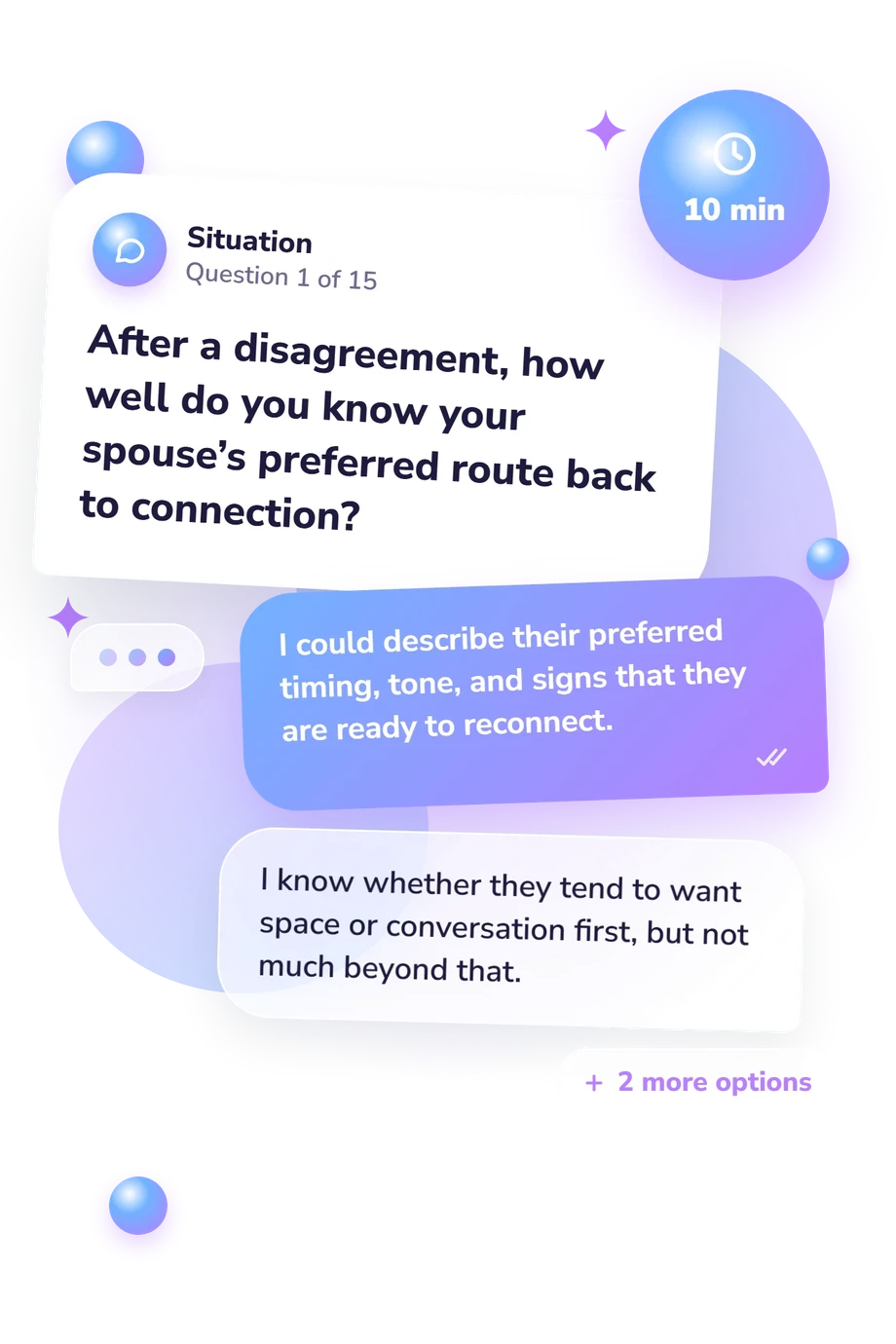
- I could describe their preferred timing, tone, and signs that they are ready to reconnect.
- I know whether they tend to want space or conversation first, but not much beyond that.
- I have noticed a useful pattern and can usually tell which approach will be welcome.
- I am not yet sure what helps them feel ready to reconnect after conflict.
- I could predict their likely reaction and explain which part of the change would matter most.
- I would have little basis for predicting whether they would feel relieved, disappointed, or energized.
- I know whether they usually favor structure or spontaneity, but context could easily change my guess.
- I could make a well-grounded prediction based on similar situations we have shared.
- I could recognize several sensitive subjects but might not connect this comment to the right one.
- I would be guessing because we have not discussed the experiences or topics that feel sensitive to them.
- I know a broad subject that may be involved, though not the personal meaning behind it.
- I could likely identify the sensitive point and understand the context without claiming to know exactly how they feel.
Newlywed Quiz - Description and methodology of the test
For a spouse seeking a picture of what they know about their partner, this assessment turns relationship moments into structured reflection. The newlywed quiz is intended for spouses who want to examine knowledge of daily habits, personal history, emotional cues, and shared expectations without treating familiarity as proof of compatibility. For spouses taking this newly wed quiz, results can highlight questions worth exploring when one partner’s understanding feels less specific.
What This Assessment Explores
The result shows whether knowledge is concrete and current. Items cover preferences, comfort, conflict repair, sensitivities, formative experiences, relationships, pride, celebrations, money, and future plans. They focus on recognizing patterns and meaning, not mind-reading.
The profile separates familiarity into these dimensions:
- Everyday Preferences and Rhythms (0-15) measures recognition of routines, preferences, and comforts: Still discovering (0-5), Growing familiarity (6-10), or Strong familiarity (11-15).
- Personal Story and Inner World (0-15) measures familiarity with experiences, relationships, concerns, and pride: Story still unfolding (0-5), Meaningful understanding (6-10), or Deep familiarity (11-15).
- Shared Relationship and Future (0-15) measures expectations about connection, repair, money, traditions, and plans: Conversations ahead (0-5), Shared outline (6-10), or Well-defined partnership (11-15).
Together, the newlywed questionnaire shows where knowledge is detailed and where conversation may add context; it does not rate marital quality.
Methodology and Scientific Basis
Each item presents a relationship situation with four response choices. Options ask how specifically you know your spouse’s likely reactions, preferences, concerns, and priorities in conflict, free time, celebrations, finances, and future plans.
The questionnaire presents a profile across the three catalogue scales. The displayed bands describe levels of familiarity in each area, not compatibility judgments, so interpret results through the situations behind your choices rather than as fixed judgments.
Its framework is conceptually consistent with Love Maps (Gottman & Silver, 1999), which emphasizes knowledge of a partner’s inner world and daily life. Formative experience questions have a conceptual parallel in Buehlman, Gottman, and Katz (1992), whose oral-history work linked couples’ accounts of their past with later relationship outcomes. Carrere et al. (2000) examined newlywed stability, while Shapiro, Gottman, and Carrere (2000) examined satisfaction after the first baby. These studies provide relationship-research context, not validation of this questionnaire’s three scales or scoring.
As a newlywed test, it depends on honest self-report, memory, current mood, and prior conversations. Use the profile to start specific discussions, while your spouse’s account can add context.
- Gottman, John M., and Nan Silver. The Seven Principles for Making Marriage Work: A Practical Guide from the Country's Foremost Relationship Expert. New York: Crown Publishers, 1999.
- Buehlman, Kim T., John M. Gottman, and Lynn Fainsilber Katz. How a Couple Views Their Past Predicts Their Future: Predicting Divorce from an Oral History Interview. Journal of Family Psychology, 5(3-4), 295-318, 1992. 10.1037/0893-3200.5.3-4.295
- Carrere, Sybil, Kim T. Buehlman, John M. Gottman, James A. Coan, and Lionel Ruckstuhl. Predicting Marital Stability and Divorce in Newlywed Couples. Journal of Family Psychology, 14(1), 42-58, 2000. 10.1037/0893-3200.14.1.42
- Shapiro, Alyson F., John M. Gottman, and Sybil Carrere. The Baby and the Marriage: Identifying Factors That Buffer Against Decline in Marital Satisfaction After the First Baby Arrives. Journal of Family Psychology, 14(1), 59-70, 2000. 10.1037/0893-3200.14.1.59
Updated: