
Muscle Origin and Insertion Quiz
How the Scales are Structured
Who Usually Takes This Test?
See How You Compare
Below is a preview of how scores are typically distributed across each scale.
Example Questions From the Test
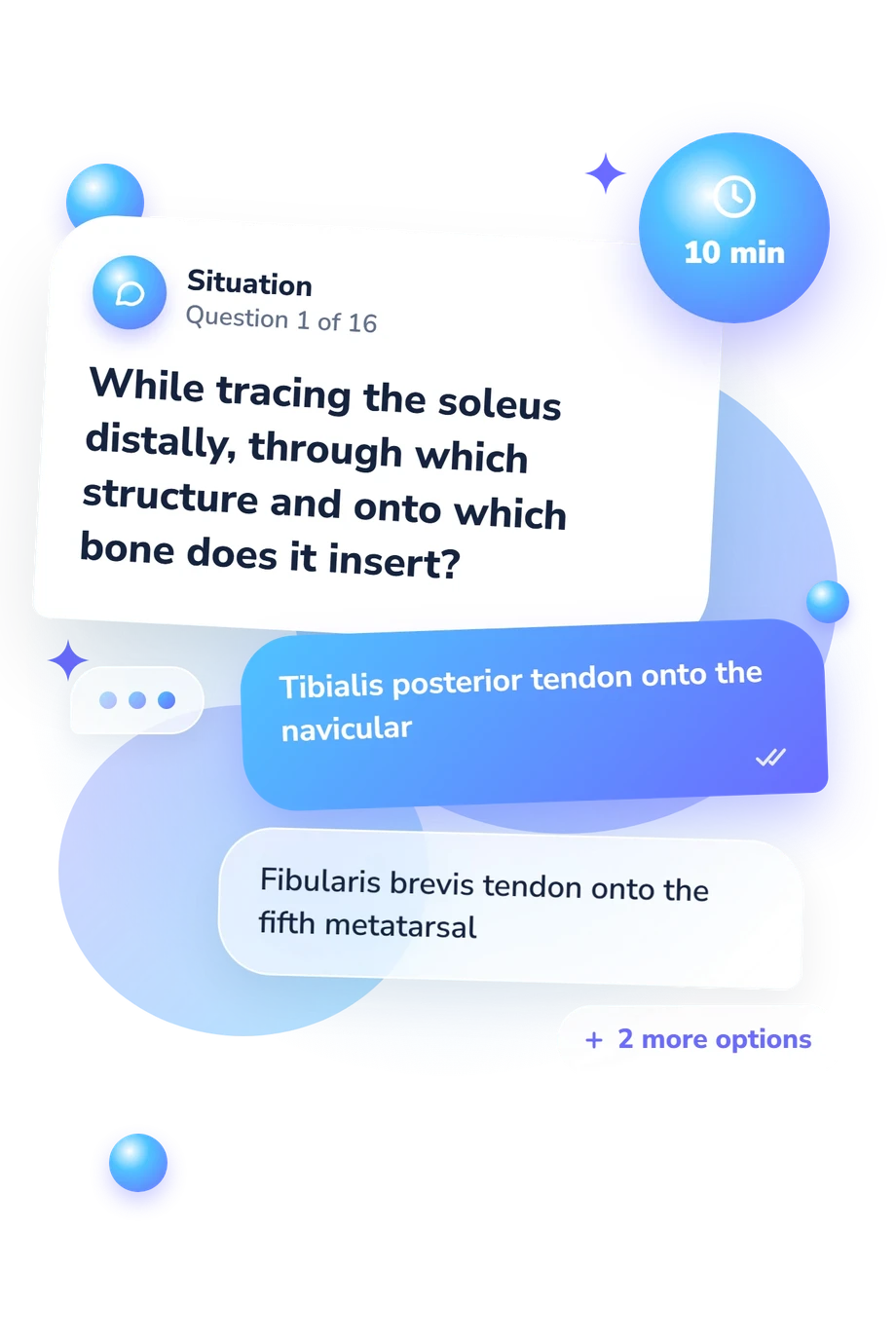
- Tibialis posterior tendon onto the navicular
- Fibularis brevis tendon onto the fifth metatarsal
- Flexor hallucis longus tendon onto the great toe
- Calcaneal tendon onto the calcaneus
- Lateral lip of the intertubercular sulcus
- Medial lip of the intertubercular sulcus
- Deltoid tuberosity
- Floor of the intertubercular sulcus
- Lateral lip of the intertubercular sulcus
- Floor of the intertubercular sulcus
- Lesser tubercle
- Medial lip of the intertubercular sulcus
Muscle Origin and Insertion Quiz - Description and methodology of the test
Students, trainees, and practitioners who want to check their grasp of attachment anatomy can use this muscle origin and insertion quiz as a focused recall exercise. It helps with regional anatomy, practical identification, or using this origin and insertion of muscles quiz to revisit landmarks. It quizzes the origins and insertions of muscles, giving a picture of attachment knowledge and helping readers decide whether an anatomy refresher would be useful.
What This Assessment Measures
Questions connect each named muscle with its origin, insertion, or both through bony and tendon landmarks. Repair, tracing, and imaging scenarios require applied recall rather than isolated naming. Coverage moves across the shoulder, arm, trunk, hip, thigh, and leg, including attachments that are easily confused in neighboring regions.
The result is reported on one knowledge scale:
- Muscle Origin and Insertion Knowledge (0-16) measures attachment recall: Foundations to review (0-6) calls for review of origins, insertions, and landmarks; Developing knowledge (7-12) shows many recognized sites with some confusion; Strong knowledge (13-16) reflects consistent recall.
Higher results suggest reliable recall in the tested examples; lower results identify terminology, landmark, or muscle-specific areas to revisit. Attachment knowledge can help explain muscle actions; in this origins insertions and actions of muscles quiz, the questions support functional study while scoring origins and insertions rather than muscle action.
Methodology and Evidence Base
Each item presents a short prompt with four answer choices. Related landmarks appear together, so success depends on distinguishing neighboring attachments and tracing a muscle to the correct bone or surface. One point is awarded for each correct answer, so the raw total maps directly to the displayed result bands. The total records recall of the attachment facts represented by these items.
Kawamata et al. (2016) describe muscle function through origins and insertions. This questionnaire is conceptually consistent with that framework, not an adaptation of it. The anatomy atlases by Agur and Dalley and by Drake, Vogl, and Mitchell provide reference points for its attachment sites. For anyone using this muscle origin insertion action quiz, the questions support functional reasoning by clarifying a muscle’s line of pull.
Interpret the outcome as a focused profile of those facts: recent study, terminology familiarity, attention, and uncertainty between closely related landmarks can affect performance, so it offers useful study targets without establishing competence in movement analysis or clinical practice.
- Kawamata, Seiichi, Tomoyuki Kurose, Junya Ozawa, and Harutoshi Sakakima. A beginner's guide to understanding muscle function based on origins and insertions. Structure and Function, 2016, 14(2): 62-74. 10.11172/keitaikinou.14.62.
- Agur, Anne M. R., and Arthur F. Dalley II. Grant's Atlas of Anatomy. 16th ed. Philadelphia, PA: Wolters Kluwer, 2024. ISBN 9781975193430.
- Drake, Richard L., A. Wayne Vogl, and Adam W. M. Mitchell. Gray's Anatomy for Students. 5th ed. Philadelphia, PA: Elsevier, 2023. ISBN 9780323934237.
Updated: