
Magic Quiz
How the Scales are Structured
Who Usually Takes This Test?
See How You Compare
Below is a preview of how scores are typically distributed across each scale.
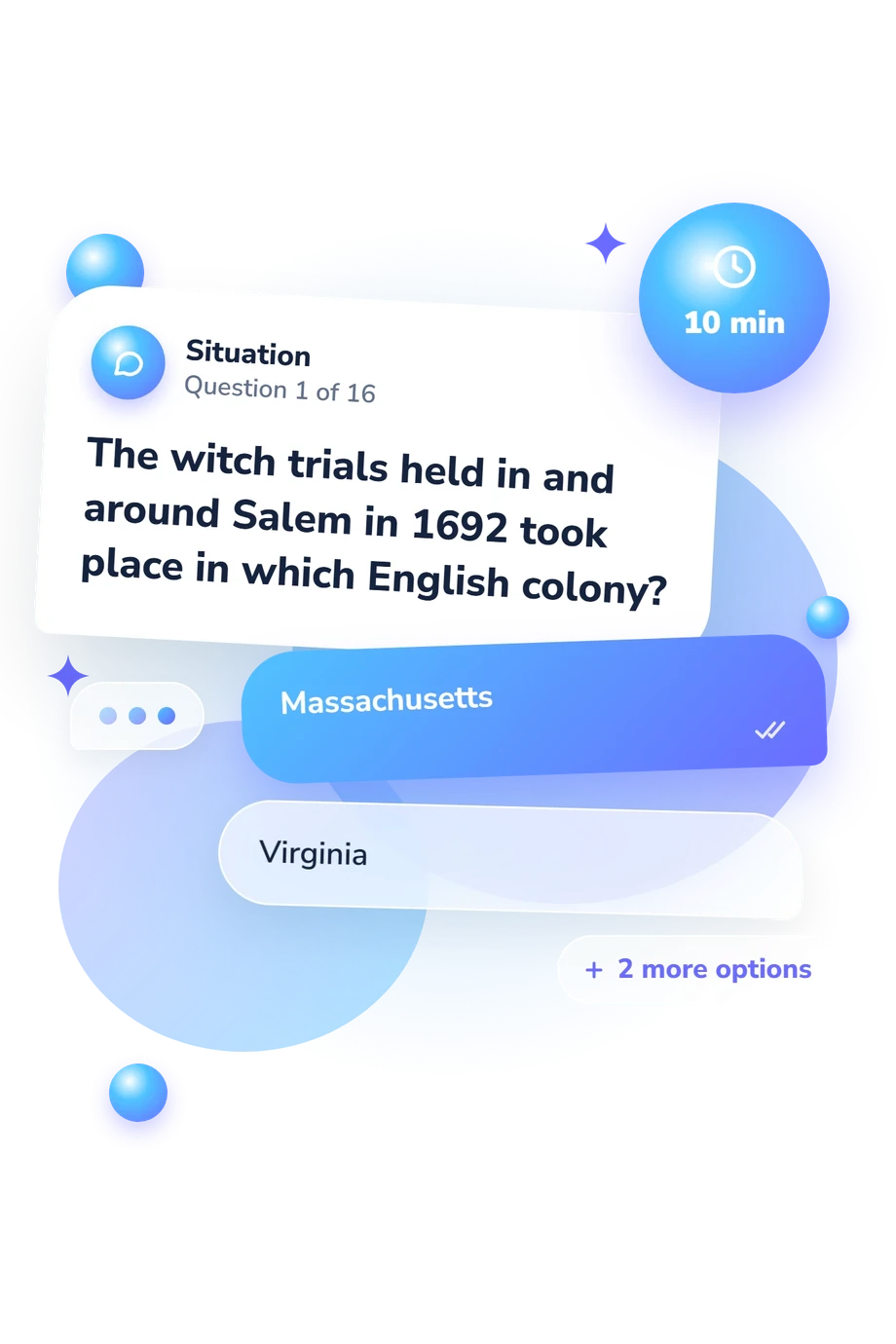
Example Questions From the Test
- Massachusetts
- Virginia
- Pennsylvania
- Maryland
- An alchemical adept
- A court astrologer
- A stage conjurer
- A cunning person or member of the cunning folk
- The Hermetic Order of the Golden Dawn
- The Society of Jesus
- The Royal Society
- The Knights Hospitaller
Magic Quiz - Description and methodology of the test
Curious readers can use this assessment to explore how well they recognize the people, practices, objects, and performance techniques associated with magic across different periods. The magic quiz is designed for self-directed learners who want a map of their historical understanding, whether their interest is cultural, theatrical, folkloric, or esoteric. As a magic knowledge test, it turns broad curiosity into a focused profile rather than a claim about supernatural ability.
What This Assessment Explores
This questionnaire treats magic as a broad historical subject rather than a single practice. Its items cover folk belief, witchcraft, ritual concepts, alchemy, divination, ceremonial traditions, magical books, and stage performance, asking readers to distinguish related ideas and identify notable objects, figures, and techniques. It suits learners interested in cultural history or theatrical craft; as a magick quiz, it measures recognition, not supernatural ability.
The result is reported on one scale, Magic Knowledge (0-16), with these bands:
- Emerging knowledge (0-6) indicates that you recognize some magical themes but may confuse historical traditions and performance methods.
- Developing knowledge (7-12) indicates a solid foundation across periods, with distinctions among ritual, folklore, divination, and illusion still worth refining.
- Strong knowledge (13-16) indicates broad, accurate understanding of magic’s cultural history and key methods.
Methodology and Evidence Base
Each item presents a historical or descriptive prompt with four answer choices. Selecting the correct association, definition, person, object, or performance method makes the result a knowledge score rather than a personality profile. For the curiosity behind an am I magical quiz, the distinction matters: a high result reflects knowledge of magic and its history.
The Magic Knowledge questionnaire is conceptually consistent with the historical coverage discussed by Collins (2015) and Davies (2023). Davies (2009) most closely supports the treatment of grimoires, while Lamont and Steinmeyer (2018) helps frame stage magic as practiced performance involving technique, apparatus, and audience attention. These works provide context; they do not establish that this online questionnaire reproduces or validates any cited book.
It is best read as a curated online knowledge tool, not a standardized scale with norms for this specific form. Results may reflect prior reading, cultural exposure, wording, and guessing. Use the profile to choose subjects for further study, treating the bands as descriptions of performance on this questionnaire rather than universal judgments about expertise.
- Collins, David J., ed. The Cambridge History of Magic and Witchcraft in the West: From Antiquity to the Present. Cambridge University Press, 2015. 10.1017/CHO9781139043021
- Davies, Owen, ed. The Oxford History of Witchcraft and Magic. Oxford University Press, 2023. 10.1093/oso/9780192884053.001.0001
- Davies, Owen. Grimoires: A History of Magic Books. Oxford University Press, 2009. 10.1093/oso/9780199204519.001.0001
- Lamont, Peter, and Jim Steinmeyer. The Secret History of Magic. Tarcher, 2018.
Updated: