
Islamic Quiz
How the Scales are Structured
Who Usually Takes This Test?
See How You Compare
Below is a preview of how scores are typically distributed across each scale.
Example Questions From the Test
- Mawlid
- Ashura
- Eid al-Adha
- Eid al-Fitr
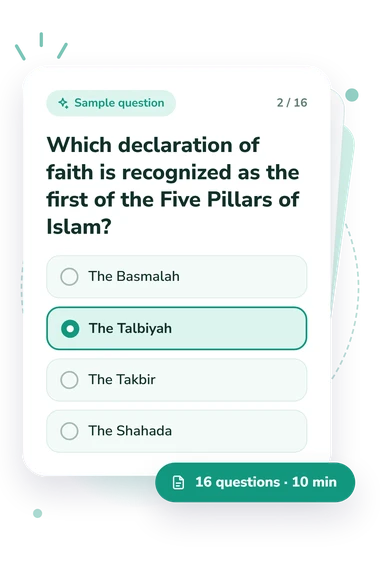
- The Basmalah
- The Talbiyah
- The Takbir
- The Shahada
- Ali ibn Abi Talib
- Abu Bakr
- Umar ibn al-Khattab
- Uthman ibn Affan
Islamic Quiz - Description and methodology of the test
If you want a structured review of core Islamic knowledge, the Islamic Quiz lets you check factual recall and see how broadly you recognize commonly taught material. For a focused review, this Islamic studies quiz offers a focused review of general knowledge across beliefs, practices, history, scripture, and observances. The result offers a practical snapshot for planning further study.
What This Assessment Explores
The questionnaire’s Islamic knowledge quiz questions test commonly taught terms, observances, scripture, historical events, and sacred places. They use recall and brief situations to ask about prayers, purification, celebrations, pilgrimage locations, and Quranic details.
These content areas belong to one overall score, not separate scales:
- Questions about beliefs and declarations test recognition of foundational concepts.
- Items on worship and purification ask about prayer, fasting, and ritual preparation.
- Questions on sacred observances cover Ramadan, Hajj, and charitable duties.
- Scripture and revelation items ask about chapters, verses, and revelation history.
- History and places questions cover the Hijra, early caliphs, pilgrimage sites, and qibla.
Islamic Knowledge runs from 0-16 and counts correct answers. Foundations to Build (0-6), Developing Knowledge (7-12), and Strong Knowledge (13-16) describe increasing command of the covered facts; this educational result does not measure faith, devotion, or religious authority.
Methodology and Evidence Base
Each item presents a short question or scenario with four answer choices. That structure also suits adults taking an Islamic knowledge quiz: because each item has a correct answer, the total is a straightforward count of correct responses. It records factual accuracy.
The design is conceptually consistent with Inventory of Basic Religious Knowledge, a published reference for assessing basic religious knowledge. This questionnaire is not presented as a reproduction or validated adaptation of that inventory. Abdel Haleem’s translation supports Quranic references, while Esposito’s dictionary supports terminology and historical context.
These sources support the subject matter and conceptual coverage, not inherited psychometric properties. The online questionnaire is separate from the published IBRK and is not presented as having test-specific norms, reliability, or validity evidence; its displayed bands are descriptive ranges tied to correct-answer totals.
Guessing, wording familiarity, memory, and current exposure can affect performance. Read the result as a snapshot of factual knowledge that can guide further study.
- Mohammad Aziz Shah Mohamed Arip, Samsiah Mohd Jais, Aniza Benu, Mohd Safuan Zakaria, Nur Hazwani Zahariman, and Norehan Ishak. "Construction, Validity and Reliability of the Inventory of Basic Religious Knowledge (IBRK)." International Journal of Assessment and Evaluation in Education, vol. 2, 2012, pp. 86-94.
- M. A. S. Abdel Haleem. The Qur'an: A New Translation. Oxford University Press, 2004.
- John L. Esposito, ed. The Oxford Dictionary of Islam. Oxford University Press, 2003. 10.1093/acref/9780195125580.001.0001