
Is She Right for Me Quiz
How the Scales are Structured
Who Usually Takes This Test?
See How You Compare
Below is a preview of how scores are typically distributed across each scale.
Example Questions From the Test
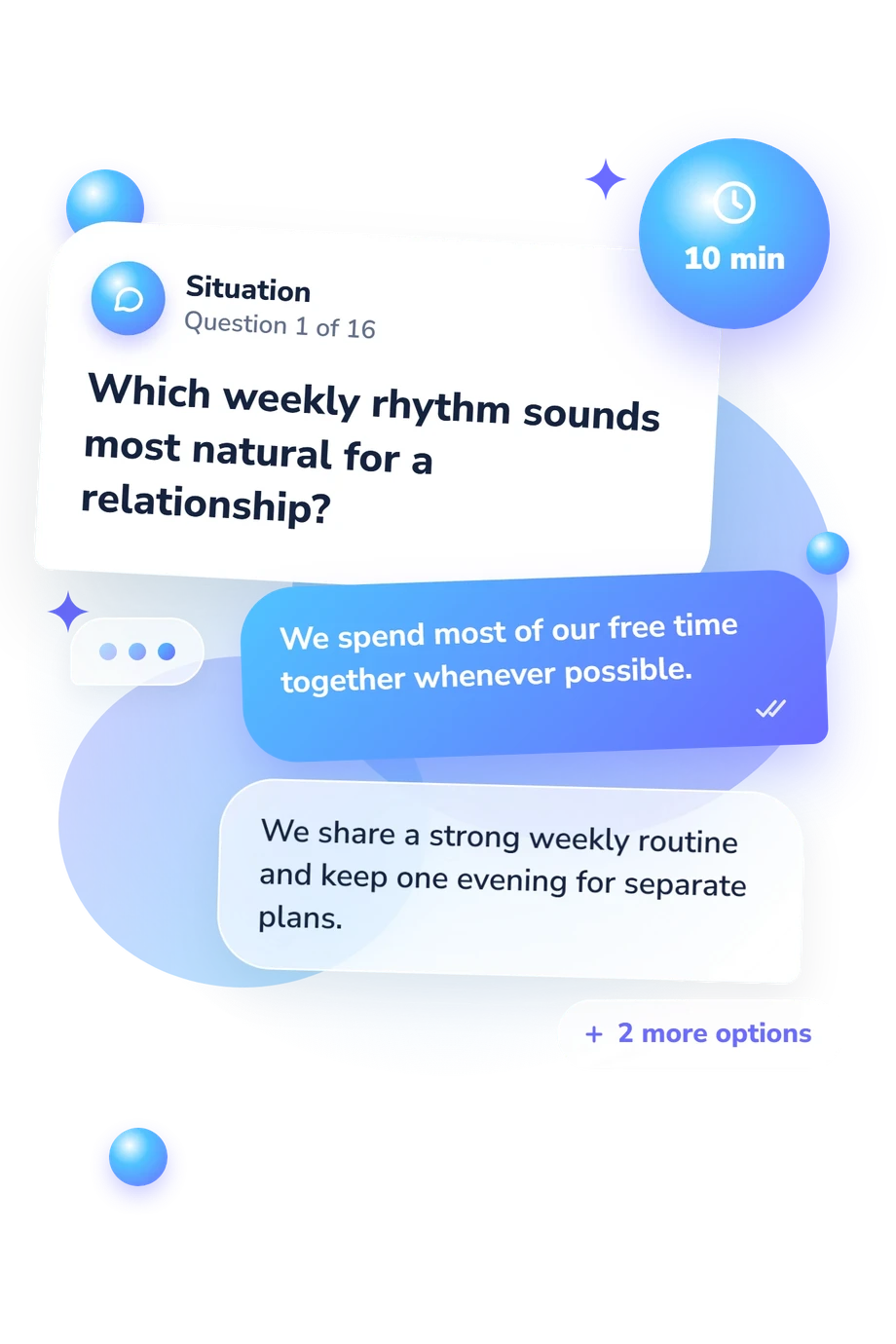
- We spend most of our free time together whenever possible.
- We share a strong weekly routine and keep one evening for separate plans.
- We pursue several independent interests and protect intentional time together.
- Our schedules remain fluid, and we reconnect deliberately without expecting constant overlap.
- We protect our freedom to make most decisions independently.
- We discuss our thinking but retain separate final calls.
- We coordinate decisions that could significantly affect the other person.
- We build shared long-term plans and use them to guide major choices.
- We divide the work efficiently and focus on getting it finished.
- We put on music and chat while working at a comfortable pace.
- We invent a playful challenge to make the task more engaging.
- We embrace the silliness, with jokes, dramatic commentary, or spontaneous dancing.
Is She Right for Me Quiz - Description and methodology of the test
People weighing long-term compatibility can use the Is She Right for Me Quiz to reflect on the partner qualities that feel most natural to them. It is intended for anyone clarifying expectations, comparing relationship rhythms, or preparing for a thoughtful conversation about fit. This romantic compatibility quiz is a preference profile: it organizes partner preferences to help name priorities and compare relationship rhythms, rather than measuring relationship quality or success.
What This Assessment Explores
Everyday choices reveal the partnership style that feels appealing: emotional openness, dependable coordination, personal autonomy, or lively spontaneity. The result describes affinity, not ability or relationship quality. For anyone taking the is she the right girl for me quiz, the result turns a broad impression into specific preferences.
The four result dimensions are:
- Deep Communicator (0-12) measures affinity for emotional openness: Experience-Led Connection (0-4), Selective Depth (5-8), and Strong Communication Affinity (9-12).
- Grounded Teammate (0-12) measures preference for reliability: Flexibility First (0-4), Balanced Foundation (5-8), and Strong Grounded Affinity (9-12).
- Independent Free Spirit (0-12) measures attraction to autonomy: Togetherness-Centered (0-4), Connected Independence (5-8), and Strong Free-Spirit Affinity (9-12).
- Playful Companion (0-12) measures appeal of humor and improvisation: Calm Connection (0-4), Lighthearted Balance (5-8), and Strong Playful Affinity (9-12).
Methodology and Scientific Basis
Each item presents a relationship situation with four preference-based response options, including reactions to vulnerability, disrupted plans, separate hobbies, and major decisions. The completed questionnaire displays four profile dimensions. Point allocation is not documented, so the results form a preference profile rather than scores from a stated algorithm; no response is correct, and no style is universally better.
The closest conceptual comparison is Sprecher and Regan (2002), which examined qualities people prefer in romantic partners and friendships. Fletcher and Simpson (2000) offer the ideal-standards framework for understanding how desired partner characteristics organize relationship expectations. Proyer (2017) contributes a model of adult playfulness relevant to humor, improvisation, and spontaneity. The questionnaire is conceptually consistent with these works but is not an adaptation of those measures and has not been validated by those studies.
The result bands are descriptive categories, not standardized population norms or clinical cutoffs. Self-reports can also shift with current mood, recent relationship experiences, and self-awareness; as a relationship fit quiz, it works best when considered alongside real interactions and broader reflection.
- Sprecher, Susan, and Pamela C. Regan. "Liking Some Things (in Some People) More Than Others: Partner Preferences in Romantic Relationships and Friendships." Journal of Social and Personal Relationships 19, no. 4 (2002): 463-481. 10.1177/0265407502019004048
- Fletcher, Garth J. O., and Jeffry A. Simpson. "Ideal Standards in Close Relationships: Their Structure and Functions." Current Directions in Psychological Science 9, no. 3 (2000): 102-105. 10.1111/1467-8721.00070
- Proyer, René T. "A New Structural Model for the Study of Adult Playfulness: Assessment and Exploration of an Understudied Individual Differences Variable." Personality and Individual Differences 108 (2017): 113-122. 10.1016/j.paid.2016.12.011
Updated: