
Innate Personality Quiz
How the Scales are Structured
Who Usually Takes This Test?
See How You Compare
Below is a preview of how scores are typically distributed across each scale.
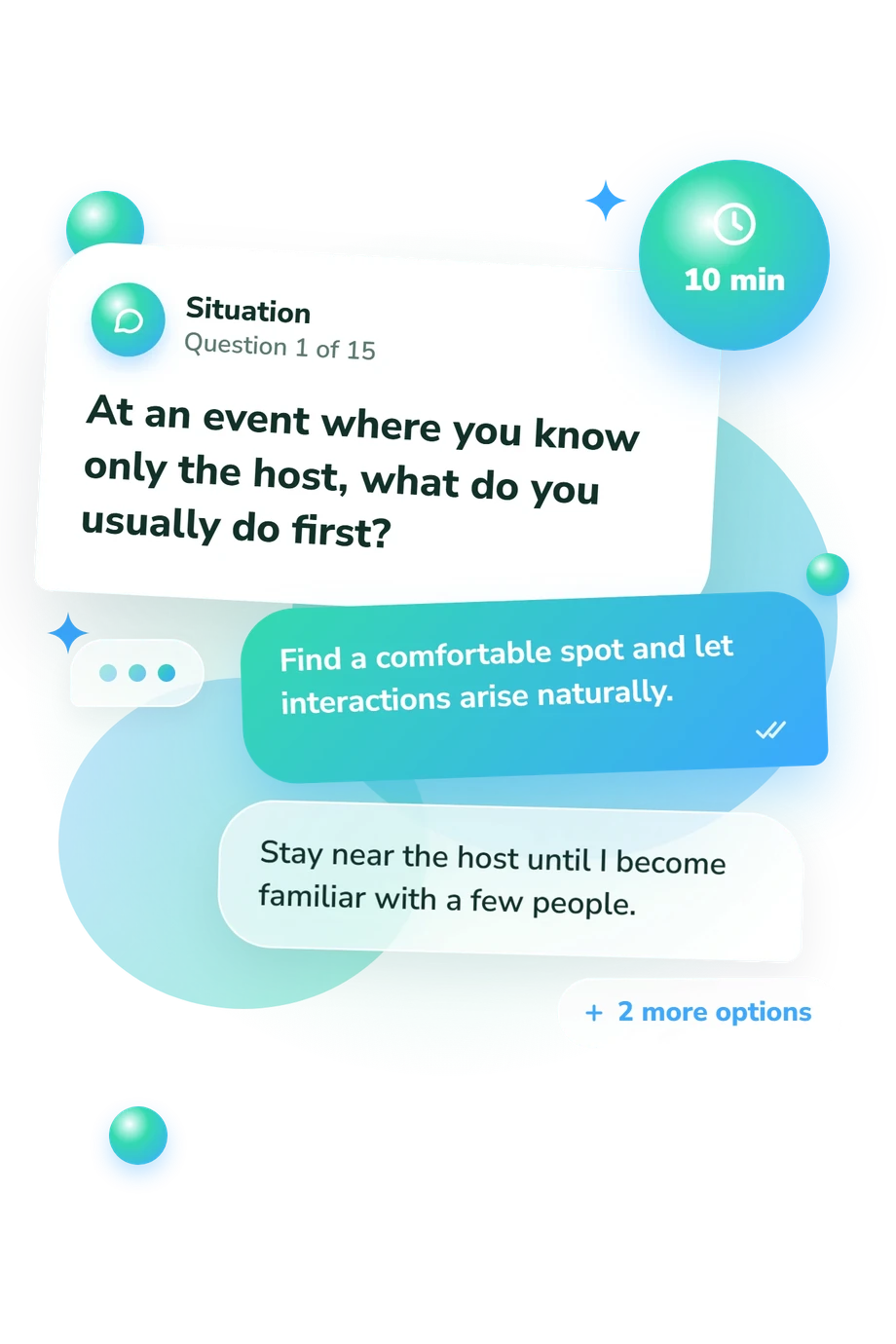
Example Questions From the Test
- A dish I already know I enjoy.
- A familiar dish with one different ingredient or variation.
- Something new after checking what it contains.
- The option most unlike anything I have tried before.
- Settling only the essentials and working out the rest there.
- Booking the main arrangements while leaving most days open.
- Planning key activities with some unassigned time between them.
- Creating a detailed itinerary with decisions made in advance.
- I begin wanting substantial time alone fairly early.
- I enjoy the company but need regular quiet breaks.
- I remain engaged most of the day, with a little downtime.
- The continued interaction tends to increase my energy.
Innate Personality Quiz - Description and methodology of the test
People who want to understand recurring preferences in everyday choices can use the Innate Personality Quiz as a compact starting point. Rather than judging character, it maps how you tend to approach novelty, company, and planning. As an innate traits quiz, it gives language for patterns that may help you reflect on routines, decisions, and social energy.
What This Assessment Explores
The questionnaire functions as an innate personality traits quiz by examining preferences rather than ability, virtue, or fixed identity. Its scenarios sample responses when novelty competes with familiarity, interaction with solitude, and open options with advance order. The result gives visitors a vocabulary for everyday tendencies without treating any profile as better than another.
The result separates these areas:
- Exploratory Drive (0-15) reflects attraction to novelty: Familiarity-led (0-5) favors known options; Selectively exploratory (6-10) welcomes purposeful or manageable novelty; Discovery-led (11-15) is drawn to variety and unfamiliar experiences.
- Social Stimulation (0-15) reflects how much interaction feels energizing: Quietly recharging (0-5) favors solitude or low-key company; Socially flexible (6-10) varies with context; Interaction-fueled (11-15) often gains energy through shared activity.
- Structure Preference (0-15) reflects advance order: Adaptability-led (0-5) favors open options; Lightly structured (6-10) balances planning and flexibility; Plan-led (11-15) prefers clear steps and timelines without measuring competence.
Methodology and Scientific Basis
Each of the 15 scenarios offers four response choices along the relevant preference continuum. Five items address each dimension, and responses are combined into dimension totals interpreted through the published bands. Because the point contribution of each option is not stated, use those bands rather than reverse-engineering a scoring formula.
Its conceptual reference point is the Big Five Inventory-2 (Soto and John, 2017), especially broad tendencies associated with openness, extraversion, and conscientiousness. The connection is conceptual: this online questionnaire is not a digital administration, short form, or validated adaptation of the BFI-2. Goldberg’s (1990) Big Five factor structure provides the wider framework, while Soto and John’s (2017) brief-form research shows how broad domains can be sampled with fewer items.
Your innate traits quiz result is best read as a description of present preferences. It has no stated population norms, reliability estimates, or clinical cutoffs, so its bands describe orientation rather than standardized standing. Because responses depend on self-report, current context, mood, and self-awareness can influence the pattern; treat it as structured reflection, not a diagnosis or standalone clinical assessment.
- Christopher J. Soto and Oliver P. John (2017). The next Big Five Inventory (BFI-2): Developing and assessing a hierarchical model with 15 facets to enhance bandwidth, fidelity, and predictive power. Journal of Personality and Social Psychology, 113(1), 117-143. DOI 10.1037/pspp0000096
- Christopher J. Soto and Oliver P. John (2017). Short and extra-short forms of the Big Five Inventory-2: The BFI-2-S and BFI-2-XS. Journal of Research in Personality, 68, 69-81. DOI 10.1016/j.jrp.2017.02.004
- Lewis R. Goldberg (1990). An alternative "description of personality": The Big-Five factor structure. Journal of Personality and Social Psychology, 59(6), 1216-1229. DOI 10.1037/0022-3514.59.6.1216
Updated: