
Infection Control Quiz
How the Scales are Structured
Who Usually Takes This Test?
See How You Compare
Below is a preview of how scores are typically distributed across each scale.
Example Questions From the Test
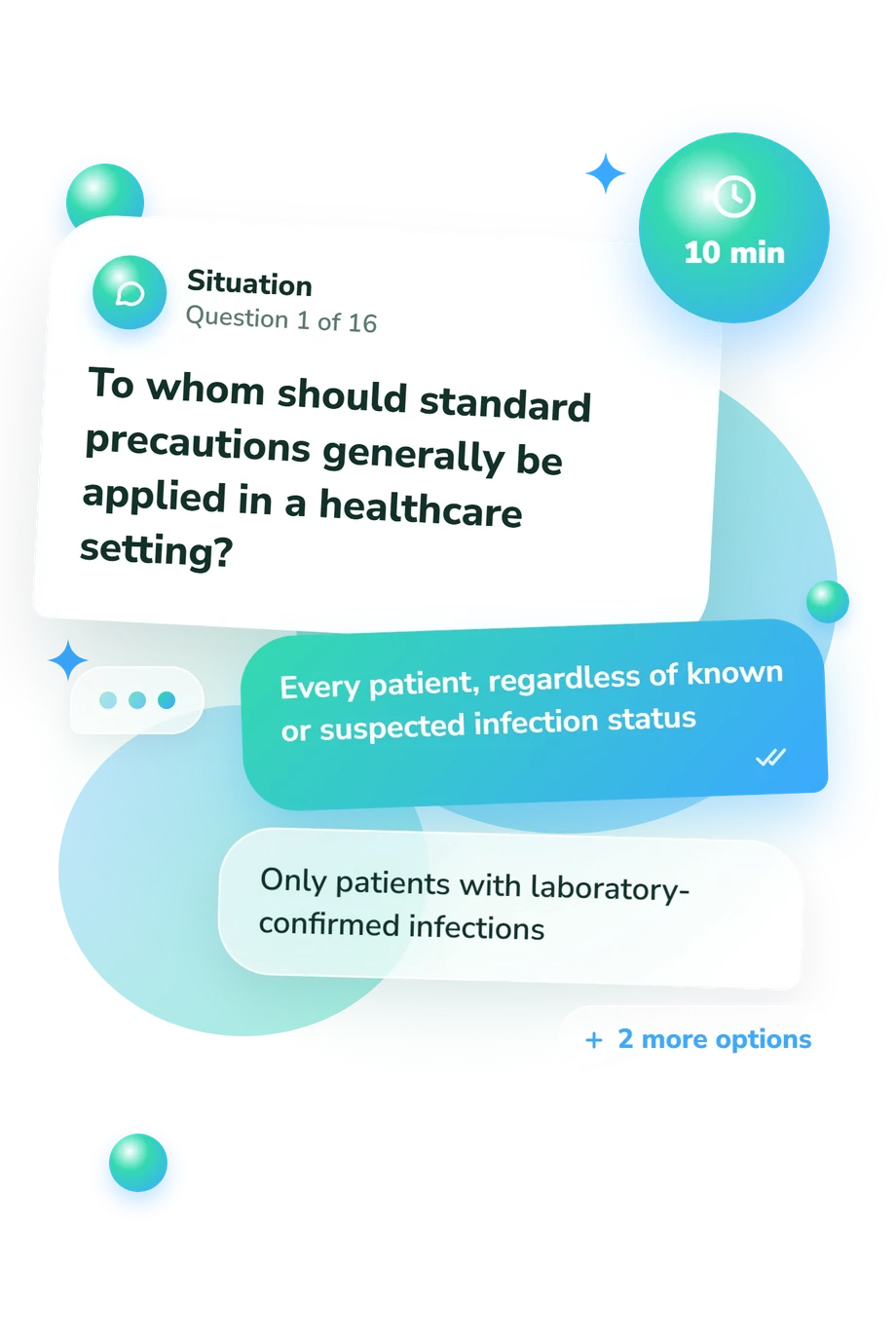
- Every patient, regardless of known or suspected infection status
- Only patients with laboratory-confirmed infections
- Only patients who have fever or respiratory symptoms
- Only patients placed in an isolation room
- Susceptible host
- Mode of transmission
- Portal of exit
- Portal of entry
- Wipe the product off immediately to prevent residue
- Use extra product but shorten the contact time
- Keep the surface wet for the full labeled contact time
- Dry the surface first and then apply the disinfectant lightly
Infection Control Quiz - Description and methodology of the test
Healthcare learners and workers who want to check practical prevention knowledge can use this infection control quiz to examine everyday safety decisions. It suits readers who handle patients, equipment, specimens, surfaces, or occupational exposures. Its infection-control quiz questions and answers format presents each decision with alternatives, while the result highlights topics that may deserve review before applying workplace procedures rather than treating a single score as proof of competence.
What This Assessment Measures
These items examine infection-prevention decisions in healthcare. They cover precautions, source control, hand hygiene, gloves, injection safety, sharps, exposure response, environmental cleaning, disinfection, sterilization, and specimen transport. The focus is recognition of recommended actions, not symptoms or attitudes.
Rather than an infection-control quiz true or false format, it asks respondents to distinguish plausible actions. The list shows how the result can be read:
- Precautions and transmission control show recognition of baseline protection, respiratory measures, and safe movement.
- Hand hygiene and barrier use indicate whether cleaning and glove practices occur at appropriate moments.
- Injection, sharps, and exposure response show recognition of safer preparation, disposal, and follow-up.
- Infection Control Knowledge (0-16) gives the total: Foundation to build (0-6) calls for review, Developing knowledge (7-12) reflects many essentials, and Strong knowledge (13-16) indicates solid recognition of widely used principles.
Methodology and Evidence Base
Each item presents a healthcare situation with several response options, and the respondent chooses the action that best fits. The format tests recognition and application rather than agreement with statements. Responses contribute to a knowledge total; no weighting, item-difficulty adjustment, or normative comparison is stated.
For learners, this infection-control quiz and answers format checks safer choices when alternatives seem plausible. It cannot predict performance in every workplace or unusual exposure.
The content is conceptually consistent with HICPAC guidance from 2017, especially standard precautions, hand hygiene, injection safety, environmental controls, and exposure management. Isolation, source control, and transport align with Siegel et al. (2007); cleaning, disinfection, and sterilization correspond to Rutala and Weber (2017). These references support the domains, not a claim that this questionnaire is an adaptation or validated administration of those publications.
For practical review, infection-control quiz answers prompt study against current workplace and local protocols. Results can vary with attention, prior training, answer selection, and context. The score is educational, not a standardized credential; a possible exposure still requires reporting and health guidance.
- Healthcare Infection Control Practices Advisory Committee. Core Infection Prevention and Control Practices for Safe Healthcare Delivery in All Settings - Recommendations of the Healthcare Infection Control Practices Advisory Committee. Atlanta, GA: Centers for Disease Control and Prevention; 2017.
- Siegel JD, Rhinehart E, Jackson M, Chiarello L, Healthcare Infection Control Practices Advisory Committee. 2007 Guideline for Isolation Precautions: Preventing Transmission of Infectious Agents in Health Care Settings. American Journal of Infection Control. 2007;35(10 Suppl 2):S65-S164. 10.1016/j.ajic.2007.10.007.
- Rutala WA, Weber DJ, Healthcare Infection Control Practices Advisory Committee. Guideline for Disinfection and Sterilization in Healthcare Facilities, 2008 [Updated February 15, 2017]. Atlanta, GA: Centers for Disease Control and Prevention; 2017.
Updated: