
Ice Breaker Quiz
How the Scales are Structured
Who Usually Takes This Test?
See How You Compare
Below is a preview of how scores are typically distributed across each scale.
Example Questions From the Test
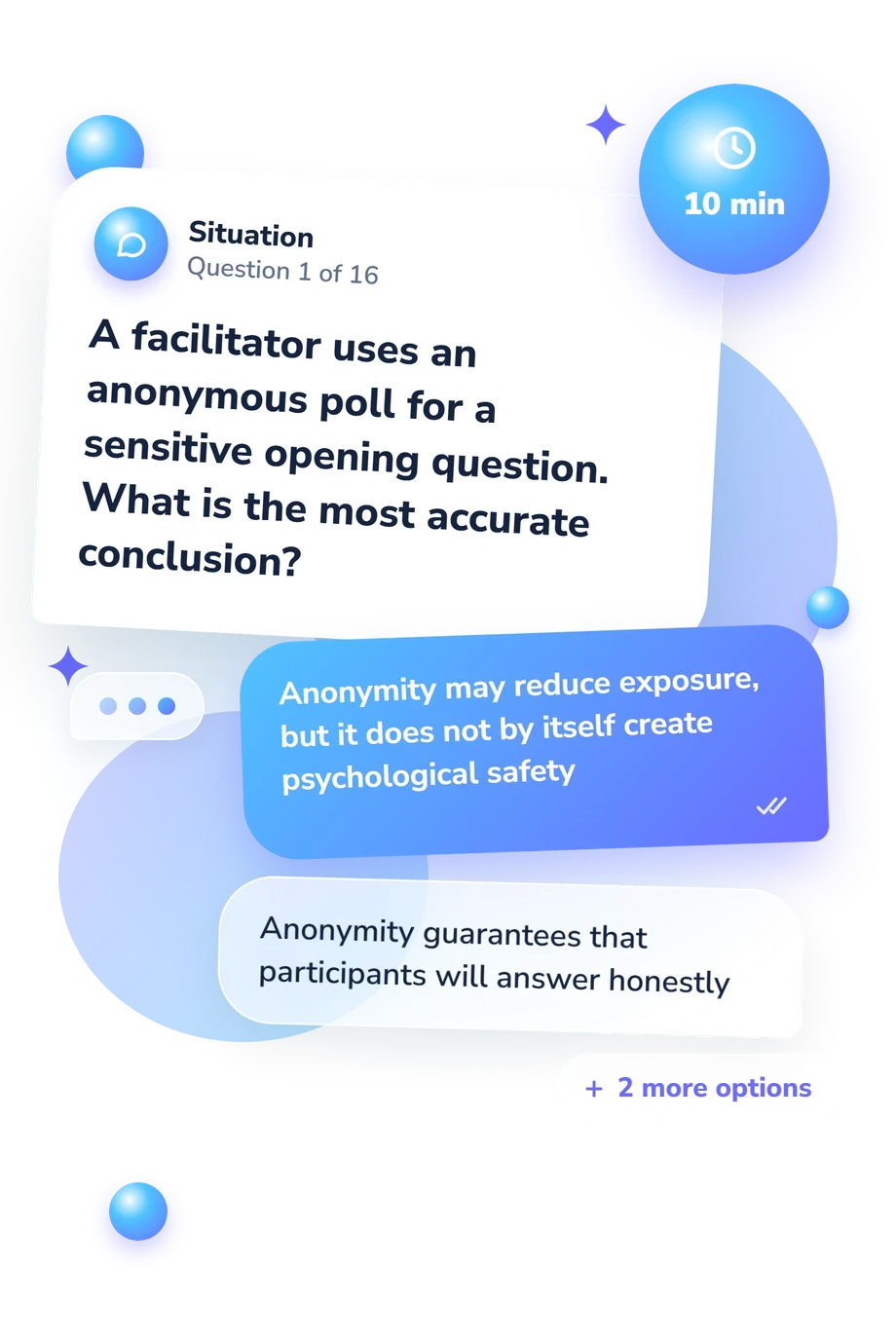
- Anonymity may reduce exposure, but it does not by itself create psychological safety
- Anonymity guarantees that participants will answer honestly
- Anonymous responses are useful only when the group already knows one another
- Anonymous polls remove the need to explain why sensitive information is being requested
- It depends on a shared cultural reference that most people are likely to recognize
- It allows several valid ways to respond and different levels of personal disclosure
- It rewards the fastest or funniest response to raise the group’s energy
- It requires participants to describe an unusual life experience
- Ask for immediate answers in an unpredictable order
- Reward the first few responses and close the activity quickly
- Require an improvised story so nobody can prepare a polished answer
- Show the prompt, allow quiet reflection, and offer pair, chat, or spoken responses
Ice Breaker Quiz - Description and methodology of the test
Designed for facilitators, trainers, team leads, and anyone planning a group opening, this ice breaker quiz offers a focused check of practical facilitation knowledge. Its knowledge-check format considers how icebreaker activities shape decisions in group openings. The overall result places your knowledge in a broad band and can guide reflection on facilitation choices that deserve more attention.
What This Assessment Explores
The assessment checks considerate group-opening knowledge, not sociability. The icebreaker quiz presents scenarios about sensitive prompts, anonymity, voluntary participation, remote access, status differences, reflection time, and transitions. These situations test whether respondents can identify choices that lower pressure while helping a group begin.
Questions cover three thematic areas:
- Voluntary participation and accessibility mean people can pass, choose less personal responses, and use varied channels or processing time.
- Psychological safety concerns interpersonal risk without humiliation or punishment, rather than guaranteed comfort or agreement.
- Facilitation judgment covers prompt pressure, pacing, debriefing, boundaries, and contextual fit.
The displayed scale is Ice Breaker Knowledge: 0-16. Emerging (0-6) indicates core ideas need review; Developing (7-12) shows many sound practices with room to refine choices; Strong (13-16) shows consistent understanding of inclusive, psychologically considerate facilitation. It measures knowledge, not whether a group is psychologically safe.
Methodology and Scientific Basis
Each item presents a facilitation situation with four answer choices. The respondent selects an answer, and the displayed method awards one point for each correct answer. Scores therefore reflect recognition of sound practice, not disclosure or a rating of group performance.
A study by Dixon and colleagues on online icebreakers offers the closest conceptual reference for participation and community online. This questionnaire is conceptually consistent with that work, not an adaptation of it. Edmondson's work supplies a relevant framework for interpreting psychological safety as interpersonal risk without humiliation or punishment. A recent blended-learning study by Tang and colleagues describes activities intended to support engagement and safety. These sources do not validate or standardize this online questionnaire.
Across the ice breaker questions, interpretation depends on the pattern of correct choices and the resulting band. The displayed method does not provide norms, reliability estimates, or evidence that the online questionnaire has been standardized against a reference population. Prior training, guessing, wording sensitivity, and current assumptions can affect performance, so the result is best read as a focused educational self-check of facilitation knowledge.
- Dixon, Julie S., Heather Crooks, and Karen Henry. (2006). Breaking the ice: Supporting collaboration and the development of community online. Canadian Journal of Learning and Technology, 32(2), 99-117. 10.21432/T25S3M
- Tang, Runshuang, Victor Vilhelm Poulsen, Xi Nan, and Jun Zhao. (2026). From Uncertainty to Engagement: A First-Day Blended Bingo and Speed-Dating Icebreaker for Building Psychological Safety. Management Teaching Review. 10.1177/23792981261460400
- Edmondson, Amy. (1999). Psychological Safety and Learning Behavior in Work Teams. Administrative Science Quarterly, 44(2), 350-383. 10.2307/2666999
Updated: