
Hyphen Quiz
How the Scales are Structured
Who Usually Takes This Test?
See How You Compare
Below is a preview of how scores are typically distributed across each scale.
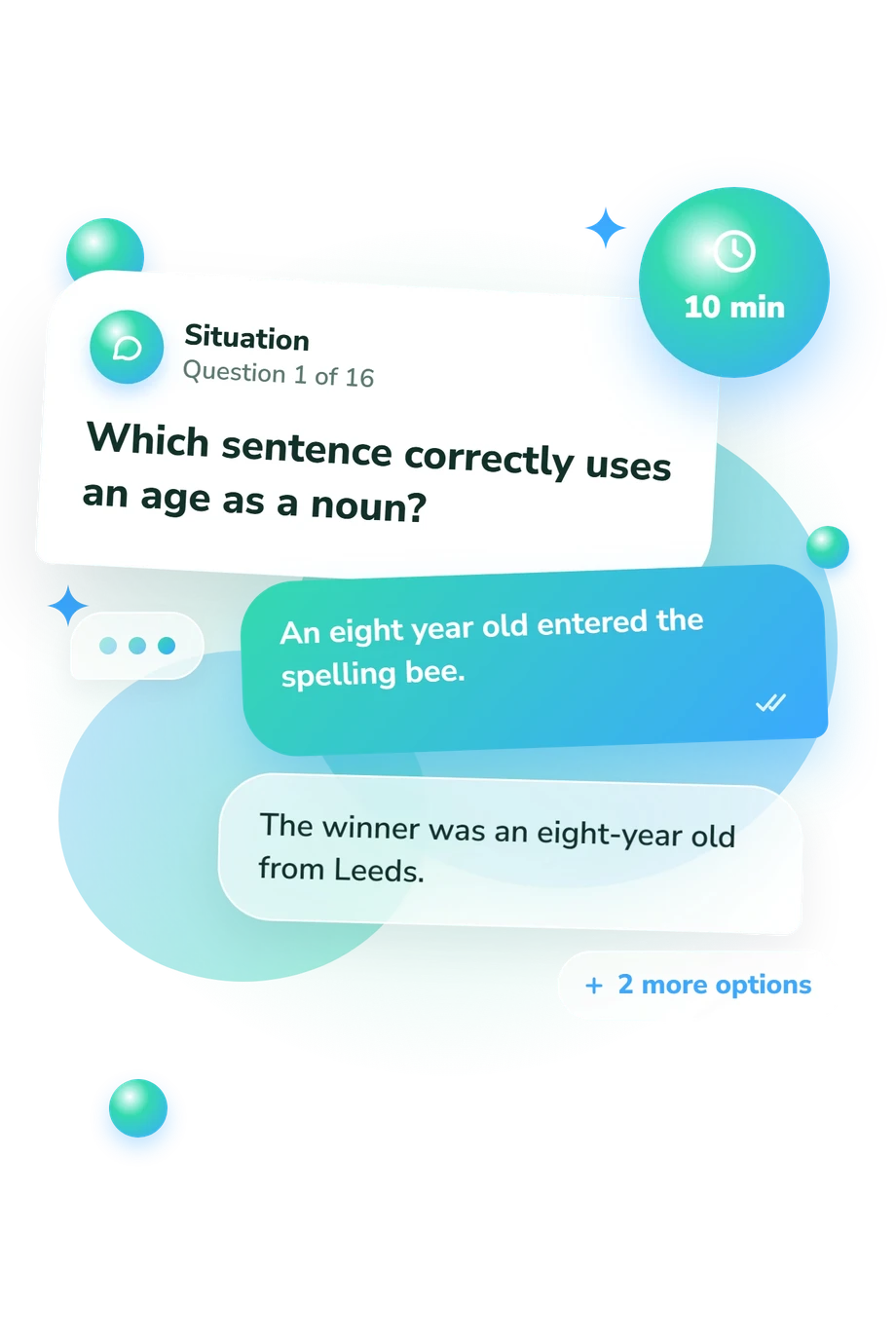
Example Questions From the Test
- An eight year old entered the spelling bee.
- The winner was an eight-year old from Leeds.
- That eight year-old accepted the trophy.
- The eight-year-old won the spelling bee.
- The team improved its decision-making process.
- Managers reviewed the decision-making-process yesterday.
- The committee changed its decision making-method.
- Training strengthened the group’s decision making process.
- The software is up to date.
- Our records remain up-to date.
- The online calendar looks up to-date.
- Every installed program is up-to-date.
Hyphen Quiz - Description and methodology of the test
Readers who want to check their command of edited English can use this hyphen quiz to examine decisions that often look small but affect clarity and consistency. It is intended for writers, editors, students, teachers, and anyone who wants a focused grammar practice tool. With its focus on compound forms, this English hyphenation quiz can be especially useful when you are unsure whether a word group should be joined, left open, or hyphenated.
What This Assessment Explores
This assessment measures control of hyphenation in edited English, not writing ability. It examines when multiword expressions function as units before nouns and when they remain open elsewhere.
It suits writers, editors, teachers, students, and learners checking conventions. For readers who edit or study English, it serves as an English hyphenation test for choices that affect how phrases are parsed.
The situations include:
- Compound modifiers show when terms such as “part-time,” “well-written,” and “decision-making” join before a noun.
- Age, number, and duration expressions show how words combine in noun modifiers.
- Prefixes and self-compounds distinguish forms such as “ex-manager,” “self-aware,” and “re-cover.”
- Suspended hyphenation handles modifiers such as “first- and second-year.”
The scale is Hyphen Knowledge (0-16), with Foundations (0-6), Developing (7-12), and Strong (13-16). These bands show how reliably respondents apply the conventions; they do not measure writing quality.
Methodology and Evidence Base
Each item presents four sentence choices, and the respondent selects the form that follows edited-English usage. The task tests recognition in context rather than recall of definitions. The total is reported as a bounded performance score across the item set.
The context-based format identifies hyphenation patterns that deserve review, giving writers focused English hyphenation practice rather than measuring general language ability.
The evidence base combines linguistic and editorial perspectives. Sun and Baayen (2021) explain how hyphenation can mark relationships within English compounds. Chicago style guidance supplies rules for compound modifiers, prefixes, number expressions, and related punctuation. The questionnaire is conceptually consistent with these sources, not a reproduction or validated adaptation of either.
Scoring is limited to the conventions represented by the items. No norm-referenced standardization, reliability estimate, or diagnostic validation is established for this online questionnaire. Familiarity with a house style, attention, and uncertainty about context can affect choices. Dictionaries and editorial styles may differ beyond the tested cases, so the result is best used to guide revision and practice.
- Sun, Kun, and Rolf Harald Baayen. "Hyphenation as a compounding technique in English." Language Sciences 83 (2021): 101326. 10.1016/j.langsci.2020.101326
- University of Chicago Press Editorial Staff. The Chicago Manual of Style. 17th ed. Chicago: University of Chicago Press, 2017.
Updated: