
How Do Men Perceive You Quiz
How the Scales are Structured
Who Usually Takes This Test?
See How You Compare
Below is a preview of how scores are typically distributed across each scale.
Example Questions From the Test
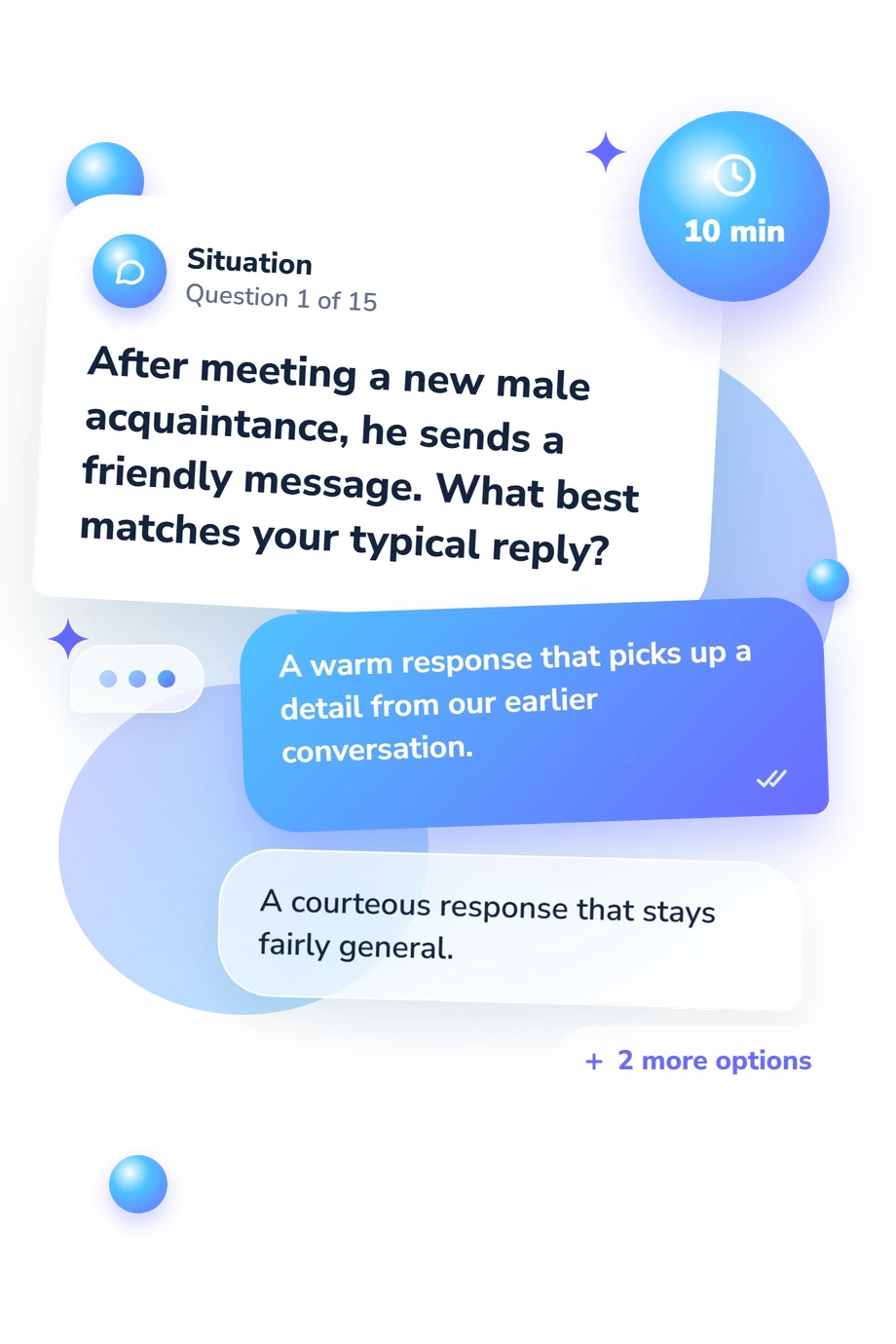
- A warm response that picks up a detail from our earlier conversation.
- A courteous response that stays fairly general.
- A short acknowledgment, often after taking time to decide what to say.
- A friendly response that follows his tone and keeps the exchange moving.
- Stay near the host or another familiar face while I settle in.
- Observe the room and respond if someone starts talking to me.
- Join a nearby conversation once there is a natural opening.
- Introduce myself to a few people with an easy greeting or question.
- Suggest a specific option I genuinely want and invite his input.
- Name two possibilities that I would be comfortable with.
- Offer a general category but leave the final choice to him.
- Say I am flexible and wait to hear what he prefers.
How Do Men Perceive You Quiz - Description and methodology of the test
People reflecting on dating, new acquaintances, or communication habits may use this questionnaire to examine how their interest, boundaries, confidence, and warmth become visible. The question how do guys see me can be explored through concrete social behavior rather than guesses about a particular man's private thoughts. The How Do Men Perceive You Quiz turns that reflection into a profile of patterns that may shape first impressions and ongoing exchanges.
What This Assessment Explores
The scenarios cover moments when signals become noticeable: replying to a message, entering a group, choosing plans, accepting a compliment, handling disagreement, and responding to a hurtful joke. They suit social and dating reflection.
For someone asking what do guys think of me, the result describes signals another person might notice, not a hidden opinion or guaranteed reaction.
The profile organizes those signals into three result dimensions:
- Emotional Readability (0-15) shows how directly your interest, feelings, and boundaries may be visible: Private signal (0-5), Measured expression (6-10), or Transparent expression (11-15).
- Self-Assured Presence (0-15) reflects visible confidence and agency: Understated presence (0-5), Situational presence (6-10), or Strong presence (11-15).
- Warmth and Approachability (0-15) reflects visible welcome, not kindness or worth: Reserved signal (0-5), Selective warmth (6-10), or Open warmth (11-15).
Methodology and Evidence Base
Each item presents a social situation with response choices ranging from private or cautious reactions to clearer expression, engagement, and self-assurance. When readers ask how do guys see you, the format links the result to observable choices rather than an ideal performance.
Results are read across the three dimensions and their bands; the overall pattern matters more than one answer. A score describes a questionnaire-specific tendency, not another person's private thoughts.
Methodologically, this is a structured self-report profile, not a standardized administration of a published test. Its frame is consistent with the Stereotype Content Model (Fiske et al., 2002), while the questionnaire focuses on visible warmth, agency, and expression. It is not an adaptation of that model or the Nonverbal Immediacy Scale (Richmond, McCroskey, and Johnson, 2003). Gross and John (1997) offer a reference for emotional expressivity, and Ambady and Rosenthal (1992) for brief expressive behavior and interpersonal impressions; these sources do not provide norms or validation for this profile.
Self-report can reflect current mood, self-awareness, context, and desired presentation, while observers may read the same behavior differently.
- Susan T. Fiske, Amy J. C. Cuddy, Peter Glick, and Jun Xu (2002). A Model of (Often Mixed) Stereotype Content: Competence and Warmth Respectively Follow From Perceived Status and Competition. Journal of Personality and Social Psychology, 82(6), 878-902. 10.1037/0022-3514.82.6.878
- Virginia P. Richmond, James C. McCroskey, and Aaron D. Johnson (2003). Development of the Nonverbal Immediacy Scale (NIS): Measures of Self- and Other-Perceived Nonverbal Immediacy. Communication Quarterly, 51(4), 504-517. 10.1080/01463370309370170
- James J. Gross and Oliver P. John (1997). Revealing Feelings: Facets of Emotional Expressivity in Self-Reports, Peer Ratings, and Behavior. Journal of Personality and Social Psychology, 72(2), 435-448. 10.1037/0022-3514.72.2.435
- Nalini Ambady and Robert Rosenthal (1992). Thin Slices of Expressive Behavior as Predictors of Interpersonal Consequences: A Meta-Analysis. Psychological Bulletin, 111(2), 256-274. 10.1037/0033-2909.111.2.256
Updated: