
Heredity Quiz
How the Scales are Structured
Who Usually Takes This Test?
See How You Compare
Below is a preview of how scores are typically distributed across each scale.
Example Questions From the Test
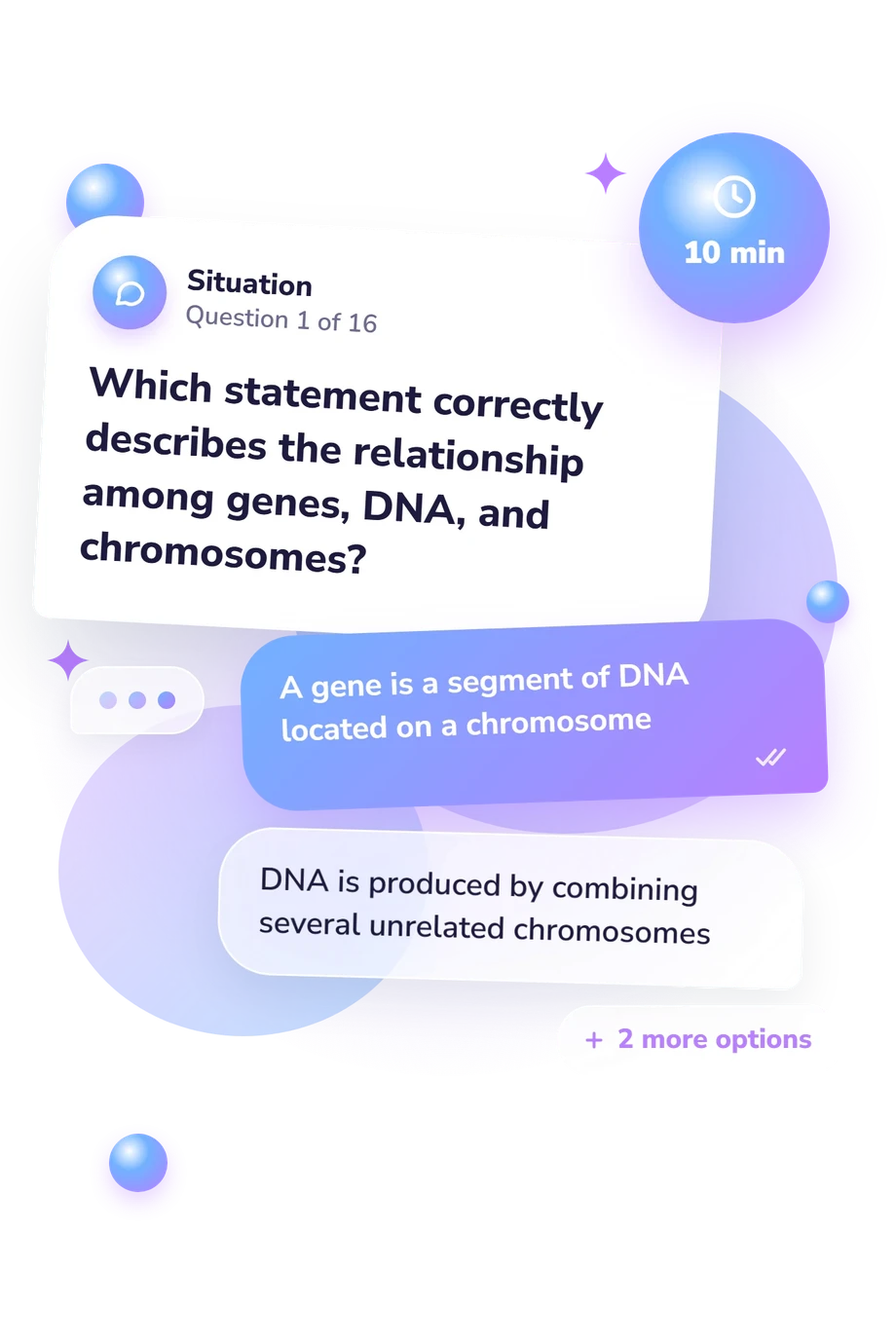
- A gene is a segment of DNA located on a chromosome
- DNA is produced by combining several unrelated chromosomes
- A chromosome is a short protein segment located inside a gene
- An allele is made from a complete set of chromosomes
- Acquired characteristic
- Phenotype
- Genotype
- Environmental influence
- The visible expression of every trait in an organism
- The complete collection of genetic material in a cell
- An alternative version of a gene
- The cellular process that separates homologous chromosomes
Heredity Quiz - Description and methodology of the test
Students, educators, and curious learners can use this heredity quiz to examine how well they connect foundational genetics ideas with familiar inheritance problems. As an inheritance quiz, it suits anyone who wants a clear snapshot of conceptual understanding rather than a personality profile. The result indicates whether a broad review of foundational concepts may be useful, helping you decide whether to revisit core material.
What This Assessment Explores
This questionnaire measures how genetic information is organized, transmitted, recombined, and expressed. It suits learners who want to apply biology concepts to inheritance probabilities, chromosome behavior, and gene-environment examples rather than report attitudes or symptoms.
The questions examine four connected areas:
- Genes, DNA, and chromosomes show whether basic genetic organization is understood.
- Alleles, genotypes, and phenotypes separate inherited instructions from observable traits.
- Dominance, genetic crosses, and probability show how inheritance outcomes are reasoned through.
- Meiosis, mitochondrial transmission, and environment extend understanding beyond simple dominance.
The Heredity Knowledge scale runs from 0-16. Foundations to build (0-6) suggests that reviewing basic ideas may be useful; Developing knowledge (7-12) reflects sound core understanding with room to strengthen application; Strong knowledge (13-16) indicates reliable command across varied scenarios. As a genetics knowledge test, it offers a focused learning signal, not a complete biology profile.
Methodology and Scientific Basis
Each item presents a genetics definition, scenario, or inheritance problem with four answer choices, and the respondent selects the option that best fits established biological principles. The content moves from terms to crosses, probabilities, chromosome counts, mitochondrial transmission, and gene-environment examples.
The questionnaire reports one overall knowledge result on the displayed scale and does not show separate topic scores. Its bands therefore give a broad learning interpretation rather than a detailed map of strengths and gaps.
Conceptually, the questions are consistent with the Genetics Concept Assessment (Smith et al., 2008), a concept-focused approach to genetics understanding. They also overlap with Bowling et al. (2008) on genetics literacy and Kalas et al. (2013) on meiosis reasoning. These sources support the relevance of the domains, but this online questionnaire is not presented as an adaptation or standardized administration of any one instrument. Because this heredity and genetics quiz uses selected-response questions, guessing, prior instruction, and current attention can affect the result, so it is best used to guide review rather than formal placement.
- Smith, Michelle K., William B. Wood, and Jennifer K. Knight. "The Genetics Concept Assessment: A New Concept Inventory for Gauging Student Understanding of Genetics." CBE-Life Sciences Education 7, no. 4 (2008): 422-430. 10.1187/cbe.08-08-0045
- Bowling, Bethany Vice, Erin E. Acra, Lihshing Wang, Melanie F. Myers, Gary E. Dean, Glenn C. Markle, Christine L. Moskalik, and Carl A. Huether. "Development and Evaluation of a Genetics Literacy Assessment Instrument for Undergraduates." Genetics 178, no. 1 (2008): 15-22. 10.1534/genetics.107.079533
- Kalas, Pamela, Angie O'Neill, Carol Pollock, and Gulnur Birol. "Development of a Meiosis Concept Inventory." CBE-Life Sciences Education 12, no. 4 (2013): 655-664. 10.1187/cbe.12-10-0174
Updated: