
Hamlet Act 3 Quiz
How the Scales are Structured
Who Usually Takes This Test?
See How You Compare
Below is a preview of how scores are typically distributed across each scale.
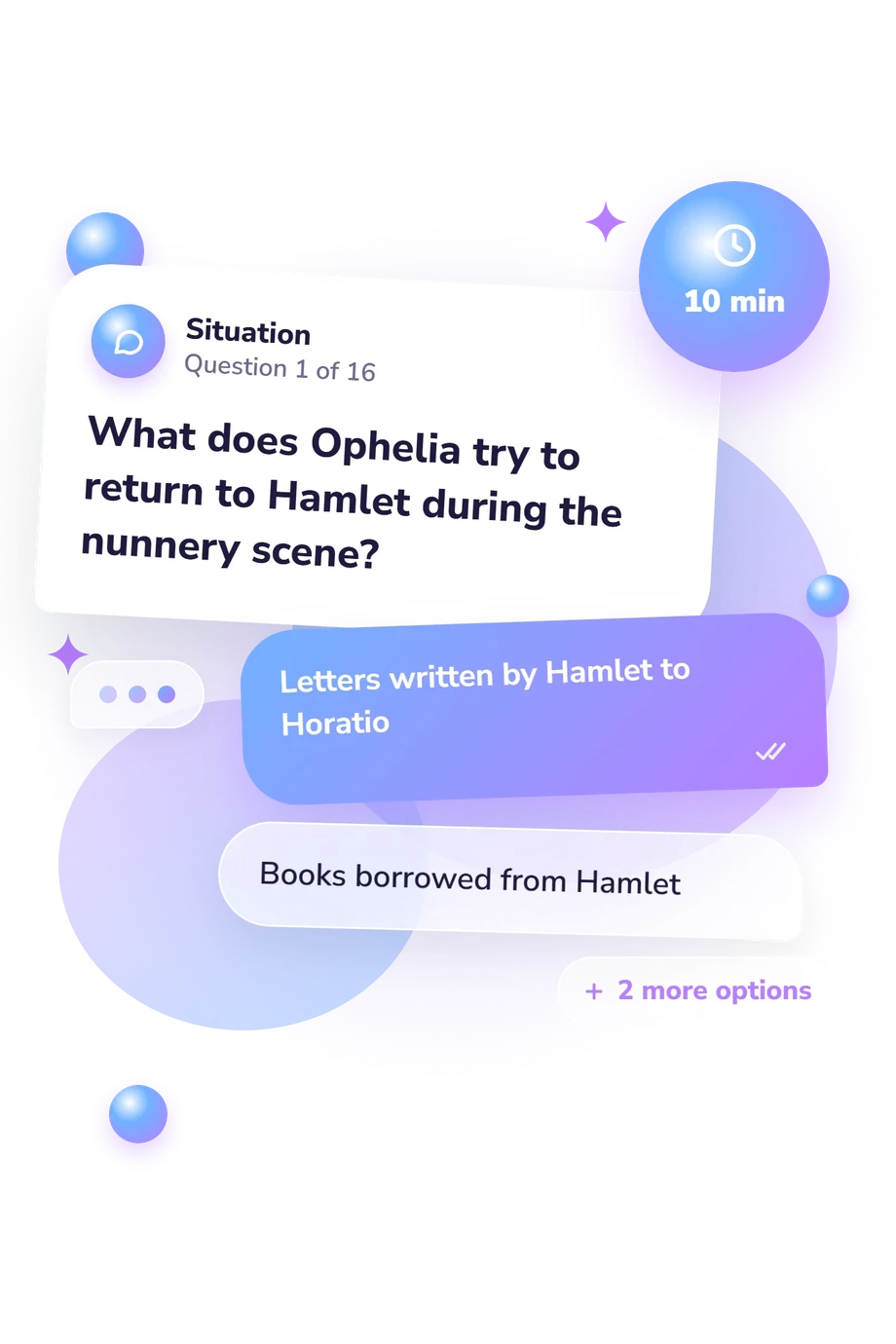
Example Questions From the Test
- Letters written by Hamlet to Horatio
- Books borrowed from Hamlet
- A ring sent to her by Gertrude
- Remembrances Hamlet previously gave her
- To judge Claudius’s reaction to a scene resembling the murder
- To learn whether Claudius recognizes the visiting actors
- To stop Claudius from leaving before the final speech
- To record Claudius’s public criticism of the acting
- Gertrude and Horatio
- Claudius and Polonius
- Rosencrantz and Guildenstern
- Polonius and Laertes
Hamlet Act 3 Quiz - Description and methodology of the test
For readers revisiting Shakespeare’s tragedy, the Hamlet Act 3 Quiz provides a focused way to check overall knowledge of key scenes, motives, and theatrical choices. Before class discussion, an essay, or a rereading, this Hamlet Act III quiz offers a practical check on how securely the act is remembered. Its result summarizes command of the act without reducing literary meaning to a single verdict.
What This Assessment Explores
Act 3 moves through surveillance, performance, prayer, confrontation, and violence, so the assessment checks specific events, details, and their connections. Hamlet Act 3 questions focus on what happens, why characters act as they do, and how Shakespeare creates tension through unequal knowledge.
The questions concentrate on four areas:
- Plot sequence: your result reflects how well you track major events and their consequences.
- Character motive: it shows whether you recognize the aims and strategies of Hamlet, Claudius, Gertrude, Ophelia, Polonius, and the Ghost.
- Dramatic irony: it measures attention to concealment, mistaken interpretation, and private knowledge.
- Themes and theatrical structure: it tests how themes such as revenge and uncertainty emerge through acting, staging, and the play-within-the-play.
The displayed scale is Hamlet Act 3 Knowledge (0-16): Foundation to revisit (0-6), Developing understanding (7-12), and Strong command (13-16).
Methodology and Evidence Base
Each item uses selected-response format: a question is followed by four choices, and the respondent selects the option that best matches the play. The result is reported as a knowledge score, interpreted through the stated performance bands. The bands describe performance on these items, while the total score gives a broad indication of command across Act 3 rather than separate results for plot, motives, themes, or staging; no psychometric norms or subscale scores are presented.
For retrieval practice, this Hamlet Act 3 test asks readers to connect action with motive, dialogue, staging, and dramatic irony. Its evidence base is literary rather than psychometric. Hamlet, Act 3 (Shakespeare) supplies the events and wording being checked. Replogle’s 1969 study supports attention to the play-within-the-play as a structural device, while Gottschalk’s 1973 analysis supports reading the act through the pressures and delays of revenge. These sources provide literary context for the questions, which assess Shakespeare’s Act 3; neither source makes the online quiz an adaptation.
Results are a snapshot of text-specific recall. Prior reading, recent revision, memory for scenes, and literary ambiguity can affect performance, so a lower band points to study targets rather than a fixed limit on ability.
- Shakespeare, William. Hamlet: Revised Edition. Edited by Ann Thompson and Neil Taylor. The Arden Shakespeare Third Series. Bloomsbury, 2016.
- Replogle, Carol. Not Parody, Not Burlesque: The Play within the Play in Hamlet. Modern Philology, vol. 67, no. 2, 1969, pp. 150-159. 10.1086/390152
- Gottschalk, Paul. Hamlet and the Scanning of Revenge. Shakespeare Quarterly, vol. 24, no. 2, 1973, pp. 155-170. 10.2307/2868854
Updated: