
GED Quiz
How the Scales are Structured
Who Usually Takes This Test?
See How You Compare
Below is a preview of how scores are typically distributed across each scale.
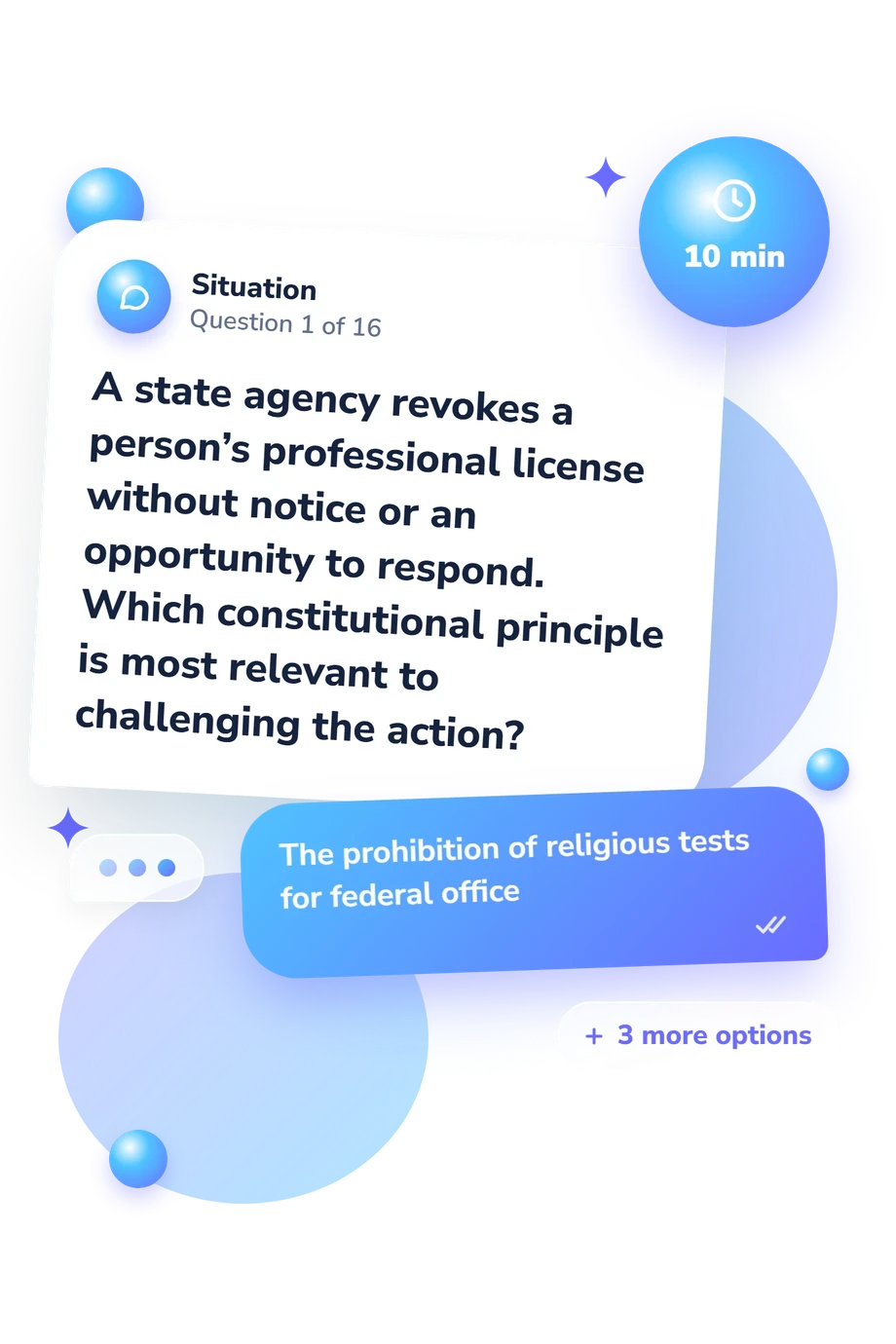
Example Questions From the Test
- Congress overrides the veto with the required two-thirds votes
- The Senate appoints a new president
- The House asks the Supreme Court to rewrite the bill
- Congress transfers veto power to state governors
- A modern textbook chapter about industrial labor
- A documentary produced a century later
- A diary written by a factory worker at the time
- A recent encyclopedia entry on manufacturing
- Protection from self-incrimination
- Protection from unreasonable searches
- The right to a speedy criminal trial
- Freedom of speech
GED Quiz - Description and methodology of the test
Learners preparing for the GED and wanting a focused review of social studies can use this GED Quiz to check how confidently they apply core ideas. Presented as an online quiz for the GED, it turns constitutional principles, historical change, economics, geography, and source evaluation into practical reasoning tasks. The result offers an overall snapshot of performance, while one short attempt cannot capture every aspect of GED readiness.
What This Assessment Explores
Questions connect civic principles with situations, ask you to recognize historical change, apply economic relationships, use geographic measures, and judge evidence. It suits learners preparing for GED study who want to identify gaps in reasoning as well as recall.
The result draws on these thematic groups:
- Civics shows how well you apply rights, amendments, federalism, separation of powers, and checks and balances.
- History and source analysis show how well you connect major events, identify primary evidence, and compare conflicting accounts with independent support.
- Economics and geography show how well you reason about supply, opportunity cost, migration, and population density.
Together, these groups offer a compact view of common social studies tasks. This GED practice quiz can point to topics worth revisiting, but one result cannot represent every skill on the full examination.
Methodology and Scientific Basis
Each item uses a prompt with four answer choices. Questions ask for the best principle, explanation, calculation, or evidence-based conclusion, so the format tests applied reasoning rather than isolated recall. The result reflects correct answers in this practice set.
Scoring is direct: one point per correct answer produces GED Social Studies Knowledge (0-16). The bands are Foundation Building (0-6), Developing Knowledge (7-12), and Strong Knowledge (13-16). They describe performance here, not an official GED score or a prediction of exam performance.
The content is conceptually aligned with the GED Social Studies assessment framework, which organizes preparation around civics, history, economics, geography, and interpreting sources. Technical manuals and measurement studies provide context for GED testing, but they do not validate this Freudly questionnaire or make it an official adaptation.
This GED social studies quiz samples several domains, so its overall result can guide what to study next. The result is an unvalidated practice result, not an official GED score or prediction; review missed concepts and compare performance across broader practice before drawing conclusions about readiness.
- GED Testing Service. (2016). Assessment Guide for Educators: Social Studies. Washington, DC: GED Testing Service LLC.
- GED Testing Service. (2015). GED Test Technical Manual: 2014 GED Test. Washington, DC: GED Testing Service LLC.
- Ezzelle, Carol, and J. Carl Setzer. (2009). Technical Manual: 2002 Series GED Tests. Washington, DC: GED Testing Service, American Council on Education.
- Whitney, Douglas R., Andrew G. Malizio, and Wayne M. Patience. (1986). Reliability and Validity of the GED Tests. Educational and Psychological Measurement, 46(3), 689-698. DOI 10.1177/0013164486463025.
Updated: