
French Quiz
How the Scales are Structured
Who Usually Takes This Test?
See How You Compare
Below is a preview of how scores are typically distributed across each scale.
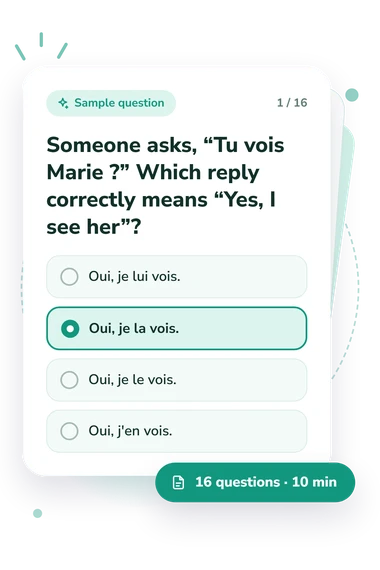
Example Questions From the Test
- Oui, je lui vois.
- Oui, je la vois.
- Oui, je le vois.
- Oui, j'en vois.
- meilleur
- mieux
- bon
- le mieux
- You need to visit on another day.
- The museum closes every afternoon.
- Admission is free today.
- The museum opens only on Monday.
French Quiz - Description and methodology of the test
For learners seeking a practical check of everyday French, this french quiz offers a focused snapshot of selected grammar, vocabulary, forms, and meanings. It suits students reviewing basic or intermediate material, self-directed learners, and people deciding what to practise next. It can serve as a quiz for beginners in French, connecting individual answers with clear revision priorities.
What This Assessment Explores
Knowledge of selected French grammar, vocabulary, forms, and everyday meanings is the focus of this french language quiz. The prompts test recognition of pronouns, articles, tense, negation, comparison, agreement, polite requests, and everyday expressions. Travel, shopping, greetings, weather, and asking for help provide contexts in which these forms and meanings are tested.
These groups capture the tested content:
- Pronouns, articles, and partitives show whether small grammatical words are selected accurately.
- Verb forms and time expressions show how tense and duration are connected.
- Adjectives, comparison, negation, and agreement show control of form and meaning.
- Functional vocabulary and polite phrases show whether familiar messages are understood in context.
The result is reported as French Knowledge (0-16), with one point for each correct answer. Foundations to build covers 0-6, Developing knowledge covers 7-12, and Strong foundation covers 13-16. These bands describe performance on the tested concepts, not complete language ability.
Methodology and Evidence Base
Each item offers a short prompt and four answer choices, with one best answer. Sentence completion, meaning recognition, and situation-based selection require attention to both grammatical form and intended use. Correct responses are counted against the answer key to produce the displayed total.
The format makes this quiz in French useful for noticing recurring errors, but the result remains a local snapshot of selected knowledge. It is not a norm-referenced score, a CEFR conversion, or a certificate.
The design is conceptually consistent with TCF (France Education international, 2025), whose structured tasks sample practical French ability. This questionnaire is not the official TCF or an adaptation of it. Purpura (2004) connects grammar assessment with vocabulary, morphology, syntax, meaning, and context, while Alderson, Clapham, and Wall (1995) stress alignment among specifications, tasks, scoring, and interpretation.
Used as a daily practice tool, it supports regular review, although performance may vary with recent study, attention, guessing, and test-taking conditions. Broader listening, speaking, reading, and writing evidence is needed to describe wider ability.
- France Education international. 2025. TCF Candidate's Manual, Version L, April 2025. France Education international.
- Purpura, James E. 2004. Assessing Grammar. Cambridge University Press. 10.1017/CBO9780511733086.
- Alderson, J. Charles, Caroline Clapham, and Dianne Wall. 1995. Language Test Construction and Evaluation. Cambridge University Press.