
Football Player Quiz
How the Scales are Structured
Who Usually Takes This Test?
See How You Compare
Below is a preview of how scores are typically distributed across each scale.
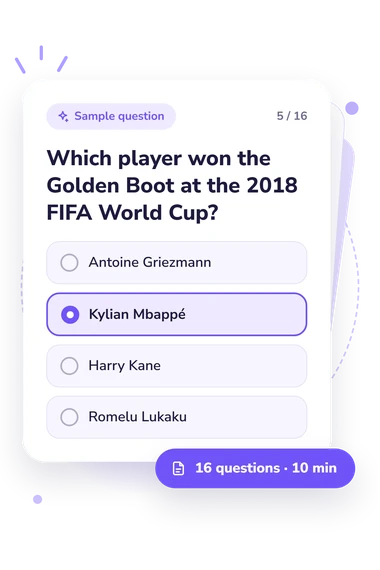
Example Questions From the Test
- Francesco Totti
- Alessandro Del Piero
- Zlatan Ibrahimović
- Pavel Nedvěd
- Park Ji-sung
- Hwang Hee-chan
- Lee Kang-in
- Son Heung-min
- Nicolas Anelka
- Thierry Henry
- Olivier Giroud
- Cesc Fàbregas
Football Player Quiz - Description and methodology of the test
Readers who enjoy football history, club careers, and international tournaments can use the football player quiz to check how confidently they recognize notable names and milestones. Its single result shows overall performance on the sampled player questions, while further exploration can deepen knowledge beyond the score. By asking about clubs, national teams, awards, and career paths, this quiz about football players checks biographical recognition.
What This Assessment Measures
Questions link players with clubs, national teams, awards, and career milestones. Readers can test recall across leagues and eras, but one aggregate score cannot separate club, tournament, award, or national-team knowledge. It shows performance across this mix, not which topic was strongest.
Many prompts give a clue rather than a name: a club sequence, tournament achievement, captaincy, award, or career association. By identifying the player linked to each clue, this football player name quiz tests recognition through biographical links.
The result uses one scale: Football Player Knowledge, 0-16. Bands are Foundation Builder, 0-6; Developing Expert, 7-12; and Football Authority, 13-16. They describe performance on selected questions, not every aspect of football expertise.
The question themes include:
- Club pathways show transfer and career-sequence recognition.
- International clues show national-team and tournament familiarity.
- Awards and milestones show recall of honors and captaincies.
Methodology and Evidence Base
Each item presents a football prompt with four alternatives and one intended answer. Items sample club histories, international representation, awards, tournament records, and career paths. Because the set is fixed, a result also reflects which players and eras are included.
Viewed as a football player knowledge test, it measures factual recognition rather than tactical analysis, physical skill, or live-match judgment. The scoring display converts responses into a bounded total and an interpretive level; this describes recall on the questionnaire, not a ranking of fans.
The Test of Soccer Common Content Knowledge, usually called TSCCK, offers only a limited conceptual comparison because it concerns common soccer content knowledge rather than recognition of players, biographies, career paths, awards, or national teams. This questionnaire is not an adaptation of TSCCK, and that instrument does not provide direct validation for it.
The displayed bands should be read in relation to the selected content: prior exposure, memory, language, and attention can affect responses. Use the result to reflect on recall of the included players and investigate unfamiliar careers or competitions.
- He, Yaohui, Phillip Ward, and Xiaozan Wang. "Validation of a Common Content Knowledge Test for Soccer." Journal of Teaching in Physical Education, 37(4), 407-412, 2018. 10.1123/jtpe.2017-0204
- Lee, Han J., Bomna Ko, Phillip Ward, Tae-Koo Lee, Kelsey Higginson, Yaohui He, and Yun-Soo Lee. "Development and Validation of Common Content Knowledge Test of Soccer." Korean Journal of Sport Science, 29(4), 650-662, 2018. 10.24985/kjss.2018.29.4.650
- American Educational Research Association, American Psychological Association, and National Council on Measurement in Education. Standards for Educational and Psychological Testing. Washington, DC: American Educational Research Association, 2014.