
Earth Day Quiz
How the Scales are Structured
Who Usually Takes This Test?
See How You Compare
Below is a preview of how scores are typically distributed across each scale.
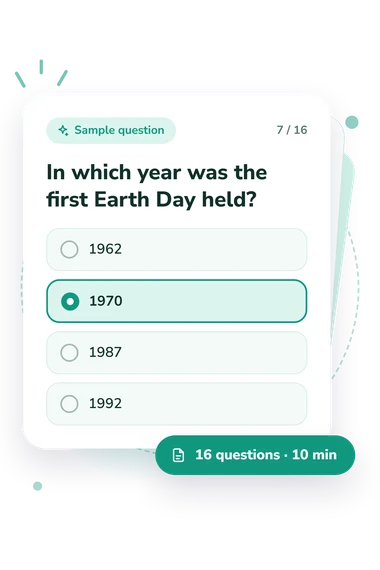
Example Questions From the Test
- Sunlight
- Natural gas
- Coal
- Uranium ore
- Replacing locally grown beans with imported beans
- Replacing a beef-based meal with a lentil-based meal
- Replacing tap water with bottled water
- Replacing seasonal vegetables with frozen beef
- Replacing paper bags with thicker single-use plastic bags
- Moving fallen leaves from the forest to a landfill
- Preventing unnecessary clearing and degradation of the forest
- Painting nearby buildings green to promote awareness
Earth Day Quiz - Description and methodology of the test
People who want a focused check of environmental understanding can use the Earth Day Quiz to connect familiar facts with everyday choices. It suits curious adults, learners, families, and educators who want a practical starting point rather than a personality profile. Families can also use it as a quiz for kids about Earth Day when discussing climate, waste, conservation, and responsible community action.
What This Assessment Explores
This knowledge check links Earth Day’s purpose with practical environmental reasoning. Its questions move across climate and weather, renewable energy, food emissions, forests, biodiversity, waste, recycling, runoff, transport, and community projects. As an environmental knowledge quiz, it asks the respondent to distinguish accurate environmental principles from plausible alternatives.
The result brings together three content groups:
- Climate and energy show whether the score reflects understanding of warming, renewable sources, emissions, and lower-impact choices.
- Biodiversity and conservation show whether the score reflects habitats, native species, forests, and pollinator support.
- Waste and practical action show whether the score reflects prevention, recycling, water protection, transport, and durable community projects.
Earth Day Knowledge (0-16) summarizes performance on this quiz only. Starting Point (0-6) indicates room to build understanding; Developing Knowledge (7-12) indicates a useful foundation; Strong Knowledge (13-16) indicates a consistent grasp of Earth Day’s purpose and environmental principles.
Methodology and Scientific Basis
Each item presents a short situation or factual question with four answer choices. The respondent selects the best answer, so the format tests recognition and applied judgment rather than agreement with attitudes or claims about personal behavior.
Its closest reference is EKT-19 (Player et al., 2023), a published environmental-knowledge measure. This questionnaire is conceptually consistent with that instrument, not an adaptation of it, and its Earth Day content is a separate selection. Geiger, Geiger, and Wilhelm (2019) distinguish environment-specific knowledge from broader knowledge when considering links with pro-environmental behavior.
The four-choice structure makes it a quiz with answers about Earth Day: each item has a best response, but recognizing an answer does not guarantee that someone can apply it consistently. The online version is a focused knowledge snapshot rather than a measure of ecological identity or personal virtue, and it has no stated population norms, reliability, validity, or clinical status.
Historical documentation of Earth Day supports the questions about the first observance, its date, and the event’s central purpose. Guessing, wording familiarity, education, and recent exposure to environmental information can affect performance. Behavior also depends on opportunity, motivation, resources, and local rules.
- Player, Lois, Paul H. P. Hanel, Lorraine Whitmarsh, and Punit Shah. 2023. “The 19-Item Environmental Knowledge Test (EKT-19): A short, psychometrically robust measure of environmental knowledge.” Heliyon 9(8): e17862. 10.1016/j.heliyon.2023.e17862
- Geiger, Sonja Maria, Mattis Geiger, and Oliver Wilhelm. 2019. “Environment-Specific vs. general knowledge and their role in Pro-environmental behavior.” Frontiers in Psychology 10: 718. 10.3389/fpsyg.2019.00718
- . n.d. “The History of Earth Day.”. Accessed September 21, 2026.
Updated: